

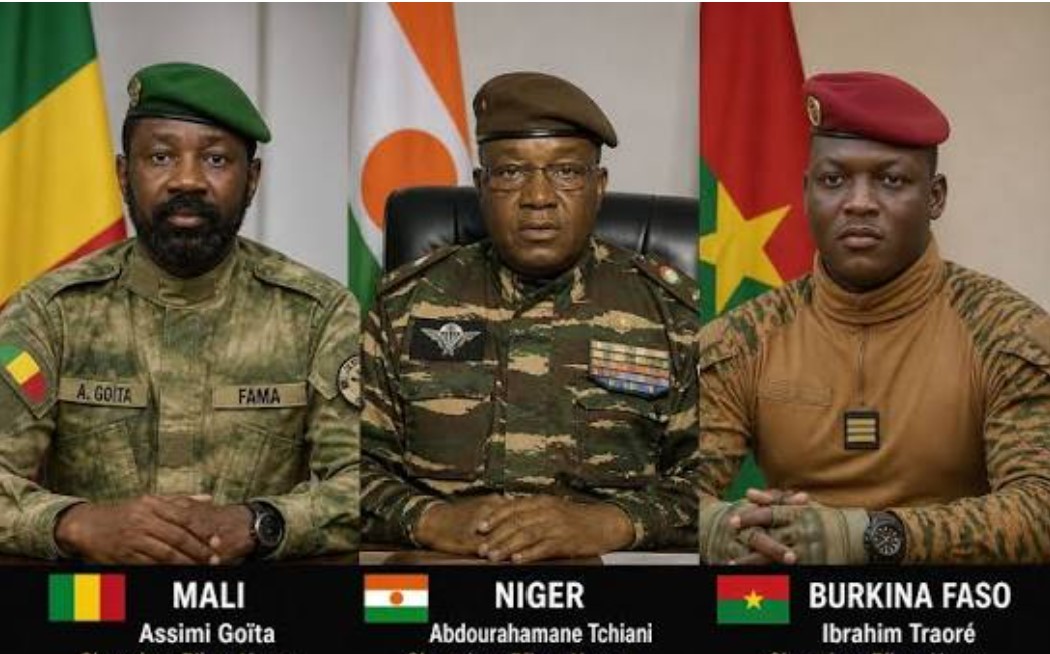
Mali, Burkina Faso, and Niger’s military juntas are weaponising decrees and building a Sahel where truth is contraband
June 2024 arrived in Mali like a merciless visitor. As the once empty sky gathered its grey armies of cloud over the Sahelian nation while the metallic clack of hoes against the earth announced the return of the farming season, terror struck the greater Mopti region.
From that period until November of the same year, Al-Qaeda-affiliated terrorist group Jama’at Nusrat al-Islam wal-Muslimin (JNIM) waged a sustained, widespread, aggressive terror raid against local populations.
By the time the rains retreated and the harmattan arrived with a breath of the desert wind, ruins and rubble covered in layers of dust and ashes had become a defining feature of the landscape. The JNIM fighters had systematically attacked at least ten villages across the Doucombo and Pignari Bana districts, intentionally wrecking livelihoods by burning over 1,000 homes and looting more than 3,500 livestock belonging to local communities.
The Pre-November strikes were designed to break community resilience, destroy local food security, and punish villagers suspected of collaborating with the Malian military or local self-defence militias, according to a 2025 report by the Human Rights Watch (HWR).
In one of its worst single-day civilian massacres in July 2024, the terrorists surrounded a wedding in nearby Djiguibombo village, slaughtering roughly 40 villagers.
Later, on November 22 2024, a deadly Al-Qaeda ambush on a Russian Mercenary convoy – Wagner Group occurred. The attack took place on the road between the town of Bandiagara and the village of Djigibombo in the Mopti region. The militants hit the convoy using an improvised explosive device (IED) before launching a follow-up assault.
The strike targeted the Wagner Private Military Company (PMC), which operates under state control as the Africa Corps to support Mali’s military government.
In between these attacks, the Malian government could not afford to acknowledge the scale of the mayhem, but one Sahelian journalist and his team could not just stand by, so they reported the story of two village attacks on their news platform.

The broadcast that led to six months of shutdown
On November 12, 2024, Oumar — not his real name — and his team drove into the scorched landscape of the Mopti region in Mali. Two villages had been burned to the ground by jihadist fighters. Survivors had fled to Sévaré, where they sat in the open sun with nothing but what they could carry.
As the crew passed through the ruins of the razed villages, the heavy silence that seemed to press against the earth was eerie. Smoke curled lazily from the ruins as though the flames had not yet accepted that their destruction was complete. Houses that had once sheltered families were now broken skeletons of what they used to be. Walls leaned at impossible angles, their cracked surfaces blackened by fire. Roofs had collapsed into heaps of burnt wood and twisted metal, leaving behind only the outlines of rooms where people had slept, prayed, cooked, and thrived. The village paths were covered with debris — torn pieces of clothing, scattered household items, broken farming tools, and the remnants of lives that revealed the full horror of what remained.
Oumar and his team filmed the plight of the victims and broadcast the report on Joliba FM, a Burkina Faso-based station.
In the report, the interviewees describe what they went through and the hardships they endured. They also discussed what they see as the authorities’ negligence in handling the situation.
“It was honest, professional journalism,” Oumar explained, as his voice trembled under the weight of painful memories he had never escaped.
“Within days of our broadcast, people began to whisper in the newsroom, saying Joliba was working against the government.”

According to him, things escalated when, shortly after the broadcast, a political opinion leader discussed the same issue on one of Joliba’s programs, Rendez-vous des idées, hosted by a certain Attaher Halidou. In a subsequent episode of Rendez-vous des idées, the same opinion leader, Issa Kaou Djim, commented on the alleged coup attempt in Burkina Faso, describing the incident “as a staged event,” and that was the turning point.
“That was the moment everything unravelled,” Oumar quipped.
In the hours that followed, Burkina Faso’s media regulator, Conseil Supérieur de la Communication (CSC), filed a complaint with Mali’s High Authority for Communication.
Already, Joliba TV News had been walking a tightrope since the report about the terrorist attacks. The controversy surrounding the comments on its show were, however, the final straw. The authorities, in coordination with the media regulator, announced the withdrawal of the channel’s broadcasting license, targeting it for a complete shutdown. Following several interventions by media organizations and professional associations, the sanction was eventually reduced to a six-month suspension, so, for half a year, the station went dark, and neither the station nor its staff earned any income.

A journalist’s ordeal
One of the videographers at the heart of one of the damning reports, who craved anonymity for fear of backlash, described the months that followed as “horrific, dreadful and haunted.”
He said even before the suspension, management of the organisation had been summoned by the High Authority for Communication multiple times and was also under censorship scrutiny by public institutions simply for reporting professionally and objectively.
“I have already spent six months facing extremely difficult circumstances. Even after operations resumed, the financial problems remained. To give you an idea, I was earning only 75,000 CFA francs ($130) per month, and salaries could be delayed by as much as three months,” another affected journalist who goes by the pseudonym Abdoulaye revealed to this investigation.

After all the problems and difficulties experienced by the reporters at Joliba, many of them were eventually laid off for economic reasons.
Yet, some presenters and editors remain much more in the authorities’ crosshairs than some of the reporters working behind the scenes, Oumar confirmed.
“For example, after some hard-hitting reports which could upset certain people, the reporters would keep a low profile, but on the other hand, the presenters and editors are regularly appearing to answer questions before authorities,” Oumar explained.
According to Abdoulaye, many other journalists have reportedly received warnings, and it has become apparent that it is now very difficult to work on political and security-related issues in Mali and Burkina Faso.
“One media outlet that was sanctioned, I can recall, is the newspaper Alternance. Its publishing director is currently in prison,” he said.
Attempts to speak to several affected journalists met some brick walls, as many are living in constant fear. One of the journalists contacted via secure channels for this investigation was apparently still shaken from his ordeal; his response was terse and revealing: “It is a real concern for me right now. I am not in a position to comment on these questions, as they still haunt my mind.”
Three soldiers, one playbook and the making of a censorship cartel in the AES
The military juntas of Mali, Burkina Faso, and Niger came to power on a shared common political narrative: that the civilian governments they overthrew had failed their people through corruption, dependence on Western institutions, and an inability to manage the Sahel’s compounding security crises.
The crowds that celebrated each coup were not, for the most part, wrong to be angry. The governments that fell had failed in real, documented, and sometimes devastating ways. So, in more ways than one, the grievances and desire for change were legitimate and understandable. What was not discerned from the outset, however, was that as soon as the celebration moved indoors, journalists and the media who could hold the three countries accountable for the same security and social safety nets they promised would become the frontline victims of state repression.
Documents from three sources — the RSF World Press Freedom Index, the Committee to Protect Journalists (CPJ) incident database, and Freedom House annual reports, as well as document reviews, interviews with journalists living in fear or in exile, and regulatory and legal materials (decrees), revealed that state repression in the Alliance des États du Sahel (AES) is not a series of coincidental decision by three seperate governments, but a coordinated regional playbook.
Findings show a Sahel-wide architecture of censorship constructed law by law, decree by decree, suspension by suspension, and disappearance by disappearance.
What began in Mali has been replicated in Burkina Faso and Niger and is now evolving into something more alarming: cross-border enforcement, where one junta’s regulators act against journalists operating in a neighbouring country, at the request of that country’s junta.
The numbers alone are damning. Niger’s 37-place single-year fall is the steepest ever recorded in the RSF World Press Freedom Index’s fifty-two-year history. Burkina Faso has lost 73 places since its pre-coup peak. Mali, where the junta arrived first, has fallen 22 places — but those numbers conceal a more qualitative transformation: the progressive elimination of every institutional structure designed to protect independent journalism, and their replacement with machinery designed to punish it.

MALI: Where ‘professionalism’ became a legal weapon
Colonel Assimi Goïta completed his consolidation of power with a second coup on May 24, 2021, removing the very transitional president his first coup had installed. From that point, the suppression of independent media became systematic and escalating. On March 17, 2022, the High Authority for Communication suspended Radio France Internationale and France 24 after both outlets reported on alleged extrajudicial killings by Malian soldiers operating alongside Wagner Group mercenaries. The suspension was framed as provisional. By April 2022, it was made permanent. The United Nations condemned it. The European Union called it unacceptable.
“We consider this unacceptable. We deplore this decision and the unfounded accusations,” the EU said in a statement, but the junta ignored it, as it would ignore every subsequent international protest.
RSF applied an exceptional mid-cycle methodology update for Mali in 2022 — a rare measure triggered by dramatic in-year deteriorations that cannot wait for the annual cycle — and Mali dropped from 99th to 111th in a single revision. The message embedded in that methodological exception was clear: what was happening in Mali was not the ordinary erosion of press freedom. It was a sudden, deliberate collapse.
…The Communiqué That Defined ‘Acceptable’ Journalism
On September 15, 2023, Mali’s High Authority for Communication (HAC) issued a formal communiqué responding to media coverage of the terrorist attack on the passenger boat ‘Tombouctou.’ The document is carefully worded — on its face, it reads as an advisory, a regulatory reminder rather than a formal censorship order. But its operative mechanism is the deliberate vagueness of its demands.
There were no explicit standards or sanctions listed in the document, but the irony is that the document itself comes from the same regulator legally empowered to impose warnings, suspensions and permanent licence withdrawals.
“Such broad language leaves considerable discretion to the regulator,” one anonymous activist told this investigation. A lawyer who reviewed the document added that it functions as “soft regulation — until authorities choose to enforce it, at which point it becomes hard censorship, with no clear legal standard a journalist could have relied on to know they were at risk.”

The communiqué did not exist in isolation. In November 2024, Joliba TV was already suspended for broadcasting content deemed critical of the junta. In March 2023, radio columnist Mohamed Youssouf Bathily — known by his on-air name ‘Ras Bath’ — was jailed for denouncing the alleged assassination of a former prime minister on his programme. In November 2023, journalist Abdoul Aziz Djibrilla was murdered in northern Mali; two colleagues were abducted in the same attack. That same month, the UN-funded Mikado FM — established specifically to serve communities caught between security forces and armed groups, the very communities that most needed reliable information — shut itself down, unable to sustain operations under the accumulated pressure of regulatory restrictions.
…When Having Sources Became the Violation
On September 9, 2024, the HAC announced the suspension of French international television network TV5 Monde from all authorised cable and satellite packages in Mali for a period of three months. The cited offence was a report aired on August 26, 2024 in which the journalist had presented the accounts of sources affected by drone strikes that killed 21, including 11 children, in Mali’s Tinzaouaten — described in the HAC’s own communiqué as ‘corroborating’ — without also including the official version of events from the Malian Armed Forces’ public relations directorate, DIRPA, an allegation rebutted by TV5 Monde claiming that the Army authourites did not respond when contacted for comments.

The implication of this regulatory logic is that in Mali, under the junta’s communications framework, a journalist who speaks to witnesses and survivors of a security incident but does not also transmit the military’s version of events has committed a professional violation punishable by suspension. “Any source who is not the Malian Armed Forces is, by definition, insufficient. By the same logic, every witness to a massacre is inadmissible testimony, and every survivor who speaks without DIRPA’s endorsement is a liability,” explained a Malian civil society activist who has documented restrictions on media freedom and civic space for several years, requesting anonymity for safety concerns.
In April 2024, the HAC ordered all media to suspend coverage of political party activities entirely. In February 2026, Youssouf Sissoko, director of the newspaper L’Alternance, was detained for publishing a commentary piece critical of Niger’s president’s remarks about a jihadist attack. The junta arrested a Malian journalist for criticising a foreign leader. This, by any measure, was a demonstration of the merger of censorship across borders.
Mali’s RSF ranking now stands at 121st globally. It was 99th the year the soldiers arrived.
BURKINA FASO: The Army that conscripted Journalism
Before January 2022, Burkina Faso was among Africa’s more credible press freedom stories. RSF ranked it 37th globally in 2019 — a country with a professional, multi-platform media ecosystem that had been built over decades of post-revolutionary democratic struggle and that included the legacy of Norbert Zongo, the investigative journalist murdered in 1998, whose name remained a touchstone for press freedom in the country. By 2026, Burkina Faso stood at 110th. The 73-place collapse is one of the most dramatic single-country declines in the RSF Index’s history. The “patriotic treatment” of news and information championed by Capt. Ibrahim Traoré, the transitional president, has taken precedence over the possibility of rigorous journalism,” RSF said on its website.
But the number alone does not convey what actually happened to journalists in Burkina Faso under Captain Ibrahim Traoré’s government.
…The Law That Made Any Blogger a Regulatory Target
On November 21, 2023, Burkina Faso’s Transitional Legislative Assembly passed Organic Law No. 041-2023/ALT, restructuring the Superior Council of Communication (CSC) and granting it enforcement powers of a scope and reach that the regulator had never previously held. The law is not subtle about its ambitions. It is a total-spectrum censorship architecture, written into statute.

Article 3 of the decree extends CSC regulatory authority beyond professional journalists and media companies to include bloggers, web activists, influencers, and any internet user with 5,000 or more followers, friends, or subscribers.
“This means that a citizen with a Facebook page and an audience of that size is now subject to the same state media regulation as a television broadcaster,” says a political analyst based in Ouagadougou.
General sanctions in the decree include warnings, suspension of programmes, suspension of publications, suspension of broadcasting, reduction of licence duration, fines, withdrawal of broadcasting licences, and outright prohibition of publication. While on the other hand, individual journalists may receive warning, suspension of activities, temporary withdrawal of press card with the press card committee legally required to comply. The CSC may also require search engines to delist websites; order internet service providers, hosting companies, and technical intermediaries to block access to content and the CSC president — now personally appointed by Captain Traoré — may immediately suspend any broadcast deemed to ‘threaten public order’ or ‘offend public morality,’ with the full Council reviewing the measure within 72 hours. (Previously, the CSC president was elected by his peers, i.e. the fellow board councilors, through an internal democratic vote before being formally appointed by the head of state.)
Other extant regulations include the authorisation of CSC inspectors to conduct searches, seize equipment, inspect premises, and access professional documents.
Consequently, any meaningful regulatory independence or every editorial decision by all journalists, bloggers, or social media accounts with meaningful reach is now subject to immediate punitive action, without judicial review, at the discretion of a regulator whose president is appointed by the head of the junta.
“This substantially broadens state regulation beyond professional journalists to include any influential online speaker,” a Burkinabè influencer told this investigation, then declined to be named for fear of being among those to experience the law’s reach and that fear is the law’s most powerful provision.
…Disappearing Into Uniform: Three Journalists in Three Weeks
The Emergency General Mobilisation Law, Decree No 2023-0475PRES, enacted in April 2023, gave Traoré’s government the authority to compel any citizen to report for military training and service without charges, legal process or trial beyond an order and the expectation that armed men would enforce it. The first targets were journalists who had been publicly critical of the junta: in November 2023, Issaka Lingani and Yacouba Ladji Bama received conscription orders to report for military training. Lingani went into hiding. Bama, who was outside the country at the time, did not return.
Then, in the space of less than three weeks in June 2024, three journalists vanished from Ouagadougou in circumstances that would only be explained months later. Serge Atiana Oulon, investigative journalist for L’Événement, disappeared on or around June 10, days after his newspaper published a report alleging the embezzlement of 400 million FCFA in funds designated for the VDP civilian self-defence militias. Television commentator Kalifara Séré was last seen leaving the CSC offices on the evening of June 18 after being summoned there. Columnist Adama Bayala — a man with a medical condition — vanished from his university office on June 28.
The Burkina government, while suspending Oulon’s newspaper in CSC Decision No. 2024-027 accused the publication of “malicious insinuations without sufficient proof,” alleging that the newspaper implied links between a fund diversion and President Traoré without demonstrating those links with adequate evidence. It then went ahead to slam a one-month suspension across all of L’Événement’s publication platforms, including digital.
Shortly after the suspension, Serge Atiana Oulon disappeared. In October 2024, the government confirmed he had been conscripted into the army, but as of the publication of this investigation, he has not been seen.

In October 2024, Burkina Faso’s Justice Minister confirmed to the African Commission on Human Rights what many had suspected: Oulon, Séré, and Bayala had all been conscripted into the army. Séré was released in July 2025. Bayala in September 2025. Oulon has not been seen since. Meanwhile, satirical columnist Alain Traoré of Le Reporter was seized by masked men identifying themselves as agents of the National Intelligence Agency in July 2024 and disappeared for months before eventually being released in September 2025.
In March 2025, intelligence officers arrived at the offices of the Association of Journalists of Burkina and arrested its president Guézouma Sanogo, vice-president Boukari Ouoba, and member Luc Pagbelguem — the entire functioning leadership of the one professional body specifically tasked with defending journalists’ rights. The following month, videos circulated showing all three in military uniform. As of this publication, they remain in service.
“There was a call for my physical elimination and that of my family via a WhatsApp audio message. I also underwent a forced interrogation by State Security. The programme I hosted was suspended by management under pressure from the authorities. I faced legal proceedings, a trial, and then prison,” an exiled journalist told the Whistleblowers and Journalists Safety International Centre (WAJSIC).
The international media was expelled at the same pace. RFI was suspended in December 2022 for allegedly broadcasting a terrorist leader’s message. Jeune Afrique was suspended in October 2023. BBC Afrique and Voice of America were suspended simultaneously in April 2024 for reporting on alleged military abuses. VOA was banned again for three additional months in October 2024. In December 2025, the transitional government adopted a penal code amendment that included the reinstatement of the death penalty for offences classified as high treason, terrorism, or espionage — a category broad enough, in the hands of an unreviewable regulator, to encompass a great deal of journalism.
In September 2025, Traoré publicly rejected democracy and proclaimed a “Progressive and Popular Revolution.”
NIGER: From near-free to criminal state in three years
Of the three countries in the AES, Niger’s collapse was both the fastest and the most dramatic. In May 2023, two months before the coup that would end its civilian government, RSF ranked Niger 61st globally — a meaningful press freedom environment by Sahelian standards and one that had been steadily improving under President Mohamed Bazoum. Freedom House assessed Niger at 51/100, but following the July 2023 military coup, Niger’s score dropped to 33/100. Under Bazoum, the legislature had gone further than any government in the region’s modern history: it passed a law eliminating prison sentences for defamation and online press offences, effectively decriminalising journalism.
By 2026, Niger had experienced the steepest single-year decline in the RSF Index’s fifty-two-year history, dropping 37 places in a single year to land at 120th globally. The country had not merely reversed the democratic gains of the Bazoum era. It had built, in their place, a legal and regulatory apparatus specifically designed to treat journalism as a criminal act.
Within 48 hours of General Abdourahamane Tchiani’s coup on July 26, 2023, RFI and France 24 signals were cut. No formal decree was published, and no legal instrument was cited. The junta reached out to the telecommunications infrastructure and switched off the frequencies. It took less than two days to black out a country’s access to international news broadcasting.
…Samira Sabou: The Award That Came With Open Charges
On the night of September 30, 2023, men identifying themselves as members of the security forces arrived at the Niamey home of Samira Sabou’s mother. Sabou, a blogger, investigative journalist, and president of the Association of Bloggers for Active Citizenship, was taken away without explanation. For eight days, her whereabouts were unknown. The Niamey judicial police initially denied that she had been arrested. Her family did not know whether she was alive and her lawyer could not locate her.
On October 7, she was transferred to the criminal investigation unit. On October 11, she was charged with ‘producing and disseminating data likely to disturb public order,’ released pending trial, with no trial date set. In 2024, the Committee to Protect Journalists named her its International Press Freedom Award winner — one of the most prestigious recognitions in journalism globally. She received the award while the charges against her remained open and while the government that had arrested her was building new legal machinery to put her back in prison.
…The Legal Arsenal: Four Instruments Designed to Criminalise Reporting
Niger’s key suppression instrument is the Ministry of Interior’s January 30 2024 order, which suspended all activities of Niger’s umbrella journalists’ body — Maison de la Presse. It went ahead to dissolve its elected board, and installed a state-appointed committee headed by the Secretary General of the Ministry of Interior — the same ministry overseeing security forces that had been arresting journalists.
At a stroke, every Nigerien journalist lost the professional association that had historically negotiated their protections, documented violations, and pressed for press freedom reforms.
Then in June 2024, Niger reversed the decriminalisation law achieved under Bazoum by signing into law Ordonnance No. 2024-28, amending the 2019 Cybercrime Law. It explains that the 2022 amendment had removed prison terms for electronic defamation and insults, but that the new ordinance reintroduced imprisonment.
“A prison sentence of one (1) to three (3) years and a fine of one (1) million to five (5) million CFA francs is henceforth provided for any person found guilty of defamation or insults committed by electronic means,” the official Ministry of Justice communique stated.
“So, imprisonment applies even where the facts stated are true, provided they are deemed likely to disturb public order,” an exiled Nigerien Journalist told this investigation.
The tightening of the legal framework continued on 15 November 2024, when the junta issued Decree No. 2024-715/P/CNSP/MC/P/EN to implement Law No. 2019-03 on electronic transactions. Article 38 requires trust service providers — which include web hosting companies — to retain, for a minimum of one year, all data capable of identifying any person who contributed to online content, including IP addresses, timestamps, and access account identifiers. Providers must also report any content flagged as illegal to competent public authorities. The decree grants judicial authorities the power to order content blocking and targeted surveillance of online communications, including journalists’ sources.

Similarly, Ordinance No. 2025-42 — General Mobilisation Law, which was issued in December 2025, raised rights concerns, particularly for obliging citizens to “refrain from sharing information that could hinder mobilisation efforts” and to inform public authorities about nationals of “hostile” countries present in Niger, as well as any acts that could obstruct mobilisation. The Ordinance had no clearly defined exemptions for professional journalists or media organisations.
In 2023, Burkina Faso adopted a similar general mobilisation measure, which drew criticism from human rights groups over its impact on civil liberties. Amnesty International said that the April 2023 decree on general mobilisation was used by the authorities to sanction and silence civil society members, journalists, and human rights defenders who criticised the government.
Although the ordinance did not explicitly criminalise speaking to journalists, the climate it fostered extended to news sources. On 26 April, security forces arrested Ali Tera, a civil society activist interviewed by BBC Hausa correspondent Tchima Illa Issoufou for a report on attacks in Tillabéri, illustrating that providing information to the press had itself become a source of risk.
What may be the single most revealing act of press suppression in the Sahel’s recent history came in November 2025, when six journalists were arrested and charged with cybercrime for sharing a government press conference invitation. The invitation had been issued by the government itself. It happened to include the name of a person associated with former president Bazoum. The journalists — Ibro Chaibou, Youssouf Sériba, Oumarou Abou Kané, Moussa Kaka, who is CEO of Radio Télévision Saraounia, and others — were remanded to Kollo prison, 30 kilometres from Niamey. They were imprisoned for distributing a document the government had produced.
“There is no clearer illustration of what Niger’s information environment has become: a space so controlled that circulating the authorities’ own communications can be treated as a crime,” an exiled journalist told this investigation.
In January 2026, Deutsche Welle’s Niger correspondent Gazali Abdou Tasawa was arrested for reporting on Nigerian refugees living near a cemetery. He became the fifth journalist simultaneously in detention in the country.
The Sahelian void and the Narrative warfare that filled it
“When independent media is systematically suppressed, something always rushes in to fill the space,” an exiled Malian journalist told this investigation in a secure interview.
In the AES region, the silence created by expelled broadcasters, conscripted journalists, dissolved professional associations, and shuttered newsrooms has been filled with a coordinated ecosystem of pro-junta propaganda, state-aligned digital influence networks, and what researchers describe as a ‘hostile narrative swarm’ — the same phenomenon that could be seen in digital investigations of AES narratives such as this, this and this.
A previously documented investigation by this reporter into the digital machinery behind Captain Ibrahim Traoré’s outsized online popularity found AI-generated content, including fabricated quotes, synthetic imagery, and algorithmically amplified narratives, being systematically deployed to construct a version of Burkina Faso’s reality that bore little resemblance to the one experienced by its citizens. The investigation identified networks of accounts producing and circulating content at volumes and speeds incompatible with organic, human-driven activity, all converging on the same pro-junta talking points: sovereignty, anti-imperialism, the liberation from Western influence, and the inevitability of the revolution.
That finding was reinforced by a separate investigation which mapped the architecture of anti-ECOWAS and anti-Western disinformation networks operating across Francophone West Africa. That report documented coordinated inauthentic behaviour across platforms, traced the ideological and operational links between AES-aligned digital actors, and identified the specific narrative clusters hostile to France, hostile to ECOWAS, hostile to any governance criticism of the juntas, that these networks consistently amplified in a structural pattern.
Most recently, an investigation into the propaganda ecosystem selling Burkina Faso as Africa’s economic miracle documented how fabricated economic data, AI-generated testimonials, and coordinated social media campaigns were being used to fill the informational space left by expelled independent outlets with a counter-narrative so aggressively circulated that it was being mistaken, in some quarters, for fact. The investigation found these campaigns targeting not only domestic audiences but regional ones, designed to inoculate neighbouring populations against critical coverage of the AES juntas before that coverage could reach them.
Taken together, these three bodies of documented publication establish a clear pattern where the AES information ecosystem has been deliberately restructured, with the suppression of independent journalism on one side and the industrial production of regime-aligned content on the other; the two processes appear as components of a single strategy.
The consequences of this architecture are visible in the way critical journalism is received when it does manage to surface. When Sky News Africa correspondent Yousra Elbagir produced a documentary in April 2026 using rare access granted by the Burkina Faso government, several accounts met Elbagir’s report with hostility, branding her a ‘traitor,’ a ‘sellout,’ ‘anti-African,’ someone ‘working under Western influence.’ The trend aligns with the documented behaviour of influence operations previously identified by this investigation mapping of anti-ECOWAS disinformation networks across Francophone West Africa.
The WAJSIC exclusive research, identifies the specific organisations behind these operations in Burkina Faso: the Rapid Communication Intervention Brigades, known as BIR-C, and the Wagnignan — pro-government social media collectives whose name means ‘come out’ in Mooré — which coordinate with intelligence services to monitor dissenting opinions online, execute smear campaigns against journalists and civil society figures, and drive public discourse toward narratives defending the regime. Artificial intelligence tools are increasingly deployed to generate content that glorifies the transitional authorities while attacking critics. The boundary between these informal structures and the state apparatus has, in practice, disappeared.
“They have created hysteria and fear around freedom of expression and the manifestation can be cyber bullying — smear campaigns. It is psychological. A lot of our people lack informed perspective but it is also purely an emotional reaction. People like Traoré exploit this and use it as a smokescreen to be popular and cover their failures and abuses,” stated a Burkinabe expert working with a Washington-based human rights organisation.
Russian state media — Sputnik Afrique and RT in particular — have expanded their presence across the AES precisely as Western and independent African outlets have been expelled. The WAJSIC Sahel Media Report notes that AES states now systematically incorporate each other’s state news broadcasts into their own programming schedules, creating, at a regional level, a unified official narrative that leaves no gap through which independent analysis might enter.
When borders stopped protecting journalists
Perhaps the most alarming finding of this investigation is not what any single junta has done to its own journalists — it is what the three juntas are beginning to do to each other’s. The Joliba FM case that opened this report was not a straightforward domestic regulatory action, but a cross-border enforcement operation: Burkina Faso’s CSC filed a complaint with Mali’s HAC, and the two military governments coordinated to suspend a broadcaster operating on Malian soil because its coverage had displeased authorities in Ouagadougou. Two sovereign states with separate regulatory bodies, both under military control and acting in concert against journalism.
In February 2026, Mali’s HAC detained Youssouf Sissoko of L’Alternance for publishing a commentary piece critical of Niger’s president’s remarks about a jihadist attack. A Malian journalist, detained by Malian authorities, for words critical of a Nigerien leader. The information space of the Sahel is ceasing to be three separate national environments subject to three separate governments. It is becoming a single regulated territory and the regulator is the collective will of three military juntas acting in unprecedented informal coordination.
The RSF 2026 World Press Freedom Index explicitly characterises this as ‘a cause for serious concern,’ documenting that AES press restrictions appear coordinated under a shared military ideology. AES leaders are not shy about stating their doctrine. Captain Traoré has been explicit when he said: ‘We want people who will communicate, who will encourage our forces, who will encourage the people to hold firm.’ The corollary of that statement — that people who communicate anything else have no place in the information space — is enforced not by suggestion but by arrest, conscription, and legislation whose penalties extend to the death sentence.
The Journalism that was never written
No database captures the stories that were never reported. The investigations that stopped before they started. The questions composed in a journalist’s mind and then swallowed, because the cost of asking them aloud had become impossible to calculate in advance and catastrophic to miscalculate. The Whistleblower and Journalism Safety International Center – WAJSIC exclusive research, which conducted confidential interviews with journalists across all three countries, documents the scale of what has been lost to self-censorship: in Burkina Faso, more than 85 per cent of journalists surveyed acknowledge practising self-censorship on critical topics, including security, governance, and corruption. More than 71 per cent report having personally been the target of threats while performing their professional duties.
Across the region, community radio stations — the dominant news medium in rural areas where nearly 70 per cent of the population lives, where FM signals reach communities that have no reliable electricity for television and no data budgets for internet — have retreated to safe topics. Agriculture. Health. Weather. Local social announcements.
“These are not neutral editorial choices. They are survival strategies adopted by broadcasters who have calculated, correctly, that covering governance and security is a regulatory risk they cannot afford,” said an exiled Nigerien Journalist. WAJSIC describes this as ‘editorial reorientation’ — a clinical term for the systematic withdrawal of journalism from the spaces where it is most needed.
Television schedules across the AES are increasingly saturated with government ceremonies, official military briefings, and security statements. Niger abolished its public press aid fund in 2023. Mali banned all coverage of political party activities by decree in April 2024. The print newspaper La Nation, one of Niger’s historic private dailies, shut down in 2023 for economic reasons directly linked to the collapse of advertising revenue and state support after the coup. Forty employees at Canal 3 TV in Niger were laid off after going on strike in 2024.
The testimonies collected by the WAJSIC research describe journalists living with threats that follow them even into exile. One described receiving a call for the physical elimination of himself and his family via WhatsApp audio message, followed by a forced interrogation by State Security, the suspension of his programme under management pressure from the authorities, and eventually a trial and prison. Another described months of urgent threats on social media. Others described narrowly escaping kidnapping attempts or forced conscription, and making the calculation that leaving the country was the only option left.
In Burkina Faso, the Norbert Zongo National Press Center — historically the most important institutional defender of press freedom in the country, the body that had denounced the regime’s authoritarian excesses through declarations in October 2023 and February 2024, that had provided legal support and documented disappearances, that had served as a ‘protective shield,’ in the WAJSIC language, for independent journalists — effectively collapsed in March 2025 when its coordinator and president were forced into exile and intelligence agents arrived to arrest the interim directors. What remained, according to the WAJSIC report, is ‘a limited number of civil society actors’ — a phrase that describes, with great precision, what is left when a country’s press freedom infrastructure has been systematically dismantled.
In Niger, the Maison de la Presse was dissolved by ministerial order on January 30, 2024, and its management was handed to the Ministry of Interior. The professional body that had historically advocated for journalists’ rights, negotiated protections, documented violations, and pressed for legislative reform was turned into an instrument of the state that was simultaneously persecuting the profession it was supposed to protect. The structures built over decades to defend journalism in the Sahel have been taken apart, piece by piece, and in some cases repurposed as tools of surveillance.
The First Sovereignty
In the summer of 2023, enormous crowds filled the streets of Niamey to celebrate Niger’s coup. In Bamako and Ouagadougou, the same scenes had played out when their own juntas arrived. People waved flags, chanted slogans about sovereignty and dignity and liberation, and celebrated the end of governments that had failed them. The grievances were real. The failures of those civilian governments were documented, consequential, and in some cases profound. The anger that produced the celebrations was not irrational but they were consequential…
Serge Atiana Oulon is still missing.
Samira Sabou was given the world’s most prestigious press freedom award while the charges against her remained open and her government was writing new laws to make similar charges easier to bring.
Oumar — the journalist who drove into the ruins of the Mopti region to film survivors sitting in the open sun, who broadcast their testimony honestly, and who spent the next six months in financial freefall as the price of that honesty — now covers culture.
When asked whether he misses the work that once defined him, the accountability reporting, the investigations, the journalism that holds power to account, he answered with the brevity of a man who has already grieved it and moved on:
“I have reinvented myself, and it’s much safer now,” Oumar said in one breath, which gave off a feeling as though he had reopened old wounds.
While Oumar may no longer be facing the immediate threats that once followed his reporting, the fundamental architecture upon which press freedom rests across the Alliance of Sahel States is buckling and what emerges from that collapse of accountability journalism is not just a quieter Sahel but a more authoritarian one where suppression becomes institutionalised, absolute and total.
And somewhere in the Doucombo and Pignari Bana districts of the greater Mopti region, in the ruins of at least ten villages, more than 3,500 head of livestock are gone, more than 1,000 homes are ash, and forty people who were celebrating a wedding are buried. No one, in any official AES information space, is permitted to say clearly who is responsible for those deaths, or to ask in print why the government’s security promises have so consistently failed the most vulnerable populations in the region. Not without consequence or risks.
Meanwhile, Serge Atiana Oulon is still missing and that is what sovereignty looks like, in the Sahel, in 2026.
INVESTIGATIVE METHODOLOGY AND SOURCE NOTE
Primary sources: This investigation draws principally on two primary evidence compendium including human source testimonies from journalists in the field and in exile, references to multimedia documents, official decrees, regulatory communiqués found through Open Source Intelligence (OSINT) methodology, and hyperlinked primary government and regulatory documents alongside a comprehensive AES Press Freedom Dossier containing quantitative RSF World Press Freedom Index rankings from 2015 to 2026, the full CPJ incident database for all three countries, Freedom House annual report data, a master journalists’ database, an outlets database, a laws and decrees database, and a clean comparative matrix across all three countries and all relevant dimensions.
Supplementary source – WAJSIC Sahel Media Report: A commissioned, completed but unpublished research data on military populism across the AES by Whistleblower and Journalism Safety International Center (WAJSIC) was exclusively obtained by this investigation and used for self-censorship survey data (86% and 71% figures, Burkina Faso) and the financial pressure finding (64%); the mechanics and psychology of journalist exile (Section 7.2 of the WAJSIC report); the urban-rural information access divide and radio dominance (Sections 3.2 and 4.1–4.3); the role of BIR-C and Wagnignan surveillance collectives (Section 2.3); the dynamics of ‘editorial reorientation’ and survival journalism (Section 5.3); Niger’s cybercrime legislative history including the Bazoum-era decriminalisation and the CNSP-era reversal (Section 1.3); and the documentation of the Norbert Zongo National Press Center’s collapse (Section 6.2).
Note on anonymous sources: Several sources in this investigation — including journalists still working inside AES countries, legal professionals who reviewed regulatory documents, and an expert analyst who commented on the disinformation ecosystem — spoke on condition of anonymity because attribution would carry direct legal and physical risk under the laws documented in this report. Their accounts have been cross-referenced against primary documentary evidence where possible.
This article was produced with support from the African Academy for Open Source Investigations (AAOSI) and the African Digital Democracy Observatory (ADDO) as part of an initiative by Code for Africa (CfA). Visit https://disinfo.africa/ for more information.