


On Tuesday, Defense Secretary Pete Hegseth estimated the cost of the Iran war so far to be $37.5 billion, and the Trump administration has requested billions more.
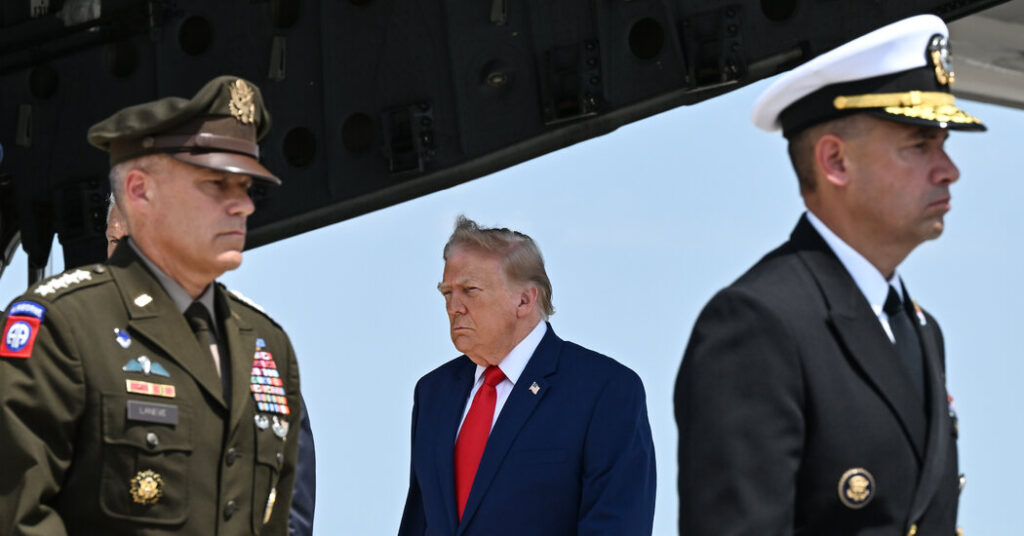
On Wednesday, President Trump watched in Dover, Del., as the bodies of four soldiers killed overseas returned to American soil.
On Thursday, global oil prices hit $100 per barrel for the first time since May.
And today, the United States and Iran traded fresh attacks across the region.
The increasingly unpopular war in Iran — a conflict Trump has repeatedly sought to declare over — has become a stubborn fixture of the summer, forcing Republicans into the unenviable position of playing defense on the issue with only three and a half months before Election Day.
“We got to wrap it up,” Speaker Mike Johnson said this week.
Trump has swung between attempts to minimize the war — he called it a “skirmish” during a rally in Atlanta on Wednesday — and threats to ramp it up further, saying yesterday that he is considering launching a “massive attack.”
Today, we’ll look at the political dimensions of a war the president is struggling to end.
The war is unpopular, even among Republicans.
A poll released last week by The Washington Post and Ipsos found that only 29 percent of Americans approve of Trump’s handling of the war in Iran. A poll this week from Politico found that enthusiasm for the war is waning even among Trump’s MAGA base. In May, a similar poll found that half of self-identified MAGA voters wanted the war to continue, even if it increased costs in the United States. That figure had fallen 13 percentage points by mid-July.
“The administration had hoped that this would be a quick and decisive operation, and clearly it’s now dragging on,” Ryan Williams, a Republican strategist, told me. “It is a liability for the party.”
Republicans are likely to hear from their constituents about the war as they head back to their districts for summer break.
Democrats are going on the attack.
Democrats are eager to turn the war into a centerpiece of their messaging in the midterms, in part by highlighting its cost and its effect on gas prices as they work to hammer home a message focused on affordability.
That strategy is already taking shape across the country:
In Maine, Majority Forward, a major Democratic group, has spent more than $1.5 million on ads accusing Senator Susan Collins, a Republican, of giving Trump a “blank check” for the war, according to an analysis by the media tracking firm AdImpact.
In upstate New York, the Democrat Cait Conley took to X to hit Representative Mike Lawler, a vulnerable Republican, for voting against a measure directing the president to end the war or seek explicit authorization to continue it. “Mike Lawler votes with Donald Trump 100 percent of the time — even when American lives are at stake,” Conley wrote.
In Iowa, the Democrat Josh Turek seized on the war in his Senate race against Representative Ashley Hinson. “Iowans can’t afford gas, groceries and health care while Hinson sends tens of billions of dollars overseas to fund a war with no strategy,” he said in a statement this week.
Republicans say those attacks won’t stick.
“Democrats ignored Iran for years, emboldening a terrorist regime that wants to decimate our country,” Natalie Baldassarre, the national press secretary for the Republican National Committee, said. “Despite Democrats’ attempts to deflect, inflation is lower than under Biden. While the left flounders on messaging, Republicans are laser focused on the midterms as we cut taxes, strengthen our national security, and keep our communities safe.”
Republicans are divided.
Perhaps more alarming for Republicans than the Democrats’ attacks is the fact that the war appears to be fracturing their own coalition.
In Washington this week, four Republicans — Representatives Tom Barrett of Michigan, Warren Davidson of Ohio, Brian Fitzpatrick of Pennsylvania and Thomas Massie of Kentucky — voted in favor of the war powers resolution that Lawler and most other Republicans rejected.
It was a rare show of defiance by Barrett, Davidson and Fitzpatrick, who will all face voters this fall; Massie lost his primary earlier this year to a Trump-backed opponent.
The war has also angered far-right figures like Tucker Carlson who are deeply opposed to foreign intervention. “It’s been kind of civil war-y over on the conservative team since this whole thing got launched,” Megyn Kelly told Vice President JD Vance on her YouTube show last month.
Some Republicans worry that those divisions will dampen the enthusiasm of their base voters, potentially keeping them home for the November elections that have seemed to fire up Democrats.
“You’re always worried about having an enthusiastic base heading into a midterm election,” Williams said.