

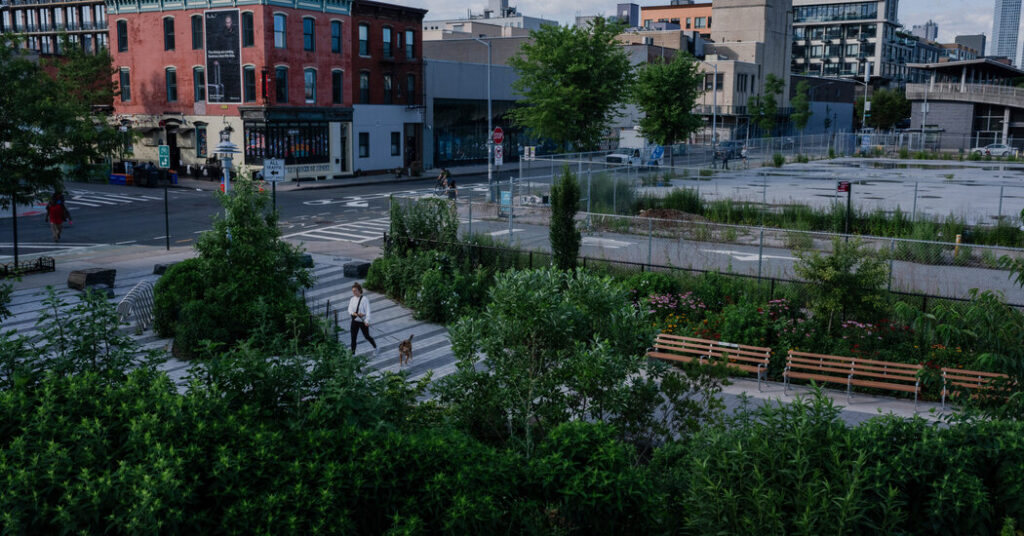
Bushwick Inlet, a cove where the brackish waters of the East River curl into a humble beach, is a small public park that opened in Brooklyn this spring. In late June, Katherine Conkling Thompson sat on a bench there, dejected and eating ice cream.
The tiny ecosystem, where the neighborhoods of Greenpoint and Williamsburg merge, has an osprey nest, oyster cages and wildflower-rich hills — hints of a sustainable future that Ms. Thompson had helped nurture. It represents a humble triumph two decades after New York City decided to remake Brooklyn’s industrial waterfront in this area into a livable, green haven with ample housing and more than 25 acres of parkland.
Soon, the inlet could have a new neighbor: a colossal residential complex with a 600-foot tower. The proximity of the restored cove to more than 1,300 high-rise apartments underscores a fraught debate around waterfront development: whether to build big to address the city’s housing shortage or develop smaller dwellings and spongelike parks to navigate climate change.
So far, the “building big” side seems to be winning. Plans for the development, called Monitor Point, have been finalized. But most of the promised parkland, which would be carved out of land that was once home to a gas and oil hub, sits vacant and fenced in, with toxins in the ground. After 20 years, only a third of it has opened to the public.
That was why Ms. Thompson had ordered the fig and salted caramel ice cream — topped with whipped cream, fudge and sprinkles — and had commenced to eat her feelings.
“People are in denial,” said Ms. Thompson, who leads two nonprofits, one devoted to the park and the other to the inlet. Monitor Point will be built in one of New York City’s highest-risk hurricane evacuation zones, she said. “I still believe this is the wrong place for housing of any kind.”
New York is facing twin crises related to housing and climate. The city’s rental vacancy rate hovers at just above 1 percent, while the metropolitan area could lose up to 80,000 homes from flooding during the next 15 years, according to a report by the Regional Plan Association, a nonprofit. By 2040, more than one million new homes could be needed in the region, a reflection of population growth, housing deterioration and the onslaught of flooding, the report says.
The lure of waterfront development collides with a lack of citywide defenses that would protect residents from sea level rise and extreme rain, said Klaus Jacob, a geophysicist and professor emeritus at Columbia University. Until such a system is in place, he said, increasing density in flood plains “is a terrible idea.”
But providing such protection could cost more than $50 billion and presents design and engineering challenges. City officials, in the meantime, have started neighborhood outreach programs about flood awareness and have built local protections, especially in Lower Manhattan. They have also introduced measures to guide real estate ventures in a hotter, wetter climate, including a policy that requires some buildings to retain storm water on the premises.
Those policies “guide the city’s coastal development while providing targeted local planning, regulations and investments to meet our urgent need for housing in a changing climate,” Louise Yeung, the city’s climate chief, said.
Monitor Point will have three towers, and half the apartments will be affordable units. It will mostly be on land owned by the Metropolitan Transportation Authority, the state transit agency.
Gotham Organization, the developer of Monitor Point, will lease the land from the authority for 99 years. Using private funds, Gotham will pay for and execute tasks that the authority, the city and other groups had agreed to perform more than 20 years ago: relocate a warehouse from the parcel, clean up the land and landscape it. Gotham will also commit $300,000 a year to the upkeep of Bushwick Inlet Park and the building of a long-awaited museum on an adjoining parcel. The nonprofit museum sold its air rights to the developer.
The project will both address the housing shortage and help the transit authority convert the patch of dilapidated waterfront into an accessible green space, said Simeon E. Maleh, executive vice president of development at Gotham.
But many residents argue that the original rezoning of the area called for smaller buildings. Some say the property, which will be elevated and built behind a new steel bulkhead (basically a large wall between the water and the land), could worsen erosion and flooding in other areas.
The bulkhead is “shortsighted,” said Nick Shannon, a landscape architect who lives in Williamsburg. “Why sever our connection to the water in one of the most opportune places to have and extend parkland?”
The new structure could further endanger migrating birds, said Ron Shiffman, an urban planner. “The city needs to breathe.”
Gena Wirth, a principal designer with Scape, the renowned landscape design company hired by Gotham for the project, said that the bulkhead would reinforce crucial infrastructure and that the property’s public walkways would open up more of the waterfront.
During negotiations for Monitor Point, Lincoln Restler, a City Council member who represents the area, said that a development built on public land should serve the public. To that end, he persuaded Gotham to nearly triple the property’s affordable units. But more housing meant more people in a flood zone, said Ms. Thompson, who had wanted an environmental school on the parcel.
Mr. Shiffman, a founder of the Pratt Center for Community Development, a Brooklyn nonprofit, said that government officials should be more discerning about where large residential buildings go.
“I’m not against high-rise densities, but there are points in time where the density gets too much,” he said. He explained that focusing only on housing quantity can overwhelm a community that needs other amenities, like open space.
The area on the border between Greenpoint and Williamsburg is a hip enclave with climbing gyms, matcha bars, padel courts and Swedish delis. It added 30,000 residents in recent years; more housing has cropped up there than in any other neighborhood in the city, Mr. Restler said.
Centuries ago, it was all tidal creeks and wetlands, said Eric Sanderson, the vice president for urban conservation strategy at the New York Botanical Garden and author of “Mannahatta: A Natural History of New York City.” Bushwick Inlet’s mouth, about 225 feet wide, once stretched more than 1,500 feet across and extended to where McCarren Park, a popular neighborhood spot (and former salt marsh), is today.
Mr. Shannon, the landscape architect, has noticed that many of the tree roots in McCarren Park grow horizontally above the ground instead of down, “like cypress trees in swamps,” he said. It is evidence of the land’s past life as a wetland, where tree roots have difficulty sinking into the ground.
The water table is high in the area, which floods regularly. Last October, a rainstorm that drowned a man in another Brooklyn neighborhood produced several feet of flooding on Mr. Shannon’s street, he said. “It looked apocalyptic.”
At a public meeting about Monitor Point in May, Councilwoman Julie Won, who represents a district in Queens, said that while flood walls and natural parks with berms were getting built across the East River in Lower Manhattan, residential towers seemed to be the priority on the waterfronts of Brooklyn and Queens. No one disagreed.
Last fall, Dr. Jacob, the Columbia geophysicist, warned officials about the redevelopment of 122 acres in Red Hook, another coastal neighborhood in Brooklyn. The proposed project will include about 6,000 residential units, a modernized port and flood protections.
Dr. Jacob urged the city, which owns the property, to take into account climate effects for the entire area, which will eventually be under sea level, he wrote.
Both real estate ventures in Brooklyn will add to the affordable housing pot: The Red Hook project is expected to kick in millions of dollars to develop affordable units on the property and in other parts of the neighborhood, and Monitor Point will include affordable units designated for older and formerly homeless New Yorkers. But the news is bittersweet for Ms. Thompson, who fears another Hurricane Sandy.
In 2012, after the storm had inundated the neighborhood, “you could only get around in a boat,” she recalled.
“People in affordable units don’t have summer homes. If there’s another Sandy, where will they go?”