

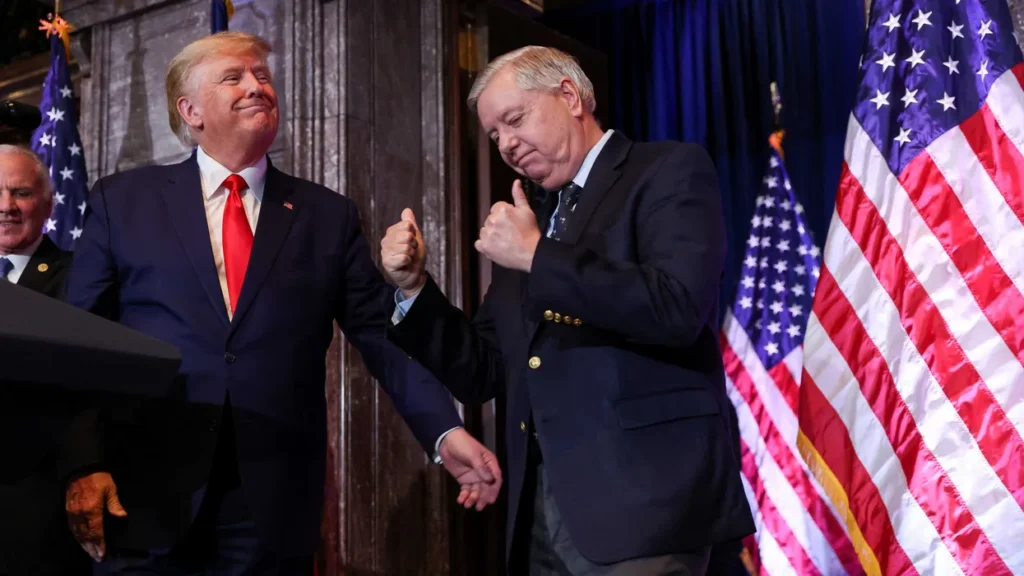
I’ll say what a lot of people are thinking but won’t say out loud, and that is history is not going to be kind to Lindsey Graham. Not even close.
When you strip away the tributes for Graham who died on Saturday – tributes from some but certainly not all – what’s left is a 30-plus-year Senate career defined less by what Graham built than by who he was willing to become to keep his job in the end.
Did Lindsey Graham actually accomplish anything noteworthy, except his slavish devotion to Donald Trump? There’s no landmark bill with his name on it that reshaped the country. No signature achievement that outlives him the way, say, his close friend John McCain’s reputation and record do.
What Graham leaves behind instead is a case study of a politician who understood exactly one thing better than almost anyone else in Washington, and that is how to do whatever it takes, at whatever cost, to keep your seat in Congress.
That instinct, or rather desperation, is what made his friendship with McCain so interesting in hindsight. For nearly two decades, Graham was McCain’s shadow, one of the “three amigos” with Joe Lieberman, the guy who choked up at McCain’s Senate farewell and said he did not cry for a perfect man but for one who admitted his imperfections.
McCain, whatever you thought of his politics, was the rare senator who occasionally put country over party at real personal cost. Graham spoke about that quality when referencing McCain, and never seemed to practice it himself once McCain was gone.
Because everyone in South Carolina, and beyond, knew the real Lindsey Graham, who clung to his Senate seat like a sloth to a branch. And when Donald Trump showed up, Graham found his most humiliating expression.
When he ran for president and failed, Graham among other things, called Trump a “kook.” He said nominating Trumpwould get the party “destroyed… and we will deserve it.” He later admitted he’d called Trump a “race-baiting, xenophobic religious bigot” and had simply “run out of adjectives.”
Then Trump won, and Graham did what Graham did best. He twisted himself in knots around Trump’s protruding derriere. He turned himself into Trump’s most reliable Senate sycophant, and that is saying a lot because the competition was, and is, fierce.
He became a fixture on Trump’s golf course, bragged about how often the two talked, and as recently as this past May was on Fox News suggesting Trump deserved a prize named after himself, “the Trump Prize,” for a Middle East deal that hadn’t even happened yet. And will likely never happen, due in no small part to Graham.
He continued to support Trump’s epic and historic failure of a war in Iran, even saying, “I go back to South Carolina, I’m asking them to send their sons and daughters over to the Middle East.”
It proved Graham would throw his own constituents under the bus – literally in this case – to keep in Trump’s good graces.
For one night, though, something broke through. On Jan. 6, 2021, hours after the Capitol was overrun, Graham stood on the Senate floor and said, “All I can say is count me out. Enough is enough.”
Two days later, a mob of Trump loyalists cornered him at Reagan National Airport, screaming “traitor” as police walked him to safety. For a brief moment, it looked like Graham might actually stay broken from Trump for good.
He didn’t, of course. Within months, he was back in Trump’s mangled hairs, and by the time Trump returned to power, Graham had made himself indispensable again as Trump’s loyal foot soldier and boot licker.
And that, above all else, is the disgraceful legacy historians are going to reckon with. At the end of his life, he was a senator who tied his name, permanently and by choice, to a president who tried to overturn a legitimate election, surrounded himself with grift and corruption, and treated the presidency as a vehicle for his own grievances.
Graham didn’t just tolerate that. He amplified it, defended it, and rode on the proverbial golf cart through all of it. He wanted South Carolina sons and daughters to sacrifice themselves for Trump, and he wanted taxpayers to pay for Trump’s ballroom.
He even “jokingly” suggested Trump should be pope. But does anyone believe it was a joke?
Could Graham have spent his final years rebuilding his reputation instead? Maybe, in theory. But South Carolina was never going to turn on Trump, which meant Graham, ever the desperate survivalist, was never going to turn on him either.
It’s worth looking at some moments from the earlier parts of Graham’s career. He became a national name in 1999 as one of the House managers who prosecuted Bill Clinton’s impeachment trial, which helped carry him into the Senate in 2002.
There was the Gang of Eight immigration deal in 2013, a genuine bipartisan effort at reform that Graham helped write and that, like so much else in Washington, went nowhere.
There was real substance in his hawkish, McCain-aligned foreign policy instincts and his years-long support for Ukraine’s fight against Russia.
But his chairmanship of the Senate Judiciary Committee from 2019 to 2021 is far more complicated. He used it to steer through Amy Coney Barrett’s confirmation in the closing days of a presidential election, cementing a 6-3 conservative supermajority on the Supreme Court for a generation.
But if there’s one moment that outlasts all the others in public memory, it’s Graham red-faced and shouting during Brett Kavanaugh’s 2018 confirmation hearing, pointing at Democratic colleagues and declaring it “the most unethical sham since I’ve been in politics.”
It worked. Kavanaugh was confirmed, and Graham owns a piece of that horrific outcome.
None of that, though, is what history is going to remember him for. Lindsey Graham will be remembered as an accomplice, willing, eager, and until his last breath unrepentant, to the most corrupt president in American history.
That is the legacy he chose, over and over again, when he had every chance to choose something else. History does not forgive that kind of choice, and neither should we.