

MEMPHIS — The Rev. Earle Fisher sat alone at a makeshift desk as the fading daylight filtered into the sanctuary of Abyssinian Missionary Baptist Church.
It is where he has written op-eds, filmed social media videos, helped organized rallies, dashed off hundreds of emails and made countless calls — all in a crusade to get the Black residents of Memphis to the polls.
On this evening, pages of printed voter rolls were spread before him, and Fisher had highlighted precincts with the lowest turnout in past elections. In each, he saw a chance to gain ground.
“I am consumed by this,” he said.
By this, he meant the recent redistricting plan adopted by Tennessee’s legislature, which breaks up the majority-Black, predominantly Democratic district that has long encompassed Memphis. It carves up the state’s second-largest city, placing pieces of it into three sprawling districts that include Whiter, more rural and more conservative areas of Tennessee.
The state’s Republican leaders have made no secret that the changes, which came soon after a Supreme Court decision in April, are intended to eliminate its lone blue congressional district.
It is one front in a broader redistricting fight that has unfolded across numerous states and both major political parties. Particularly in the South — in Texas and Florida, Louisiana and Alabama and Tennessee — Republicans have moved rapidly and at President Donald Trump’s behest to bolster GOP prospects come November.
In Memphis, as elsewhere, that effort has sparked anger and confusion, spurred raucous protests and resulted in ongoing lawsuits.
There are signs it is also energizing Black voters. In a recent South Carolina primary, early voting surged to record levels. Turnout in the district represented by the state’s lone Black congressman jumped roughly 50 percent compared with the last midterm election.
Whether a similar story will unfold in Memphis remains uncertain. But without a doubt, the GOP redistricting has fueled a fierce urgency in local figures such as Fisher, who see in redistricting an attempt to curtail the political power of one of the Blackest cities in America.
It has deepened their resolve to ensure that a city integral to the civil rights movement — a key battleground in the fight for desegregation, economic equality and labor rights — maintains a voice in Washington, despite lengthening electoral odds.
“I think, in a lot of ways, this awoke a sleeping giant,” Fisher said. “I don’t think [Republicans] have anticipated or accounted for a mass mobilization effort.”
On this day, Fisher was dialing pastors of traditionally Black churches in low-turnout precincts around the city, one after another, trying to press them into service.
“Hey, I got a list for you,” he told one minister, promising to email a spreadsheet of nearby registered voters who needed to be contacted.
“Y’all got a postcard party you’re doing? That’s dope,” he told another whose church already had a voting drive in the works.
Eventually, his phone fell silent and Fisher packed up for another day. But the 47-year-old pastor and college professor, who founded a Memphis voter-turnout group a decade ago, knew he would be back at it again by morning.
The clock was ticking.
‘We just can’t quit’
Six weeks after the Supreme Court sharply weakened the minority protections of the Voting Rights Act, hundreds of people arrived on a steamy Juneteenth morning outside the National Civil Rights Museum in Memphis.
A band played. A balloon artist twisted creations for children. The smell of barbecue and deep-fried Oreos hung in the air.
Within sight of the hotel balcony where the Rev. Martin Luther King Jr. was assassinated nearly six decades earlier, the brothers of Alpha Phi Alpha had set up a voter registration table with a sign that read, “A voteless people is a hopeless people.”
“I grew up having to ride the back of the bus. I grew up having to drink from a colored water fountain. I grew up having to go to the back to eat at a restaurant,” said Oscar Sueing, 76, a native Memphian who was helping run the booth.
Nearby sat a stack of voter registration forms, fliers with the primary- and general-election dates and free wristbands that read, “I’m voter ready.” Even Sueing’s shirt read in big block letters, “VOTE” — a right he said his elders had not taken for granted.
“When things began to change in the ’60s, I thought there was an evolution, and it was going to continue. I never thought that we would be back in Reconstruction,” Sueing said of the redistricting, which he called “an atrocity.”
The move to dilute the power of Memphis’s Black majority had rattled and angered him, he said. But ultimately, it had strengthened his resolve.
“I’m going to keep doing stuff like this. I’m going to keep working,” he said. “We just can’t quit.”
That is a refrain advocates across Memphis and Shelby County keep repeating.
Tennessee House Minority Leader Karen Camper, a Democrat whose district sits in Shelby County, said one challenge has been harnessing the indignation and enthusiasm that have burst forth in the wake of the redistricting.
“People want to find a place in the fight,” Camper said. “My objective is to try to set up a system by which people can find themselves in the fight.”
That fight is, at its core, finding a way to get Memphis voters to turn out in massive numbers. The hope: to stage an upset, keep at least one Democratic congressional district in the state, and elect people who will look out for a city with specific and serious needs.
It’s no small challenge. A May municipal primary election in Shelby County had a 16 percent turnout — the highest in years, but still low. In the last presidential contest, in 2024, less than 55 percent of the county’s nearly 600,000 voters turned out — about 10 percent lower than the national average.
Advocates across Memphis describe confusion among voters in the wake of the recent redistricting about what district they now belong to and who is even running in redrawn areas.
“It has completely upended all the expectations and calculations,” said Thomas Goodman, a politics and law professor at Rhodes College in Memphis.
Memphis has long been represented in Congress by Democrat Steve Cohen, who announced after the redistricting that he would not run for reelection.
“I don’t want to quit. I’m not a quitter,” Cohen told reporters this spring. “But these districts were drawn to beat me.”
A Washington Post analysis shows that the racial makeup of the previous 9th Congressional District, which Democratic presidential nominee Kamala Harris won by 43 points in 2024, was nearly 61 percent Black.
After redistricting, none of the three districts that now include parts of Memphis has more than a 30 percent Black population. The newly drawn 9th District would have seen Trump win by 22 points, based on 2024 election data.
When Republicans approved the new map in May over the boisterous shouts of protesters, they insisted the lines were drawn only with partisan aims, and that race was not a factor.
“It was absolutely drafted on politics,” state Rep. Jason Zachary (R) said on the House floor.
Sen. Marsha Blackburn (R-Tennessee), a candidate for governor, wrote on social media that the undertaking “is how we cement President Trump’s agenda, and usher in America’s Golden Age here in Tennessee.”
The reality is that at least some of Memphis, if not all of it, will soon be represented by someone who lives far away.
“The risk is that we end up with congressional representation that does not see the value of our city and does not advocate for the things that our city needs,” Mayor Paul Young said on a recent Friday before he took to the stage at a Rally for Representation.
Ian Randolph, head of the Shelby County Voter Alliance, put it this way as he worked a voting information booth at a Juneteenth gathering in Douglass Park that day.
“The people in Bucksnort, Tennessee, what do they have in common with Memphis?” he said, referencing a tiny community 150 miles away in Hickman County, where Trump won 80 percent of votes in 2024. That county will now share a representative with downtown Memphis. “We have interests here that don’t line up with the interests of people in rural Tennessee.”
Amid the anger and uncertainty, Memphis’s Black clergy have emerged as among the most vocal advocates of voter education and turnout.
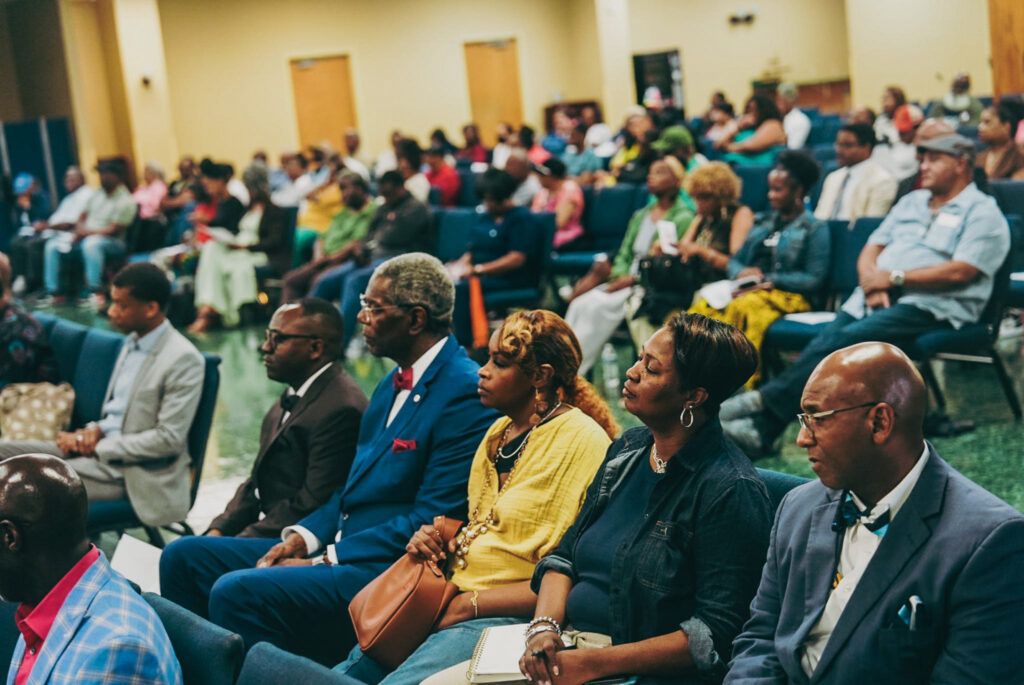
On a recent Sunday evening, more than 1,000 people crowded into the Mississippi Boulevard Christian Church for an event called “Souls to the Polls.”
“We didn’t come here just for inspiration,” the church’s leader, the Rev. Jason Turner, said that night. “We want to leave here with a game plan.”
That game plan, speaker after speaker underscored, is hard to execute but simple to summarize: Show up.
“We must stay encouraged. … These new congressional districts are still winnable districts,” Damon Griffin, a pastor and former federal prosecutor, told the crowd. “We must get our congregations to vote. We must get our communities to vote. We should get our neighbors to vote.
“But we must vote.”
‘We are in the middle of a fight’
For the moment, the legal wrangling in Tennessee continues.
A federal court in Nashville recently heard a last-minute plea from groups hoping to block the use of the GOP’s map ahead of the Aug. 6 congressional primary.
The plaintiffs argued that Tennessee’s newly drawn map couldn’t be explained by partisanship alone, and that the cracking of the majority-Black city of Memphis and Shelby County into several districts was unconstitutional.
An attorney for the state said GOP lawmakers had been explicit that the redrawn districts are not driven by any racial agenda.
However the court rules, some Black leaders in Memphis are already thinking beyond just this year’s elections.
“I may not be able to get the traction I need by August,” said Randolph of the Shelby County Voter Alliance. “I’m already focused on 2028.”
Turner, the pastor, said what stings most about the redistricting is the feeling that “we’ve lost the ground of the modern civil rights movement.”
Reversing that won’t happen overnight, he said, but rather through a sustained effort. “This is a moment that’s got people’s attention, that allows us to organize for long-term mobilization,” he said.
He recalled singing “We Shall Overcome,” an anthem of the civil rights era, at the end of the recent voting rally and thinking how it is more than just a nod to past struggles.
“Now,” Turner said, “we are singing it because we’re in the middle of a fight.”
‘Black Civics 101’
A summer Saturday, and Earle Fisher is back in his church’s sanctuary in Memphis’s Whitehaven community.
Tomorrow, he will be back in the pulpit, but today he stands in a flat-brimmed cap and T-shirt to welcome dozens of people who have come for a session called “Black Civics 101.”
A colleague will spend the next hour taking attendees through the history of Black suffrage in America, from enslavement to the passage of the 1965 Voting Rights Act.
The group will talk about branches of government, the composition of the state legislature, the importance of courts in public policy, the role of the census in determining representation. They will talk about what types of candidates are best equipped to represent this diverse community.
But first, Fisher begins with a sermon. Not about God, but a different sort of faith — the belief in the power of informed voting.
“Democracy has to be learned and practiced and protected and renewed by every generation,” he says. Your presence, he tells the group, shows “you understand that democracy is not something we inherit automatically.”
Previous generations of Black Americans learned about the Constitution in church basements, he says. They studied voting laws around kitchen tables. They understood political power began with political literacy.
“Our effort today,” he says, “is an attempt to return to those traditions.”
It will take everyone in the room and many others, he says, to knock on doors, make calls, send texts, strike up conversations at the grocery store. It isn’t enough to convince people that they should vote. People must also grasp why participation matters so much.
“We are here because every one of us is affected,” Fisher says. “Whether we are paying attention or not.”
In Memphis, paying attention matters more than ever, says the pastor who is consumed by this.
Election Day is looming. The clock is ticking.
Ela Jalil contributed to this report.