

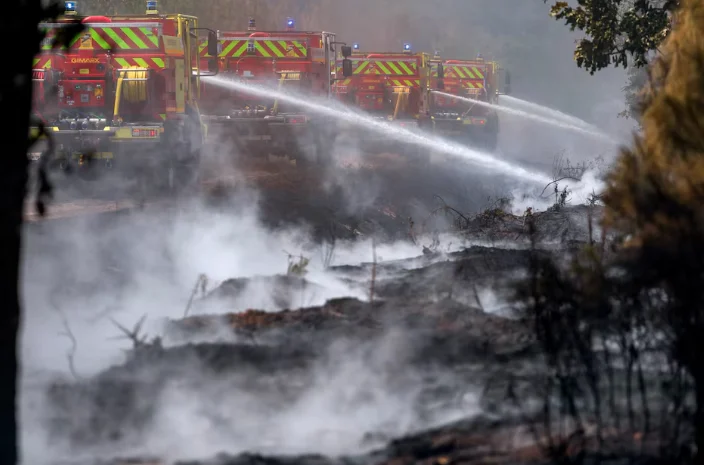
Firefighters battled massive wildfires threatening the French city and tourist region of Bordeaux and several areas of neighbouring Spain, taking advantage of improved weather conditions as authorities raced to contain the blazes before another heatwave forecast later this week.
The fires have forced the evacuation of about 220,000 people, including residents and holidaymakers, in France, while around 100,000 people in Spain have either been ordered to leave their homes or seek shelter.
Although weather conditions briefly improved on Monday, officials warned the respite would be short-lived.
Forecasters expect temperatures to climb again later this week, reaching as high as 37 degrees Celsius in the Bordeaux region, raising fears that the fires could intensify after a blisteringly hot and dry summer across Western Europe.
In France, the wildfires, which broke out last week near the Atlantic coast, have spread to within 15 kilometres of Bordeaux’s metropolitan area. Local officials said 80 firefighters had been injured while battling the flames.
During a visit to Bordeaux, President Emmanuel Macron praised emergency responders for their efforts but warned that the battle was far from over.
“We must hold on. We are going to win this battle together. The whole nation is behind you,” he said.
Prime Minister Sebastien Lecornu described the current wildfire season as unprecedented, noting that the area already destroyed had exceeded the record set in 2022.
“The fight against wildfires begins with prevention. Nine out of 10 fires are human-caused and most arise from carelessness: a cigarette butt, a barbecue, work carried out without precaution,” he wrote on X.
In Spain, firefighters reported some progress overnight after slowing the advance of large fires burning across central regions. However, a major blaze in the eastern province of Castellon remained out of control.
Firefighters there faced an added danger as flames reached areas containing unexploded ordnance left over from the Spanish Civil War.
“The ground contains old ordnance that explodes when the flames reach the area,” Chevi Bolumar, fire chief of the Valencian regional government, told public broadcaster TVE.
Three major wildfire fronts also remained active in the mountains northwest of Madrid, spanning the provinces of Madrid, Toledo and Avila.
Authorities said the Avila blaze had become the largest wildfire in Spain’s modern history.
Spanish Interior Minister Fernando Grande-Marlaska warned that the coming days would be critical.
“Today and tomorrow are absolutely crucial days in tackling this wildfire. From Wednesday onwards, weather forecasts become significantly more unfavourable,” he said.
Prime Minister Pedro Sanchez said the fires reflected the growing impact of climate change rather than isolated disasters.
“What we’re experiencing isn’t a succession of isolated events. It’s the most painful expression of a climate emergency that is making sixth-generation wildfires more ferocious, heatwaves more frequent, and our territory more vulnerable,” he said.
Sixth-generation fires are considered the most extreme and difficult-to-control category of wildfires, with many scientists linking their increasing frequency and intensity to human-induced climate change.
Among those displaced was Castellon resident Maria Angeles Serrano, who said the emotional loss caused by the destruction outweighed the material damage.
“Material damage is one thing, but that can be repaired. What really hurts is the emotional loss,” she said.
The wildfires have also dealt a blow to southwestern France’s tourism-dependent economy, Finance Minister Roland Lescure said. However, Bordeaux’s renowned vineyards have so far escaped the flames.
Christophe Chateau, communications director of the Bordeaux wine industry association (CIVB), said drought, rather than fire, remained the sector’s biggest concern.
As the crisis stretched firefighting resources across Europe, several countries stepped in to assist. Turkey, Italy and Greece deployed firefighting aircraft to Spain, while Portugal sent a specialist wildfire intervention team.
France also received support from Switzerland, which dispatched two Super Puma helicopters and their crews following a request from Paris.