

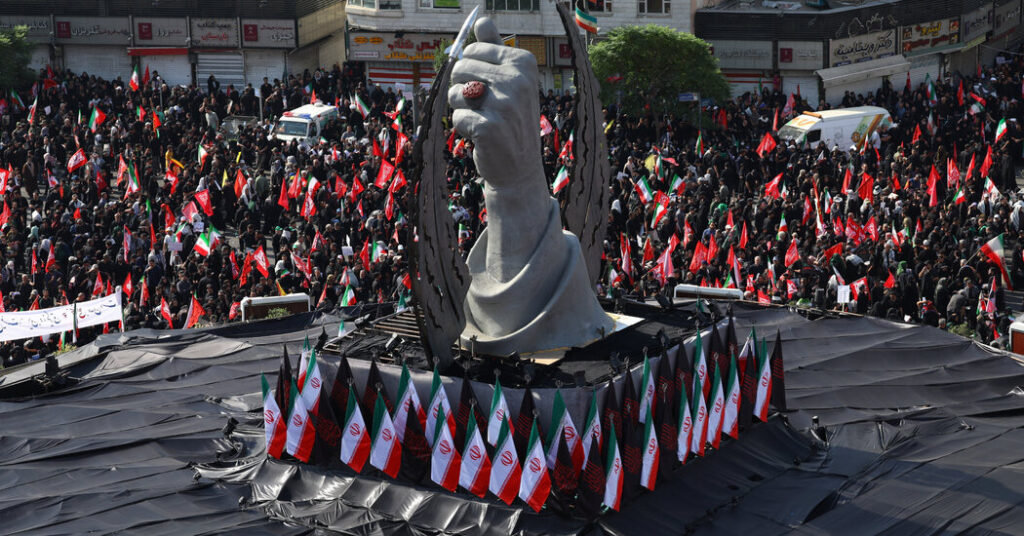
Loyal supporters regarded Ayatollah Ali Khamenei, the slain supreme leader of Iran, as a towering political figure, a religious authority, and now, in death, a fallen hero elevated to martyrdom.
But to those Iranians who opposed him, he was a dictator who ruled with an iron fist, sidelined political opponents and resorted to brute force to maintain his grip on power. Some families of those who were gunned down in waves of anti-government protests, jailed or executed, hold him directly responsible for their anguish and loss.
Ayatollah Khamenei’s rule ended on Feb. 28, when American and Israeli airstrikes killed him. Still, the government that he led for more than 37 years has endured and Iran is holding a weeklong funeral procession to honor him.
Some Iranians said they were dismayed by all of the pageantry, saying a funeral of this scale was demoralizing and infuriating. In just a little over a year, Iranians have endured two wars with Israel and the United States and a government crackdown on a nationwide uprising in January, which killed at least 7,000 people, according to the Washington-based Human Rights Activists News Agency.
“They are burying someone who is responsible for the massacre of January,” said Mahzad, 28, an artist, in Tehran. Like others interviewed by phone for this article, he asked to be identified by his first name only for fear of repercussions. “They have been treating the families who have lost their children horribly.”
Iran has never been monolithic and its population of roughly 90 million has an array of opinions about the government, politics, religion and social norms. In March, when Ayatollah Khamenei’s killing was announced, many took to the streets around the country to celebrate, dancing, honking horns and shouting, “freedom.”
Some of the supreme leader’s critics are now posting videos on social media showing themselves dancing, drinking alcohol and partying. Others are griping about the logistical inconvenience of the funeral, namely the blocked roads, checkpoints, shuttered businesses and canceled flights.
Some of these government critics expressed surprise that so many foreign dignitaries traveled to Iran to pay their respects as Ayatollah Khamenei lay in state.
“Do they not know or care about what he did?” said Bijan, an architect in the capital Tehran.
Others said that while the government can mobilize and accommodate its supporters to congregate in massive numbers in a show of force, government opponents cannot do the same without the threat of violent repression.
Mehdi, a 45-year-old former political prisoner who lives in Tehran, said part of the route of the funeral procession had also been the scene of protests and clashes in multiple bouts of anti-government unrest against the government over the past few decades.
“The same security forces who are spraying water and handing food to the funeral attendees today were shooting at our youth a few months ago, in the very same location,” he said.
Gohar Eshghi, in her 80s, became a prominent and vocal activist after her son was killed. She wrote on social media on Friday that her heart was bleeding for all the injustice waged by this government against its own people.
“This is not the pain of a family. It’s the pain of a nation,” she wrote. Her son, Sattar Beheshti, a low-income day laborer who had a blog, was killed in detention in 2012.
The government has announced a public holiday for several days this week and some residents of Tehran left the city to escape the funeral ceremonies.
“I did not want to be in Tehran and see this figure who has caused Iranians so much harm be treated like a folk hero,” said Shahrzad, a 57-year-old aid worker, who said she had traveled to the north with her family. She is a former political prisoner whose cell mates were executed in the 1980s, and in January witnessed security forces firing at and killing protesters.
“We cannot forget what we have seen,” she said.