

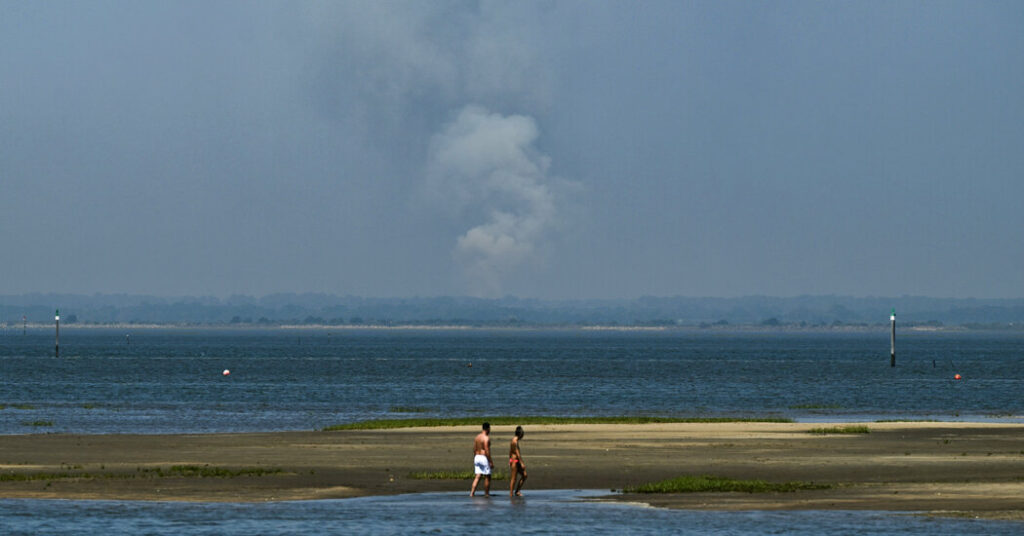
The giant wildfires in France and Spain are the countries’ largest on record, and at roughly 100,000 acres each, the blazes are bigger than all but six of last year’s wildfires in the American West.
Studies have shown that global warming is driving Southern Europe’s recent increase in sprawling, fast-moving fires that create their own weather and can be all but impossible to put out. But experts say there’s another factor behind the continent’s large fires, one rooted in societal changes that could be hard to reverse.
In parts of Europe, a generational shift away from farming has replaced patchworks of pastures and plowed fields with untamed vegetation that burns intensely during hot, dry summers like this one.
“Climate change needs to be taken into account, but also the social changes are very important,” said Emilio Chuvieco, a professor of geography at the University of Alcalá in Spain. “There is no simple solution to big problems.”
A recent report from Spain’s Royal Academy of Engineering described the situation in starker terms: The country, it said, is in a “new era of megafires.”
“The long history of fires on Earth tells us that we cannot eliminate them,” the report said. “Instead, we must learn to coexist with them.”
Industrial emissions are warming the planet to levels without modern precedent and delivering more of the parched conditions that prime forests and grasslands to burn. The result in many regions has been colossal wildfires that destroy homes, ravage ecosystems and churn up smoke that wafts thousands of miles.
“We’re seeing more extreme fire around the world,” said Jennifer K. Balch, a professor of geography at the University of Colorado Boulder. “We have essentially set the stage by warming our climate for more intense, large and faster-moving fires.”
In Canada, the total area that fires burned in 2023 was seven times the historical average. In Brazil, blazes in 2024 tore through an area of Amazon rainforest roughly the size of Belgium. In California, nine of the state’s 10 largest wildfires on record have occurred in the past decade.
In Southern Europe, the recent jump in severe burning is all the more striking coming after nearly three decades in which the amount of land burned by wildfires each year generally declined.
After a series of devastating blazes in the late 1980s and the early ’90s, Spain and France took aggressive efforts to step up wildfire prevention and suppression. They trained fire brigades and upgraded firefighting aircraft. The countries also embarked on public awareness campaigns and strengthened international collaborations to manage wildfires.
In recent years, however, rapid warming and drying seem to have overpowered those measures. In some places, firefighters’ success at snuffing out small fires may have even set the stage for larger ones by causing vegetation to build up and grow dense.
“The success of suppression today does load the dice for bigger fires tomorrow,” said Park Williams, a professor of geography at the University of California, Los Angeles.
In Spain, another reason wildfire is rebounding is the depopulation of the countryside, Dr. Chuvieco said. Gone are the people who once worked the land. Without them, the shrubs, grasses and trees have become overgrown and interconnected, allowing wildfires to burn through easily.
Bringing in more goats and sheep to graze on former pastures might be a part of the solution for Spain, Dr. Chuvieco said. “But you need people to take care of goats,” he added. And, as Spain’s rural population ages, “there are not many.”
European governments have options for encouraging people to manage the land more carefully, said Tiago Oliveira, a researcher in forest and wildfire governance at the University of Lisbon. They can help attract private funding for forest restoration projects using new kinds of financing tools. They can also create incentives for bringing grazing lands back into use by promoting local cheese and meat.
As fires worsen, more people will benefit from such initiatives, Dr. Oliveira said. “Urban people, they don’t want to suffer from smoke,” he said. And many city dwellers retain familial connections to the countryside and want to see it cared for.
Still, it is all too tempting for elected officials to respond to wildfires by spending more on aircraft and other “toys,” Dr. Oliveira said. On hot, windy days when a giant blaze is at full tilt, fire squads can do little but evacuate people and wait for the weather to change.
“We don’t need more airplanes,” Dr. Oliveira said. “We need better policies, better incentives.”