

The European Union is debating a ban on imports from Israeli settlements, but member states are divided, reflecting deep disagreements over whether and how to confront Israel as it cements claims on occupied Palestinian territory.
Superficially, the fight is technical, based on procedural questions. But political observers say this is actually a proxy battle over how to handle Israel at a time of growing dismay with its policies among the European public and some leaders.
“Legal argument is being deployed to launder what is really a political and diplomatic reluctance to act,” said Alberto Alemanno, a law professor in Paris who arranged a letter joined by dozens of experts outlining legal grounds for a ban.
More than three million Palestinians live in the West Bank, along with over 500,000 Israelis who settled there after Israel captured the territory in the 1967 war. Palestinians envision it becoming part of future state, an objective that European governments aim to advance but Israel’s far-right government rejects.
In recent years, Israeli government approvals of West Bank settlements and other official actions have led to an unprecedented expansion of Israel’s claims on the land, as military operations have displaced many Palestinians and settler violence has risen.
The International Court of Justice issued an advisory opinion in 2024 saying that Israel’s occupation and settlements are illegal, calling on countries to prevent trade that may “assist in the maintenance of the illegal situation.”
Spain, Ireland, the Netherlands, Belgium and others have taken steps to restrict or ban Israeli products from occupied territories, like agricultural goods, wine and construction materials. These countries are among those pushing for the E.U. to take strong action to limit the import of settlement products.
Germany, by contrast, says it favors dialogue over action that risks inflaming Israelis ahead of their national election in October. Germany also has what it calls “a special relationship” with Israel, rooted in the history of the Holocaust, and the German government is traditionally reluctant to take measures that may isolate Israel.
Italy and the Czech Republic are likewise opposed to a confrontational approach and say E.U. restrictions on settlement products can be adopted only if they receive unanimous approval by member states.
But Kaja Kallas, the E.U.’s top diplomat, who is pressing for strong action, is among those who say that just a qualified majority — approval by at least 55 percent of member states representing 65 percent of the bloc’s population — would be needed. The European Commission this month proposed several possible measures, including tariffs and a ban on goods produced at Israeli settlements in occupied territory.
Hugh Lovatt, a senior fellow at the European Council on Foreign Relations, calls the focus by some member states on unanimity “a distraction — and arguably an excuse for inaction.”
But European countries have been able to agree on some actions related to Israeli activities in the West Bank. In May, the 27 E.U. members unanimously imposed sanctions on people and organizations that they said facilitate “settler violence and serious human rights abuses against Palestinians” in the West Bank.
“Clearly Israel’s relations with Europe are under unprecedented strain, including with countries that have long been very supportive,” Mr. Lovatt said.
Still, some member states remain reluctant to sanction Israeli government ministers or to take steps against Israel itself.
European leaders face conflicting pressures, including public calls for action, the risk of drawing Israeli ire and potential repercussions from the Trump administration for acting against Israel, he said.
Italy’s prime minister, Giorgia Meloni, for example, is doing a balancing act, he said. Italy is insisting that E.U. restrictions on settlement products receive unanimous backing from member states while she is also calling on the bloc to rethink its relations with Israel.
E.U. ambassadors met on Wednesday to discuss possible measures to pressure Israel over settlements ahead of a summer break but did not reach any agreement. No real movement is expected until at least October when the Foreign Affairs Council is slated to meet, said Lema Nazeeh, a policy analyst and international lawyer based in Brussels.
Danny Danon, Israeli ambassador to the United Nations, said in response to questions that the E.U. proposals are “both misguided and counterproductive.” He called them part of broader global efforts to isolate Israel, diverting attention from threats to Israeli and international security. The proposals fail to recognize that Israeli and Palestinian economies are intertwined and also risk harming Palestinians, he said.
Israel and the E.U. have robust trade relations and exchanged nearly $50 billion in goods last year, according to the European Commission. Israeli goods are entitled to preferential European tariff treatment. But for more than 20 years, products from Israeli settlements, an estimated $300 million in exports to the bloc annually, have been excluded from the arrangement.
E.U. policy requires Israeli exporters to provide postal codes showing where goods originate, but the burden is on European authorities to then check the source and treat settlement products differently.
This approach has led to confusion and deception, according to a recent report from the nonprofit Global Echo that examined agricultural export and other records over nearly a decade, which found that European consumers were being “systematically misled about the origins of settlement products.”
Emily Schaeffer Omer-Man, a human rights lawyer and the group’s founder, said a trade ban is “one of the most direct ways Europe can take action to curb the Israeli settlement enterprise that is accelerating.”
This month, Israel allocated more than $430 million for 43 new settlements in the West Bank. The far-right finance minister, Bezalel Smotrich, touted the move as just one way he aims to thwart the establishment of a Palestinian state there.
Amal Jadou Shakaa, the ambassador for Palestine’s Mission to the E.U., is pressing for a ban on settlement trade, saying it is the only way to bring E.U. policy into compliance with international law.
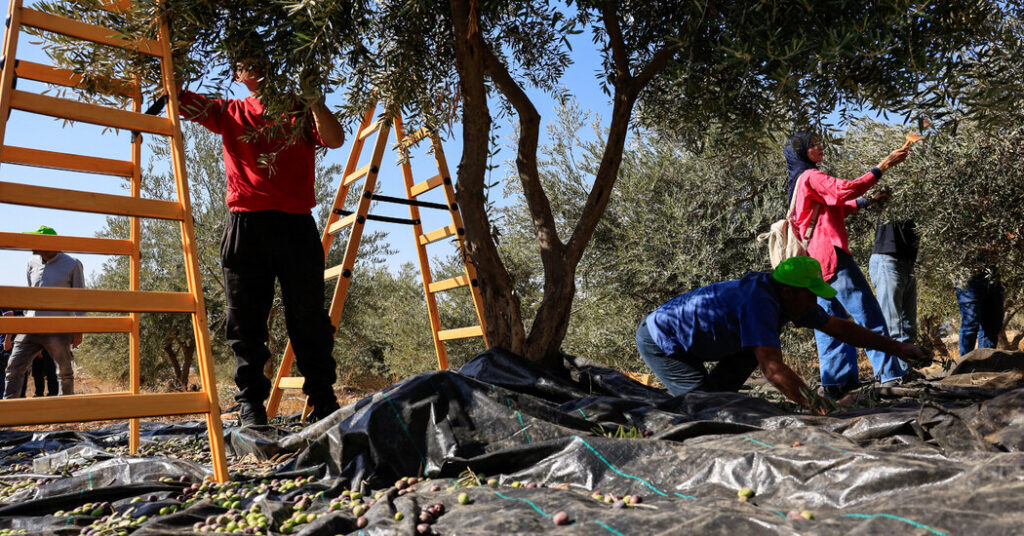
Ziad Anabtawi, founder of Al’Ard Group in the West Bank city of Nablus, which exports Palestinian agricultural products, said the growers he works with face increasingly difficult conditions. As a result of Israeli actions, he said, West Bank resources like water are diverted, access to land is increasingly blocked, and trees and harvests are being destroyed, while settlers are claiming more Palestinian land.
Mr. Anabtawi said his focus “is not on politics but on the ability of Palestinian producers to operate, invest and compete under fair, transparent and predictable conditions.” E.U. measures to pressure Israel on settlements would underscore “the importance of responsible business practices and respect for people’s rights,” he said.