

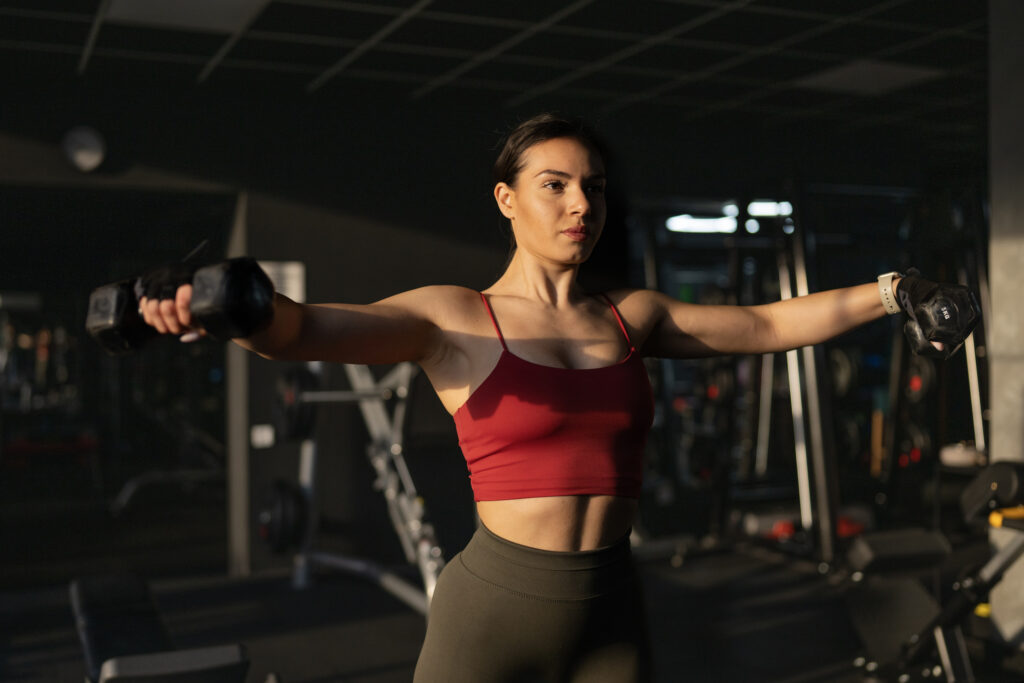
Female hormone levels change enormously during the monthly cycle.
But those changes have almost no effect on how well women’s muscles respond to weight training, a new study finds.
Scientists used rigorous methods to track 24 young women’s cycle phases and hormones while they trained for several months.
The time of the month wound up having little impact on their muscle mass or strength gains. Both increased during each phase of their cycles.
That result undercuts a rising belief among some coaches, athletes and wellness influencers that women should synchronize their workouts to their menstrual cycles, in case hormone fluctuations influence performance.
Instead, the study suggests female sex hormones such as estrogen and progesterone play little role in muscle building.
That finding echoes recent research involving men, which found that testosterone, the primary male sex hormone, doesn’t much drive hypertrophy (the formal name for adding muscle mass) when men lift weights.
“This is a great study,” said Michael Roberts, a professor and director of the Molecular and Applied Sciences Laboratory at Auburn University in Alabama. He studies hypertrophy and muscle health but was not involved in the study.
But in debunking the myth that certain hormones are key to building muscle and strength, the study does raise the interesting question of what is the answer, then?
How the myth took hold
That menstrual cycles might affect weight training makes intuitive sense, as the study’s authors from McMaster University in Ontario, Canada, point out. During the follicular phase of the cycle, just before ovulation, estrogen levels spike and the female body’s internal environment becomes more “anabolic,” they write, meaning it’s primed to build new tissue if there’s a pregnancy.
If not, estrogen levels plummet, and levels of progesterone, the other main female hormone, rise during the luteal phase. When they drop, bleeding starts. Progesterone is often considered relatively “catabolic,” meaning it slows growth or even promotes the breakdown of tissue.
In some past experiments, women did seem to add more muscle mass when they lifted during the follicular rather than the luteal phases of their cycles. But those studies generally relied on body temperature or calendar logs to estimate women’s cycle phases, measures that are, at best, inexact and often wrong.
So in the study, published in May in the peer-reviewed journal Medicine & Science in Sports & Exercise, scientists decided to be more meticulous about cycle testing.
“We thought, if we use gold standard methods and find that follicular is better” for weight training response, “then we could say there’s some merit” to that theory, said Alysha C. D’Souza, a doctoral candidate at McMaster and one of the study’s lead authors. “But if we don’t, then maybe it’s not an idea anyone should be pushing.”
A more meticulous approach
The researchers recruited 24 healthy young women with little if any weight training experience, checked their strength and muscle mass, and used repeated urinary ovulation tests to track the women’s cycles for a month.
Then the scientists randomly assigned each woman’s legs — 48 legs in all — to different training routines. Twelve of their legs were assigned intensive lower-body weight training during the woman’s follicular phase. Another 12, intensive training during the luteal phase; 12 others, moderate training throughout the woman’s entire cycle; and the final 12, no resistance exercise, as a control.
So a woman might wind up training her left leg intensively during her luteal phase and not training her right leg at all.
In essence, each woman completed two types of resistance exercise during the experiment, one with each leg. This bilateral approach reduces the effects of factors like sleep and nutrition. If a woman trains one leg mostly during the follicular phase and the other during the luteal, her lifestyle will be the same throughout and shouldn’t alter results.
The lifting routines were simple, consisting of machine-based leg press and knee extension exercises. Women with a leg assigned to moderate training did three sets of the exercises twice a week, until the leg could barely complete another repetition. For legs assigned to follicular or luteal training, the women did five sets twice a week during the appropriate phase, until the leg was quite tired. For consistency, they did a single set twice a week in the other phase. Women with a no-exercise leg didn’t train that limb.
Did hormones affect muscle building?
The routines lasted three cycles, with the researchers frequently repeating ovulation tests. At the end, the scientists rechecked the women’s strength and mass.
If extra estrogen during the follicular phase improved muscles’ response, that effect should be evident by then.
It wasn’t. Women’s leg strength and mass were greater — except in any unexercised legs — but to almost exactly the same extent, no matter when and how they’d lifted.
“We did not see a superior condition from the hormonal milieu during the follicular phase,” D’Souza said, despite estrogen being highest then.
“We also showed that it’s not detrimental to train in the luteal phase,” when estrogen is at its lowest, said Derrick W. Van Every, a PhD candidate at McMaster and the study’s second lead author.
Push yourself while training
The results point in one direction, scientifically. “It’s the physical lifting of the weight that really is the big driver” of improvements in muscular strength and size with resistance training, said Stuart Phillips, a professor of kinesiology at McMaster who oversaw the study.
The mechanical forces generated in muscles when you lift weight prompt the muscle to respond and adapt, to become stronger and larger.
“The hormonal environment,” Phillips said, “even in men, is not a big deal.”
That conclusion, which Phillips has replicated in other studies from his lab group, he said, should be welcome not only to young women who’d like to lift but also to older women and most men. If high levels of estrogen — or testosterone — were essential to add muscle, postmenopausal women and many retired men would see few gains from lifting. But they do.
There is a caveat, though. You need to push yourself somewhat while training, so that “repetitions within each set are performed relatively close to maximal effort,” said Roberts, the Auburn professor.
What is the key to gaining muscle?
This study was small, of course, lasting barely three months and involved only young, mostly White Canadians.
The findings also aren’t meant to minimize the effects that a woman’s premenstrual symptoms might have on her willingness and ability to lift, D’Souza said. If you’re feeling fatigued, achy or otherwise unwell, take things easy that day and visit the gym some other time.
But even with those limitations, the results should be a balm for anyone confused or daunted by the seeming complexities of lifting. “The magic that everybody’s looking for is just opening the door and getting into the gym,” Van Every said. Almost everything else, including hormonal status, is incidental.
“You’ll see 99.9 percent of your results,” he said, “just from showing up and lifting something.”
Do you have a fitness question? Email [email protected], and we may answer your question in a future column.