

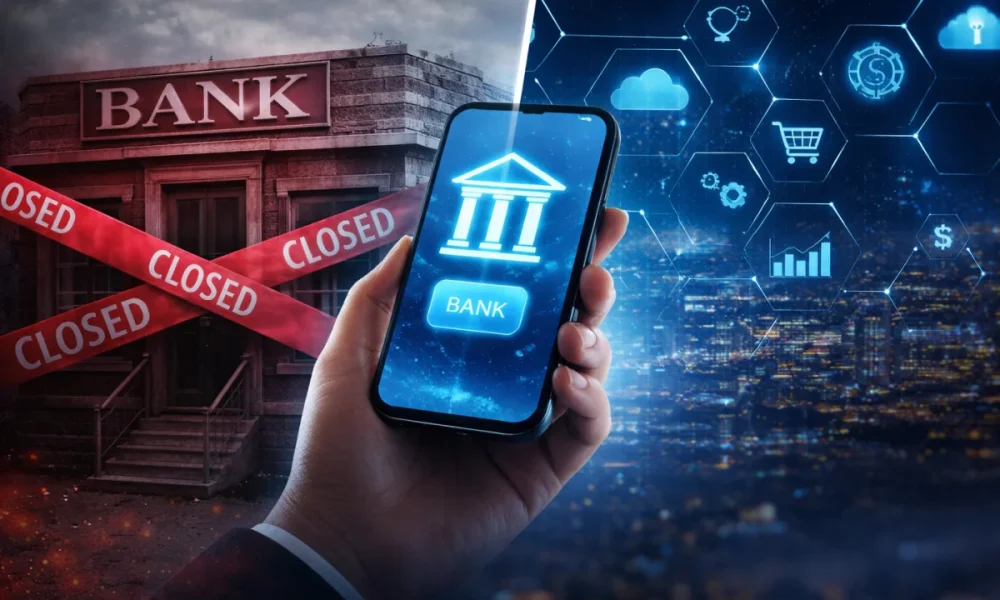
Why Nigeria’s biggest banks are discovering that the future of banking is not branchless—but branch-light
By Arthur Eriye
For many years, Nigerian banks gauged their strength by the number of branches they maintained. Each new branch signified growth, increased deposits, and market supremacy.
Today, the dynamics of profitability have transformed.
The primary competition is no longer between individual banks; it is now between the smartphone and the physical banking hall.
Recent financial reports from Nigeria’s leading banks indicate that digital banking is emerging as one of the fastest-growing sources of fee income, while traditional branches are increasingly functioning as advisory and relationship centers rather than transaction points.
This shift carries significant implications: banks are generating more revenue from customers who seldom visit a branch.
The Data Illustrates the Trend
In the first quarter of 2026, Nigeria’s publicly listed banks accrued approximately ₦224.7 billion from electronic banking services, ATM fees, and card-related charges, an increase from ₦199.6 billion during the same period in 2025—marking a growth of over 12 percent. Income from electronic banking alone constituted nearly ₦178 billion.
Among the top earners:
Access Holdings topped the sector with over ₦55.7 billion
UBA followed closely with nearly ₦46.9 billion
Ecobank generated more than ₦35.5 billion
GTCO earned around ₦21.9 billion
Zenith Bank reported over ₦21.5 billion in electronic banking income.
READ ALSO; BREAKING: CBN revokes licences of 46 Microfinance Banks in major regulatory crackdown
These statistics highlight a fundamental shift in banking profitability. While interest income continues to be the largest revenue stream for the industry, digital channels are increasingly becoming a vital source of recurring, high-margin non-interest income.
Why Digital Banking Is Winning
Digital banking is gaining traction due to the significantly lower costs associated with transactions conducted via mobile applications or USSD platforms compared to those performed in physical branches. Traditional banking branches incur various expenses, including:
Rent
Diesel and electricity
Security
Cash management
Staff salaries
Physical infrastructure
Digital platforms streamline many of these processes, allowing banks to handle millions of transactions at considerably reduced marginal costs. Research consistently indicates that digital banking enhances operational efficiency and lowers expenses while bolstering profitability.
For financial institutions, this translates to increased returns without a corresponding rise in operating costs.
However, Branches Remain Relevant
In spite of the swift expansion of digital banking, banks in Nigeria are not forsaking their branches. Rather, they are reimagining their roles. Routine transactions—such as transfers, bill payments, airtime purchases, and account openings—are increasingly being conducted online. Branches are transitioning into hubs for:
Corporate banking
Wealth management
SME financing
Mortgage services
High-value customer relationships
Complex financial advisory
In essence, the branch is transforming from a center for transactions into a hub for relationships.
The Hybrid Model Emerges as the True Champion
Data from Nigeria’s top banks reveals that the most successful institutions are not exclusively choosing digital solutions or physical branches; rather, they are integrating both. Digital channels enable scalability, increase transaction volumes, and generate fee income, whereas branches build customer trust, facilitate lending operations, and draw in higher-value deposits. Institutions like Access Holdings, GTCO, Zenith Bank, UBA, and Wema Bank have invested significantly in mobile applications, internet banking, and agency banking, all while maintaining strategically located branch networks. This strategy of being ‘branch-light and digital-first’ appears to provide greater operational leverage than either model could achieve on its own.
The Rise of Fintech Competition
The shift is also being driven by competition from fintech firms.
Digital-first companies such as Moniepoint, PalmPay and others have conditioned millions of Nigerians to expect instant, app-based financial services. Reuters and the Financial Times note that rapid digital adoption and fintech expansion are reshaping African banking, forcing traditional banks to accelerate digital investments while seeking new revenue streams beyond conventional lending.
For incumbent banks, digital transformation is no longer optional—it is essential to defend market share.
The Profitability Test
Measured purely by operating efficiency, digital banking is outperforming the traditional branch model.
It enables banks to:
Process more transactions at lower cost.
Generate recurring fee income.
Scale rapidly without proportional investment in physical infrastructure.
Reach customers in underserved areas through mobile and agency banking.
Branches, however, remain indispensable for relationship banking and complex financial services.
The banks delivering the strongest profits are those using digital platforms to reduce costs while deploying branches where human interaction creates the greatest value.
The National Daily Insight
The debate is no longer digital banking versus branch banking.
The real contest is how effectively banks combine both.
Nigeria’s banking winners are unlikely to be those with the largest branch networks—or those with no branches at all.
They will be the institutions that convert routine banking into a digital experience while reserving physical branches for activities that generate deeper customer relationships and higher-value business.
In today’s banking landscape, the most profitable branch may well be the one customers no longer need to visit.