

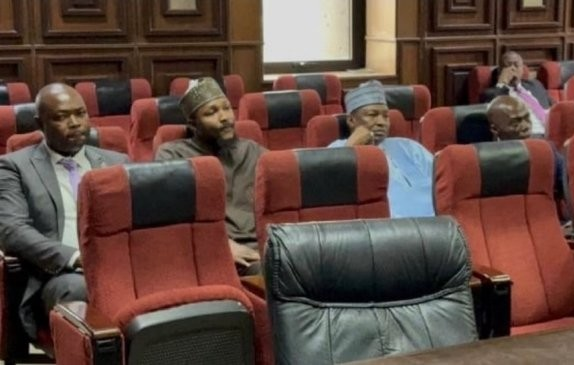
The Federal High Court in Abuja has adjourned judgment in the forfeiture suit filed by the Economic and Financial Crimes Commission (EFCC) against 57 properties linked to former Attorney-General of the Federation (AGF), Abubakar Malami (SAN), until July 10.
Justice Joyce Abdulmalik reserved judgment on May 26 after counsel to the EFCC and the respondents adopted their final written addresses and presented arguments for and against the forfeiture application.
However, when the matter came up on Monday for the scheduled judgment, the court adjourned the case until July 10 without providing any reason for the postponement. Although the case was listed as number four on the day’s cause list, it was not heard. Three other matters out of the 13 cases before the court were also adjourned.
The EFCC is seeking the final forfeiture of the 57 properties, alleging that they are reasonably suspected to have been acquired with proceeds of unlawful activities.
At the last hearing, EFCC counsel, Jibrin Okutepa (SAN), urged the court to grant the commission’s application, stating that the motion, filed in February, was supported by a 47-paragraph affidavit and 46 exhibits contained in three volumes.
Relying on the affidavit and accompanying exhibits, Okutepa argued that Malami and the other respondents had failed to show that the properties were lawfully acquired and urged the court to order their permanent forfeiture to the Federal Government.
Responding, counsel to Malami and the other respondents, Adedayo Adedeji (SAN), told the court that the former AGF had filed a 109-paragraph counter-affidavit to demonstrate why the final forfeiture order should not be granted.
He urged the court to set aside the interim forfeiture order, arguing that the respondents had shown the properties were not proceeds of crime. According to him, the EFCC’s application was based on mere suspicion rather than credible evidence.
“The court deals with evidence, not suspicion,” Adedeji submitted, urging the court to dismiss the commission’s application.
He further argued that the EFCC relied on extra-judicial statements that ought to be tested through cross-examination during a criminal trial, adding that the matter could not be fairly determined without oral evidence, which the court had earlier declined to admit.
Adedeji maintained that several of the properties were acquired before Malami assumed office as Attorney-General and, therefore, could not be linked to any alleged criminal conduct.
He also adopted separate counter-affidavits and further affidavits filed on behalf of other respondents and companies named in the suit, urging the court to refuse the final forfeiture application.
Other lawyers representing individuals and companies joined in asking the court to dismiss the EFCC’s application in the interest of justice.
Justice Abdulmalik subsequently adjourned the matter until July 10 for judgment.