

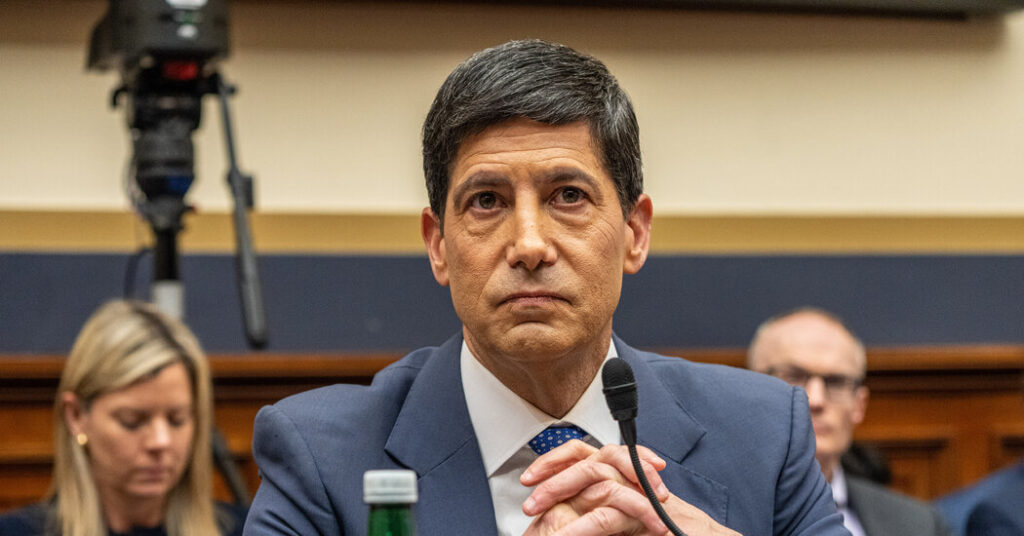
Hours before Kevin M. Warsh gave his first congressional testimony as chairman of the Federal Reserve on Tuesday, he received some good news.
Inflation had finally cooled after a string of punishing increases lifted the annual rate to a three-year high this summer.
The reprieve was visible not only in the overall inflation measure, which was driven by a steep drop in energy prices after a preliminary truce to end the war with Iran. It was also noticeable in the “core” gauge of the Consumer Price Index, which strips out volatile food and energy items. Those prices were flat for the month, bringing the year-over-year rate down to 3.5 percent.
The monthly data is always closely scrutinized. But in the days leading up to Tuesday’s release, it had taken on heightened significance. Christopher J. Waller, a Fed governor, said on Monday that a “hot” report would have forced the central bank to consider raising interest rates “in the near term.” That was taken to mean at the Fed’s next meeting on July 28-29.
The cooler-than-expected data was buttressed by a report on Wednesday that showed wholesale prices declining sharply. Together, that has stifled calls for an imminent rate increase. However, it has not eliminated the possibility down the road, keeping Mr. Warsh, who has staked his reputation on bringing inflation down, under pressure to prove his commitment to fulfilling that goal.
“Unquestionably the more-benign-than-expected data lengthened the runway available to Warsh and his colleagues to consider the situation and mull over whether they’re really going to cross the Rubicon of raising the funds rate,” said David Wilcox, a senior fellow at the Peterson Institute for International Economics and a former leader of the Fed’s research and statistics division.
“The odds, it seems to me, are that Warsh and his colleagues will have to put their money where their mouth is and tighten the stance of policy.”
What the Fed ends up having to do depends squarely on the trajectory of inflation — a point several senior policymakers made clear this week. Some appear more patient than others.
Lorie D. Logan, who as president of the Federal Reserve bank of Dallas is a voting member of the policy-setting committee this year, on Thursday called for “modestly higher” rates to “finish the job of restoring price stability.” That suggests the Fed’s meeting on Sept. 15-16 will feature an active debate on the issue, at the very least.
Lisa D. Cook, a Fed governor, suggested on Wednesday that if she did not see signs of disinflation “soon,” she would be “prepared to act.” Her comments followed a warning from John C. Williams of the New York Fed, who told reporters earlier that day that if inflation proved to be more persistent than he expected — he had forecast a deceleration in coming quarters — then the Fed would need to adjust rates. And Mr. Waller said he would need to see several months of lower inflation data to continue to hold rates steady.
There is still a path for inflation to restart its retreat to 2 percent, according to many of these officials. Energy prices, while rising again because of the re-escalation in the war with Iran, are still down from their recent peaks. The impact of tariffs is no longer as pronounced as it once was. Rental costs and other housing-related expenses, which make up a large chunk of the overall C.P.I. index, continue to only modestly increase. Perhaps most important, the labor market is not a source of inflationary pressure.
Against this backdrop, Tom Porcelli, chief economist at Wells Fargo, said the Fed could afford to be patient about raising rates, and questioned the efficacy of making any move.
“If these supply-side shocks are impacting inflation, then there’s very little the Fed can actually do about that,” he said.
But the risks are palpable, as both officials and economists repeatedly stress. For one, some of the categories that helped to keep June’s inflation data tame may not be as subdued going forward, said Omair Sharif, founder of Inflation Insights, a forecasting firm. That includes airfares and hotel rates, auto insurance and used cars, as well as wireless services, which he said could contribute to “some bumps in the road ahead for core inflation.”
The war with Iran is also far from resolved, and the Trump administration imposed new tariffs as recently as this week. Another concern stems from artificial intelligence, which John Roberts, who worked for more than three decades at the Fed, described as a “wild card” for the central bank. Booming demand amid constrained supply has lifted prices for a range of products, such as semiconductors, computer chips and servers.
In an exchange on Wednesday with Senator Jack Reed, Democrat of Rhode Island, Mr. Warsh conceded that the A.I. investment surge could push up prices in the year ahead. “Whether that’s inflationary or not, that’s up to the Federal Reserve,” he said.
That response is one commonly deployed by Mr. Warsh. This week he explained to lawmakers that he would make good on his pledge to bring down inflation with a threefold strategy: Assert the Fed’s commitment to fulfilling its goal, take responsibility for any inflation miss and consider whether the Fed can adjust its tools “to take it head-on.”
Mr. Warsh’s decision to deliberately obscure his thinking around the trajectory for rates, however, has made it difficult to ascertain where he sets the bar for raising borrowing costs compared with his colleagues.
In doing so, said Mr. Wilcox, who is also the director of U.S. economic research at Bloomberg Economics, Mr. Warsh “invites the interpretation that he might believe that he can wish that outcome into existence.”
For Mr. Warsh, a set of five task forces he has created to look into a range of policy-related issues will play a central role in helping to determine the Fed’s next steps. When pressed by Senator John Kennedy, Republican from Louisiana, on Wednesday about fixing the Fed’s inflation problem, Mr. Warsh invoked his task forces, which he said would “get to the big and hard questions, instead of trying to paper it over with policies that have not been proven as successful.”
Mr. Warsh has brought in more than a dozen former policymakers, academics and business leaders to serve as external advisers. He has paired each group with two members of the Fed staff, one from the board in Washington and one from the regional banks, according to people familiar with the matter. The staff members — who have been instructed to act as a bridge for the external advisers to help them logistically, such as identifying relevant research and making internal connections — include senior economists at the central bank, many of whom have worked there for years, the people said.
The stakes for Mr. Warsh are high, given his repeated assertions that the Fed will not fail in bringing inflation down.
“He has put his own reputation on the line to say, ‘I am going to turn this ship around,’” said Derek Tang, an economist at the research group LHMeyer.