

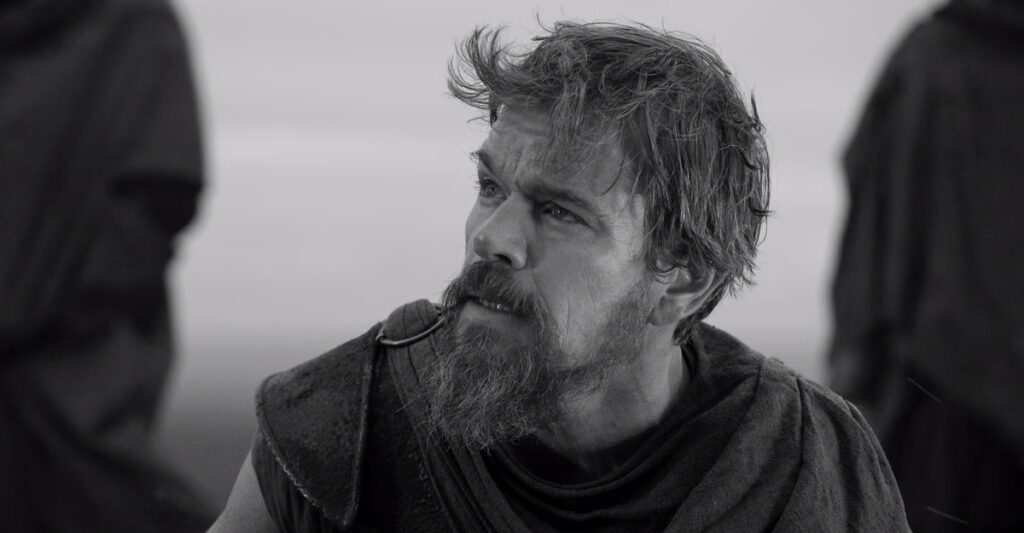
Toward the end of Homer’s Odyssey, Odysseus and Penelope finally see each other after 20 years apart. Odysseus, disguised as “an ancient old man” by the goddess Athena, tells Penelope that her husband will return to kill the suitors who have tormented her. “Not one will avoid his death and destruction,” he says. This is Homer’s protagonist: wily, aided by a god, and eager for revenge—reflective of a culture that prized honor, strength, and fealty to a set of interventionist deities.
This is not, however, Christopher Nolan’s protagonist. At key moments in the recent blockbuster adaptation of the ancient-Greek poem, Odysseus’s story seems more biblical than Homeric.
[Read: The Fear of Missing]The Odyssey
In the film, when Odysseus reunites with Penelope, he hasn’t been turned into an old man. Nolan keeps his identity secret through more naturalistic means: a dimly lit room, a cloak over his body, and latticed sliding doors that separate the two characters. The doors, which are not found in Homer’s poem, are evocative of the screen between priest and penitent in Catholic confession—a setting that Nolan, who was raised Catholic, would be familiar with. And although in Homer’s poem, Odysseus is thirsty for retribution, Nolan emphasizes a different emotion in this scene, one that is integral to the confessional and to Christian life as a whole: contrition.
Odysseus describes deep guilt over his central role in a famous episode of the Trojan War: when Greek soldiers hid inside a wooden horse to trick the people of Troy into letting them into their city. “We left them a gift,” he tells his wife, “an offering of peace, that they took into their home.” In sacking Troy, Odysseus says, he and his fellow soldiers “violated all that’s ever sacred between people”—he recognizes a link between mistreating humanity and disrespecting divinity. He confesses that he “lost his way,” not just temporally or physically but in his soul.
Other aspects of Nolan’s adaptation feel biblical, even Christian, rather than Homeric—a quasi-baptism scene at sea, for example, and the conspicuous absence of the references to sex that populate the poem. The core principle of the film’s moral universe seems to echo the Bible. “Treat others as you would be treated,” Penelope declares early in the film, expressing an ethic that various characters refer to as “Zeus’s law.” Many versions of the idea exist, in secular and religious forms. But in the film, Penelope’s words sound more like Jesus’s Golden Rule than anything in Homer, where the heroes—though bound to host strangers as if they might be gods in disguise—seek to achieve glory more than convey empathy.
[Read: Reading a 3,000-year-old poem to a 3-year-old boy]
The film’s treatment of Odysseus’s lies, too, seems consonant with the Ten Commandments instead of Homer’s moral worldview. In the poem, Odysseus’s lies are often portrayed positively, as evidence of his intelligence and resourcefulness—when he tricks the Cyclops, for example. In the film, however, Odysseus’s falsehoods have dire consequences, an apparent reflection of the biblical assertion that false witness is a sin. Odysseus tasks a young soldier named Sinon—a character who does not appear in the poem—with offering the horse to the Trojans. But he doesn’t tell Sinon that its purpose is to attack the city. Sinon dies as a result of Odysseus’s deception. Later, in Hades, he admonishes his commander: “Did you have to lie to me?”
So did Christopher Nolan make a Christian film, which the Daily Wire founder Ben Shapiro and others have suggested since the movie’s release? Not quite. As my colleague Gal Beckerman wrote, Nolan diminishes the role of the gods, treating them as socially useful but not necessarily real. It’s hard to call definitively “Christian” a movie that regards the divine as a possible fantasy. The film is God-haunted, though. Homer may have viewed Odysseus’s deceit and pillaging as glorious. Nolan’s adaptation seems to pass a different judgment. Animated in part by the wisdom of the Bible, this modern Odyssey can’t help but see how the deceptions of war degrade a person and a culture.