
Christopher Nolan on the intimacy of ‘The Odyssey’: ‘I’ve been telling this story in all my films for years’

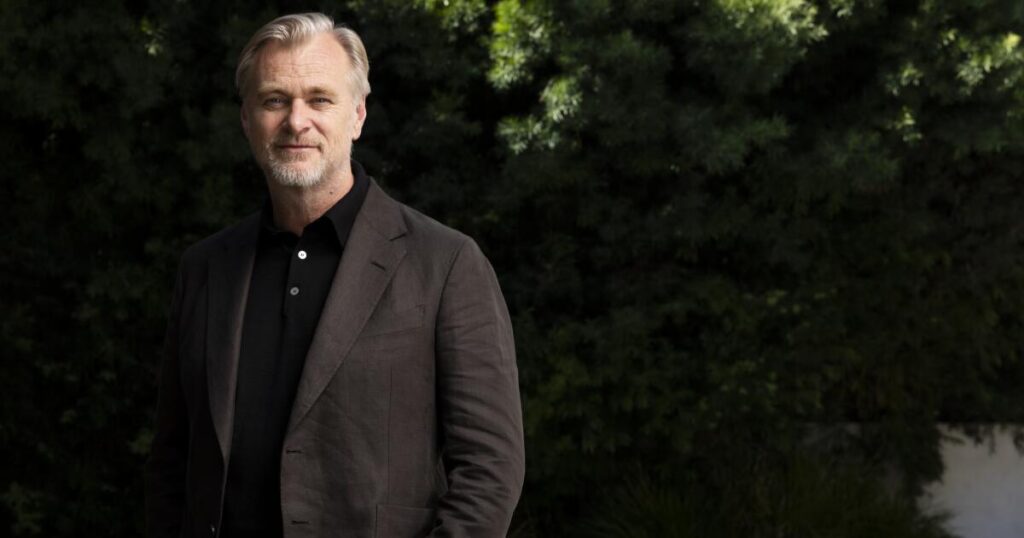
Best known as the dream factory, Hollywood also echoes a certain chocolate factory that offers all-access golden tickets to fortunate boys and girls. Filmmakers who’ve had unforeseen success don’t get chocolate — they get a golden ticket to direct a passion project the next time around. Just ask Christopher Nolan.
“One hundred percent,” Nolan says when asked if he’s experienced the phenomenon. “Every now and again, if you’re really lucky and something really clicks, if your work catches a wave, that happens. After ‘The Dark Knight’ we were able to do ‘Inception’ and after ‘Oppenheimer’ was such a success, far beyond what we hoped for, we had the opportunity to do ‘The Odyssey.’ ”
An epic poem thousands of years old attributed to Homer, “The Odyssey” is not just any passion project. In taking on the story of Trojan War veteran Odysseus (Matt Damon) and his fraught 20-year journey to return to his besieged wife, Penelope (Anne Hathaway), and his son Telamachus (Tom Holland) and rescue them from voracious suitors like Antinous (Robert Pattinson), Nolan has challenged himself with one of the oldest, most archetypal stories known to man.
Yet until now there has not been a major film adaptation, which was part of the attraction.
“As a filmmaker, you are looking for a gap in the culture and this felt like an important one,” he says, sipping on a mug of the excellent Earl Grey tea (“I’ve run on it for 25 years”) that is his constant companion.
“That world felt like it hadn’t been addressed. Ray Harryhausen did it working on a shoestring, but the opportunity to take this on — on a big scale — was there, and it hadn’t been there before.”
When Nolan says big scale, he is not kidding. His effortlessly epic, formidably impressive “The Odyssey,” which opens Friday, clocks in at 2 hours, 53 minutes, which in the Imax film version Nolan prefers comes out to approximately 11 miles of celluloid. The budget has been estimated at $250 million and the film was shot over 91 days, nine days under schedule.
Yet when Nolan, who also wrote the screenplay (“Homer was the co-writer, a very good co-writer,” he jokes), talks about the film, his focus is not on the impressive size but on the intimacy he was seeking. “I wanted to tell it in a fresh and modern way, to make it as accessible for a modern audience as it was for Homer’s,” he says.
Sitting in a quiet, sun-lit conference room in the Hollywood offices of his Syncopy production company, making sure that his guest’s mug is always topped off, Nolan says his familiarity with the Odyssey story dates back to early childhood. “But coming to the text again now, you have a slightly different perspective. It reads differently as a middle-aged man. It’s more about love and loss, a middle-aged love story.”
More than that, Nolan realized, “I’ve been telling this story in all my films for years. It’s a family story, a love story, a revenge story, a war story, a coming-of-age story. It’s a very strong foundational text for me.”
Nolan got close to “The Odyssey” when he was almost chosen to direct 2004’s Brad Pitt-starring “Troy,” based on Homer’s earlier “The Iliad.” While imagining scenarios, he came up with an arresting image for the Trojan horse, “listing over in the sand” in a way that intentionally echoes the Statue of Liberty in “Planet of the Apes.”
“It stuck with me,” he says. “It’s a powerful image I really wanted to film” and when the time came to do “The Odyssey,” in it went.
Intent on finding “language that has emotional not intellectual meaning to people,” Nolan opted to use colloquial, contemporary dialogue when constructing his script rather than artificially elevated speech. “I was maybe being naïve, it might bite me on the ass, but I wanted an earthy narrative. To me it was a no-brainer.”
For similar reasons, “The Odyssey” is very much a star-laden production, including in smaller roles Jon Bernthal as Sparta’s King Menelaus, Lupita Nyong’o as Helen of Troy and Zendaya as the goddess Athena. “These are mythological figures, iconic in some ways,” he says. “I wanted to cast it big, get the finest bunch of actors,” because their familiar faces would help a modern audience feel at home in an ancient story.
Also a no-brainer for Nolan was his choice of Matt Damon, who’d had a key role in “Interstellar” and was hard-nosed master builder Gen. Leslie Groves in “Oppenheimer,” to play Odysseus. Though Nolan avoids writing with an actor in mind (“It’s limiting,” he says), once he started thinking about who could take it on, Damon came immediately to mind.
“I’d worked with Matt twice before and he has such a great connection to the audience, he draws them in,” Nolan explains. “For this very complex character, you need an actor who disappears into parts, who is very open to the audience. You want the audience to go with him through his mistakes — and he makes a lot of mistakes. Matt was everyman for ‘The Martian,’ a kind of superhero for the Jason Bourne films, and Odysseus is part everyman, part superhero.”
Another factor in Damon’s favor, his director explains, is “though he’s one of the most proficient and accomplished of actors, he has no movie-star baggage,” something especially important in a physically taxing production that was shot in six countries.
“We were going to really challenging locations, doing a lot of boat work, and he helped to lead that process. The rest of the cast, a cadre of guys who worked their asses off rowing, was looking to him and everyone saw what he was doing for the film. Without Matt, we would have been better off doing it on a sound stage.”
The other actor whose presence deeply impacted the production, Nolan reports, is Samantha Morton, mesmerizing as Circe, the goddess who changes Odysseus’ men into swine. “This was a massive film and she is someone who comes in and changes the dynamic,” he says. “In some weird way, the film lived or died over that character. She was the fulcrum.”
“I’ve always admired Samantha’s work, she brings so much depth of thinking about her role, there are no limitations on her performance,” he says. The director worked the film’s schedule around her availability and didn’t regret it.
“After one of her takes, the crew gave her a great round of applause,” he recalls. I was talking with Emma [Thomas, Nolan’s producing partner and wife] afterwards and she remembered that the last time that had happened was with Heath Ledger on ‘The Dark Knight.’ ”
Some stars like John Leguizamo as Odysseus’ loyal servant Eumaeus are so unrecognizable in the film that when Nolan ran into the actor in New York during the editing process he didn’t know it was him “even though I’d been looking at his footage for days.”
Others, like Charlize Theron, are immediately familiar but do some of their best work. Theron plays the nymph Calypso, who keeps Odysseus enchanted on her island for seven years. The Calypso role is much expanded from the original story and Theron makes the most of it.
“I knew she would bring depth and credibility and she put her heart and soul into her performance,” Nolan says. “What she and Matt had on screen was very special.”
Though famous for his love of real-world filmmaking, for shooting on location and doing effects in camera, not in post-production, Nolan likes to point out that his films have won three visual effects Oscars.
“Though traditionally special effects deal with what’s done on the set and visual effects are what’s done afterwards, I have the heads of those departments work together throughout the shoot, even during the design process,” he says. “My responsibility is to shoot as much in the camera as I can, to give the audience a reason to believe.”
Sometimes, like Nolan’s first venture into creatures with the six-headed Scylla, it’s mostly a visual effects situation. “I was very inspired by Guillermo del Toro,” he says. “What I learned from him is that a monster is not a monster. You have to approach them the way you approach any other character.”
Another creature, Polyphemus, the enormous one-eyed Cyclops played by Bill Irwin, benefited from Nolan’s kind of synergy, starting with the famous Goya painting of Saturn eating his children. “That was very much the inspiration,” Nolan remembers. “We had it up on the wall. Whenever we brought in a new technology that was the first thing we showed them.”
To create a flesh-and-blood Cyclops on screen, Nolan and his team used “puppetry, animatronics, robotics, but Bill was on the movie for a month. In addition to being a great actor, he’s a mime, a clown, he knows how to use his physicality. He was the essence of it.”
The most purely physical effect in the film is the vessel Odysseus and his crew use in their ill-fated attempt to get home as soon as possible. An authentic Viking ship called the Draken that Nolan’s team found in Norway fit the bill exactly.
“We needed something wooden-hulled, built with ancient technology that could be out there in open ocean water, in giant swells, and the Draken has crossed the Atlantic,” Nolan explains. “We think of the Mediterranean as it is in summer holiday calm, but I’m here to tell you it’s not like that the rest of the year.”
Once the Draken set sail in the Mediterranean, the North Sea off Scotland, waters off Iceland and other locations Nolan reports, “we shot like it was a documentary. The actors learned how to sail and how to row and the boat’s 26-man crew were dressed as extras and incorporated into the movie. We were months on that boat, it became a character in the movie, we figured out things we’d never have known the answer to if we were on a sound stage.”
Adding another degree of difficulty to the water scenes — and everything else — was Nolan’s decision, working with frequent cinematographer Hoyte van Hoytema, to have “The Odyssey” be the first feature shot entirely on Imax. “I had done action before on Imax, but this was really about performance, about intimate scenes,” he says. “I was so struck on ‘Oppenheimer’ by what Imax could do for the human face, it seemed like it bore a hole into Cillian Murphy’s.”
“I’ve been wanting to do an Imax feature since I was 16 and went to the Omnimax Theatre at Chicago’s Museum of Science and Industry,” Nolan remembers. “As a kid, it really blew my mind. All I could think about as I watched those science documentaries was: What if you did a dramatic film that way?”
The difficulty, as Nolan discovered, was that the large 70mm Imax camera was so noisy that intimate dialogue scenes were impossible. But considering “The Odyssey” and knowing that new tools would be required, Nolan contacted David and Patricia Keighley, his go-to people at Imax, and asked for their help.
The resulting camera, named the Keighley, features a newly designed camera-encasing blimp that reduced the noise to what Nolan calls “a gentle purr.” Still a problem was the camera’s smaller-than-usual three-minute film magazine, which meant changing magazines in the middle of intense dramatic scenes, a situation Nolan had to plan for.
“We had to reload super fast and be super focused,” he explains. The director and his team came up with a system where, rather than take a break at each changeover, “everyone stayed in the moment,” silent and unmoving. When the system worked for an eight-page emotional scene between Odysseus and Penelope shot in Los Angeles before location work, Nolan was satisfied all would be OK.
Its high level of on-screen excitement notwithstanding, “The Odyssey” has more on its mind than derring-do. Nolan emphasizes that he felt “a responsibility to have the appropriate tone, to have a sense of consequences,” which is why the film emphasizes the ancient world’s concept of xenia, otherwise known as Zeus’ law.
“It is the golden rule, the idea that you treat people the way you want to be treated,” Nolan explains. “Partly it’s because a humble person may be a god in disguise, but it also allows society to function. People need to travel, to trade, and everyone is at the mercy of strangers.”
When xenia is violated, as it sometimes is in “The Odyssey,” “its abuse has terrible consequences. There is a price to be paid for vengeance and violence is the most straightforward expression of that.”
Finally, when all is said and done, Nolan emphasizes that “The Odyssey’s” universe “can seem alien, like another world, until it’s not. The modern world frighteningly reminds you that these things don’t change.”
As he talks about how his film has both stayed true to its ancient source and speaks to today, Nolan is simultaneously enthused and sure of himself in a selfless way. It’s easy to see why when this filmmaker gets a golden ticket, the astonishing is only a heartbeat away.