

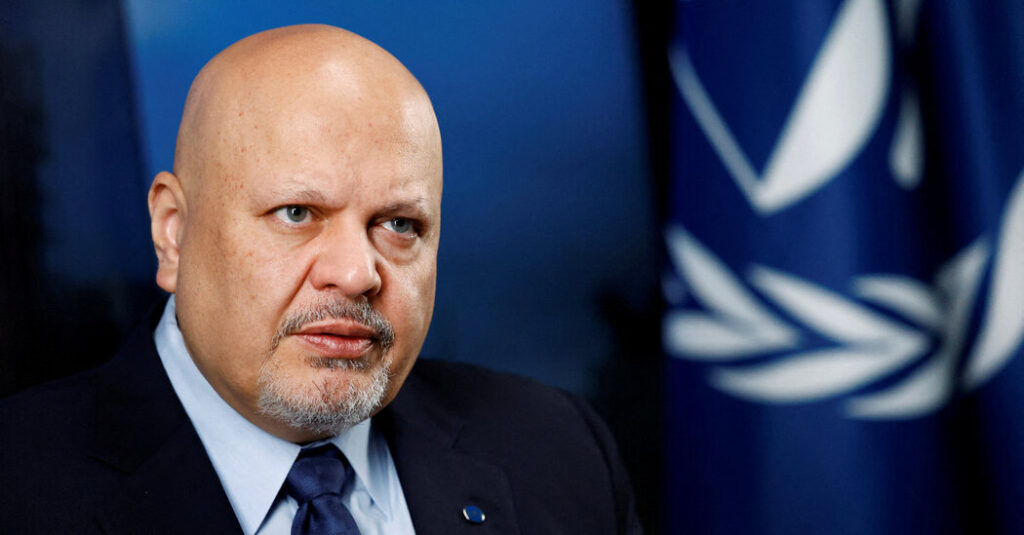
Karim A. A. Khan, the chief prosecutor of the International Criminal Court, has been removed from his position, the court’s oversight body announced on Friday, after a 20-month-long investigation into allegations that he sexually harassed a subordinate.
The decision came down to an assessment that Mr. Khan had committed “serious misconduct” and a breach of duty.
The I.C.C.’s Assembly of States Parties, the governing body that brings together its 125 member nations, made the decision during a session in New York on Friday. A substantial majority of its members, 82, voted to remove Mr. Khan, according to an official statement released Friday afternoon in New York.
The decision is one that victims’ rights groups and outside watchdogs have been pushing for, but will leave the criminal court searching for leadership at a difficult moment. The investigation into Mr. Khan left the institution without its most visible face for much of the past two years, damaging its credibility at the same time it has confronted attacks from the Trump administration.
Mr. Khan rocketed to global prominence after he issued an arrest warrant for President Vladimir V. Putin of Russia in 2023, and warrants for Hamas officials and Israeli leaders, including Prime Minister Benjamin Netanyahu, in 2024.
The United States, which is among the countries that have not signed onto the I.C.C., has objected to Mr. Khan’s charges against Israeli officials, and the Trump administration earlier this month announced plans to “dismantle” the court. The removal of Mr. Khan could leave the court in limbo at a moment when it is working on several high-profile cases. Arrest warrants for Israeli leaders remain active; a case against the former president of the Philippines, Rodrigo Duterte, has been proceeding; a Libyan militia commander was arrested earlier this year, and an application for an arrest warrant related to crimes against the Rohingya population in Myanmar has been under review.
Mr. Khan has consistently denied the allegations against him, and his lawyers have pushed back against the investigation as “procedurally unfair.”
Some external legal experts greeted the decision as a chance for the court to move on at a time when its very existence is under threat.
“The world in general has moved away from international institutions and solutions,” said Alex Whiting, a professor at Harvard Law School, who said that he thought that the process was ultimately fair, if messy, and that the chance to appoint a new chief prosecutor would give the institution a fresh start.
“I think the court will be able to move past this,” Mr. Whiting said.
But closure may be difficult. A new chief prosecutor will need to be elected. And just on Friday, Venezuela, its government newly under Trump administration direction, announced that it was withdrawing from the I.C.C.
“Damage has been done, an it will take a long time to repair and recover,” said Ezequiel Jimenez Martinez, the author of a recent book on International Criminal Court governance.
Accusations against Mr. Khan first surfaced internally in early 2024. Sarah, a lawyer from Malaysia who was then working as a special assistant to Mr. Khan, suggested to colleagues that she was being pressured to engage in sexual activities with Mr. Khan against her will, and they reported the situation internally.
Updated
Sarah declined to file a formal complaint so no formal investigation was started then. (Sarah has recently made her story public, speaking to news outlets on condition of using only her first name.)
But by that autumn, newspapers had begun to report on the existence of the complaint and its fallout.
After the allegations became public, the I.C.C.’s governing body announced an independent investigation.
A team from the United Nations was asked to look into the allegations. A panel of judges then reviewed the team’s findings. Mr. Khan went on voluntary leave from his position after the investigation began and was later suspended as it proceeded.
While the U.N. investigators said they found evidence that Mr. Khan engaged in “non-consensual sexual contact” with Sarah, the judges determined unanimously that it did not meet the “beyond a reasonable doubt” legal standard for a finding of misconduct.
Despite that, the I.C.C.’s executive body later concluded that Mr. Khan had sexually harassed Sarah, finding “beyond a reasonable doubt” that the prosecutor had engaged in a sexual relationship with her, and that “in the context of that power imbalance a sexual relationship could never be appropriate.”
In her talks with investigators through the years and in an interview last week with CNN, Sarah described how sexual attention from Mr. Khan escalated over time, starting after she began working for him as an assistant in 2023.
She said Mr. Khan used their proximity on work trips to pursue a sexual relationship with her.
The international court, officially established in 2002 and based in The Hague, has a mission to investigate and prosecute genocide, war crimes and other serious offenses.
Mr. Khan was elected by the I.C.C.’s participating countries in 2021 to serve a nine-year term, and the investigation into his conduct has left the court in a state of extended uncertainty. Some of his supporters have suggested that the case was an attempt to undermine him and the court, perhaps in response to his actions against Israel.
Josep Borrell, the former top diplomat at the European Union, wrote in a post on Project Syndicate last week that the situation was “sabotage dressed up in the language of good-faith inquiry and accountability.”
Mr. Borrell wrote that “the Trump administration and Netanyahu want the same thing: to ensure that no international court can touch soldiers, border agents, or its chosen allies, no matter how serious the allegations of war crimes and crimes against humanity.”
In a July interview with The New York Times, Sarah said that she was frustrated with claims that her allegations were in some way related to Mr. Khan’s decisions to seek warrants against high-profile leaders.
“Victims do not choose the political calendar of their abusers,” she said. “There is never a right time.”
One question now is whether outcome will enable the court’s opponents undermine it.
“The long-delayed removal of Karim Khan from the ICC for serious misconduct has exposed the moral bankruptcy of a corrupt Prosecutor,” Gideon Saar, the Israeli foreign minister, wrote on social media.
He argued that the warrants against Mr. Netanyahu and other Israeli leaders were filed to deflect from Mr. Khan’s sexual harassment complaints, and “should be revoked immediately.”