

The Centers for Disease Control and Prevention has linked four additional states to a multistate cyclosporiasis outbreak traced to shredded iceberg lettuce sourced from central Mexico, according to two individuals familiar with the investigation.
The newly linked states — Illinois, Kansas, Oklahoma and Pennsylvania — join Indiana, Kentucky, Michigan, Ohio and West Virginia, and expand the nation’s largest known cyclosporasis outbreak.
The addition of more states suggests investigators are beginning to connect thousands of illnesses scattered across the country, bringing them closer to reconstructing how a contaminated product or products moved through the food supply and whether additional restaurants, retailers or distributors received the same products.
The patients in the four additional states may have gotten sick around the same time as the patients in the first five. But investigators may have needed more time to determine which illnesses were part of the same outbreak, one of the individuals said.
The latest development means federal investigators have now traced shredded iceberg lettuce served at Taco Bell restaurants in nine states to a single supplier in Mexico. Taylor Farms de Mexicosays it has completed a voluntary recall of iceberg lettuce sourced and processed from central Mexico from the U.S. market.
Cyclospora infections have been reported in at least 41 states this year, but investigators are still working to determine how many are part of the nine-state outbreak linked to shredded iceberg lettuce supplied by Taylor Farms and served at Taco Bell restaurants and how many represent separate clusters or unrelated illnesses. The investigations include comparing patients’ food histories, laboratory findings and supply-chain records.
In North Carolina, for example, state health officials have identified illnesses that do not appear to be linked to shredded iceberg lettuce served at Taco Bell restaurants. Instead, officials this week pointed to preliminary evidence suggesting parsley and cilantro as possible sources there. Parsley and, especially, cilantro have been implicated in previous U.S. cyclospora outbreaks.
“Those items do pop up frequently and that is not necessarily to say that’s proof that that’s the cause, but it’s one of those situations where if something keeps showing up repeatedly — a certain type of herb like parsley or cilantro or a certain type of vegetable like lettuce — we can we start to think that that’s probably implicated or that may be implicated and that’s when we start collecting information on where was it purchased and that we can share with our partners … for a possible traceback,” Carl Williams, with the North Carolina state health department, said at a news conference earlier this week.
North Carolina data updated Tuesday show 561 cases have been reported since May 1, up from 307 a week earlier, according to the North Carolina Division of Public Health.
The Food and Drug Administration disclosed a new cyclospora outbreak that has sickened at least 72 people, according to an updateposted to its website Wednesday. The FDA did not identify the location of the illnesses or the suspected food source.
Parsley and cilantro have not emerged as national signals in the broader federal investigation, underscoring how investigators are still sorting through multiple clusters of illnesses that may have different sources, the individual said.
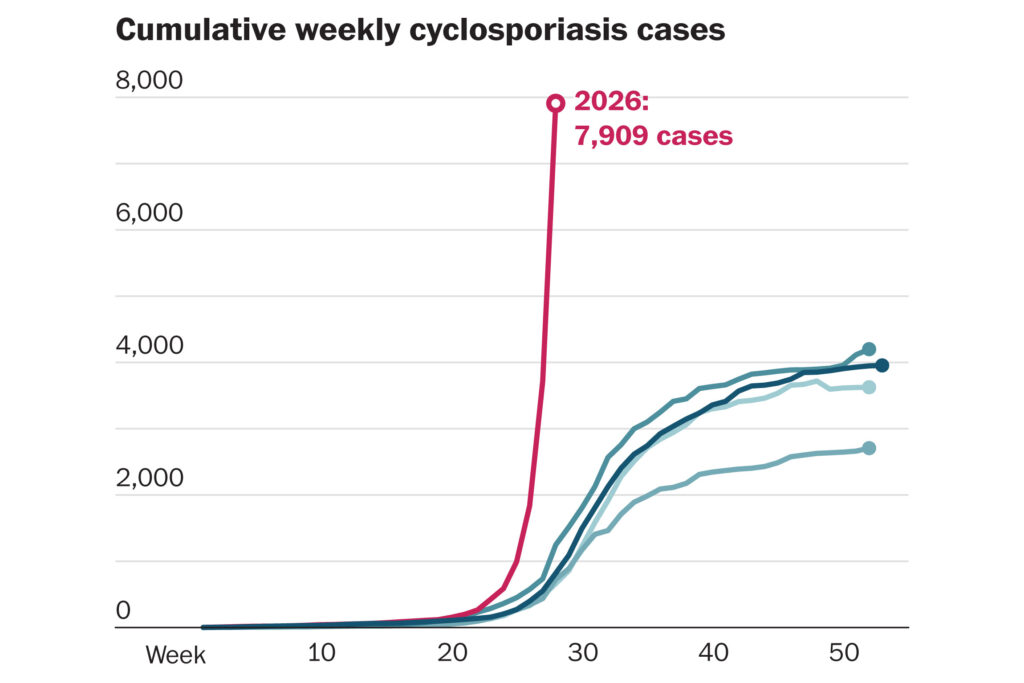
Earlier this week the CDC more than doubledits national confirmed case count, adding more than 4,000 confirmed illnesses and acknowledging more than 7,400 additional reported illnesses still under review.
Even before Friday’s update, the confirmed domestic cases had already exceeded the total number of cyclosporiasis cases reported nationwide during all of 2025.
The increase does not mean thousands of people became sick in recent days. Cyclosporiasis reports typically lag because symptoms can take up to two weeks to appear, and testing and investigations often take weeks more.
In previous cyclospora outbreaks, sometimes one batch of contaminated product is mixed with uncontaminated product that subsequently becomes contaminated, or a piece of equipment causes the contamination.
The microscopic parasite is spread through human fecal contamination.
Food safety experts say contamination can often occur before harvest, when fresh produce is exposed to contaminated irrigation water or other water used in growing or processing. Flooding can heighten the risk by disrupting sanitation systems and washing contaminated water into fields or produce-growing areas.