

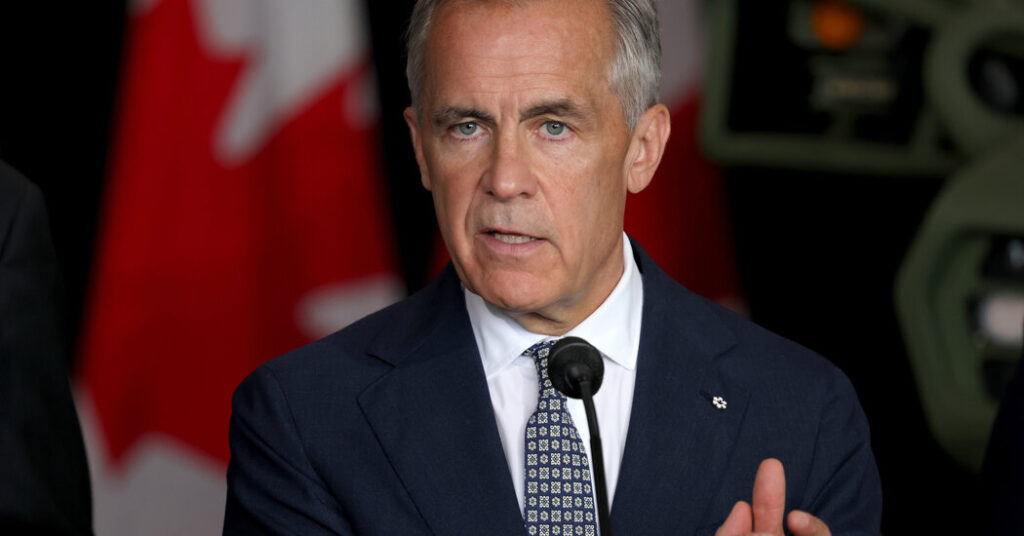
Prime Minister Mark Carney of Canada on Thursday noted the widespread disruption caused by wildfires in Ontario that have spewed smoke across parts of Canada and the United States.
“Thousands of Canadians’ lives have been upended, are being upended, by the wildfires across this country,” Mr. Carney told reporters during an appearance at an armored vehicle factory in London, Ontario.
But the division of powers in Canada means that Mr. Carney is unable to oversee the response to the wildfires that are raging throughout remote, forested areas. Like all natural resources, forests fall mostly under the jurisdiction and care of Canada’s provinces, which collect royalties for commercial logging and are also responsible for fighting wildfires. The federal government deals only with fires in national parks and on military bases.
After noting that the Royal Canadian Air Force was providing search-and-rescue aircraft and that an intergovernmental firefighting agency had deployed helicopters acquired by the federal government, Mr. Carney suggested that his level of the government was in standby mode and was prepared to assist further.
“We’re in close communication with our provincial municipal counterparts and we’ll stand ready and we will be providing additional assistance as needed because Canadians always look after each other,” Mr. Carney said before moving on to the day’s business.
Ontario has formally asked the federal government for help in evacuating 15 remote communities under threat.
Four U.S. congressional members from Michigan on Wednesday wrote to Mr. Carney and accused Canada of not properly managing its forests to prevent fires. The letter stated that the U.S. officials would “look elsewhere, and act on our own” if Canada did not take additional measures, without offering further detail. Mr. Carney did not mention the letter, and it was not clear if he had received it.
While there have long been suggestions that the federal government should establish a national firefighting force, there is not a clear consensus among fire experts that it would be an improvement over the current system. Provinces borrow one another’s firefighters and equipment as needed. Alberta currently has 94 firefighters and support workers helping in Ontario. Last year, large numbers of Ontario firefighters were in Alberta.
Proponents of the decentralized system argue that it allows firefighters to hone their skills to match regional conditions. Many Alberta forest fires occur in mountains where water is scarce, while the part of Ontario now on fire is festooned with lakes and bogs and is largely flat.