

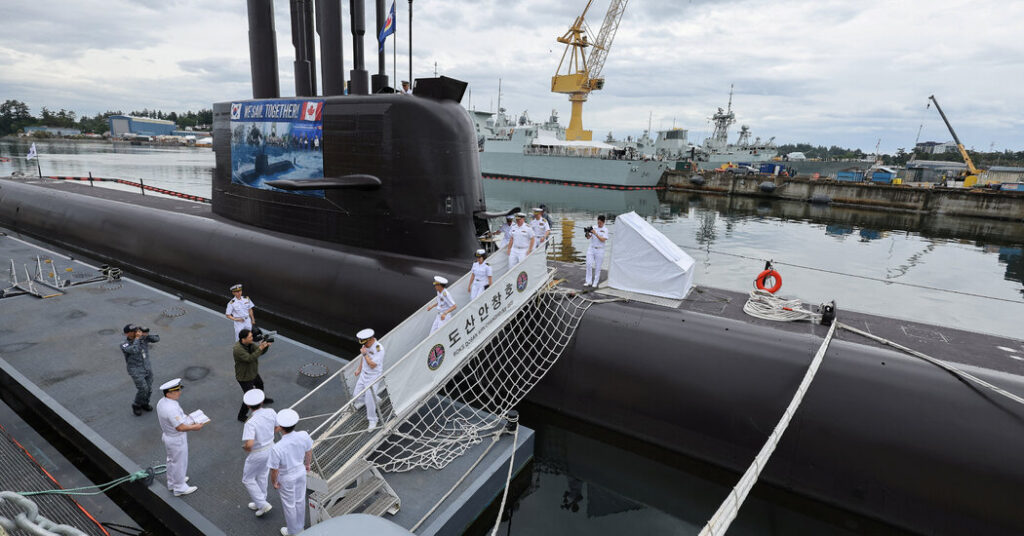
Canada said on Monday that it had chosen two European NATO allies to build a new fleet of submarines for its navy, a major step in Prime Minister Mark Carney’s campaign to reduce Canadian military and economic dependence on the United States.
After considering a South Korean bidder that actively and publicly campaigned for the contract, Canada instead selected a German-Norwegian joint venture to build a dozen diesel-electric submarines.
The deal, which would greatly expand Canada’s submarine fleet, reflects Mr. Carney’s effort to step up Canada’s defense spending and its military presence in its far north, which became more of a priority after President Trump begin musing about making Canada the 51st state and seizing neighboring Greenland. The prime minister has also vowed to reduce military reliance on American companies, which he says receive about 70 percent of Canada’s arms budget.
Who will build Canada’s submarines?
The winning proposal is led by ThyssenKrupp Marine Systems, headquartered in Kiel, Germany, in cooperation with the Norwegian and German governments, to build the Type 212CD submarines for Canada.
No submarines of that type are in service yet, but ThyssenKrupp has contracted to build several for the navies of Germany and Norway, and it has built other submarine models for Turkey, Singapore and Israel.
The other competitor for the contract, Hanwha Ocean, has built submarines for South Korea and Indonesia.
Diesel-electric submarines run diesel engines while surfaced to charge their electric batteries, which power the boat when it is underwater. The only military submarines made in the United States are nuclear-powered, not diesel-electric.
In 2021, Australia abandoned a deal for French-built diesel-electric submarines, and instead bought nuclear-powered vessels from a joint American-British venture. Canada decided against following Australia’s example, for cost and logistical reasons.
Why did the German-Norwegian bid win?
Mr. Carney made the announcement immediately before flying off to a NATO leaders’ summit meeting in Turkey. Philippe Lagassé who studies Canada’s military procurement at Carleton University in Ottawa, said that Canada’s ties with Germany and Norway through the military alliance is not supposed to be a factor in the submarine selection, but added: “We’d be naïve not to think that they don’t play some part in it.”
With Mr. Trump frequently calling into question the U.S. commitment to NATO, leaders of other alliance nations have stressed the need to reinforce their own ties.
Assessments by the Canadian government and the Royal Canadian Navy found that both the ThyssenKrupp and Hanwha submarines were roughly suitable, with each having advantages and shortcomings relative to its competitor.
Hanwha launched a multimedia advertising campaign of the kind normally associated with a new car model or soft drink. Hockey viewers last season were unable to escape a Hanwha television commercial narrated in the distinctive voice of a former, longtime anchor of the CBC’s nightly newscast.
But ThyssenKrupp apparently persuaded Canada that it can deliver its submarine in timely fashion. When asked in May how soon Canada needs the submarines, Rear Admiral David Patchell, Canada’s commander of Maritime Forces Pacific, said “I need them yesterday.”
Canada has not had much of a submarine fleet. It bought its current complement of just four submarines secondhand from Britain in 1998, but only one is currently operational.
More than submarines
Under Mr. Carney, Canada has increased its focus on wringing benefits for its industries out of major arms deals with other countries. It even returned the two companies’ submarine bids with the thought of boosting their promises of benefits for Canada.
At one point, Mélanie Joly, Canada’s industry minister, suggested that Germany could help its chances of securing the contract by persuading Volkswagen to open an assembly plant in Canada. And she put similar pressure on South Korea.
Volkswagen, which is considering closing more factories in Germany and large-scale layoffs, balked. Hanwha has a tentative deal with the Canadian auto parts makers’ trade group to make land-based military vehicles in Canada.
Both ThyssenKrupp and Hanwha have made dizzying arrays of nonbinding promises about multimillion-dollar investments and job creation. Experts will be closely scrutinizing the terms of the deal to see how Canada will hold the winning bidder to its commitments.
Bound for the north
The submarine contract fit with two parts of Mr. Carney’s agenda: to sharply raise Canada’s military budget and to assert its presence in the Arctic, an arena of growing competition among Russia, the United States and China.
He has already met his commitment to raise Canada’s military spending to the old NATO target for member nations of at least 2 percent of gross domestic product, and he has committed to NATO’s new 5 percent target by 2035.
The submarines are expected to be used largely to patrol Canada’s sparsely populated Arctic.
But Professor Lagassé said that many naval experts argue that only nuclear submarines are suitable for Arctic missions because they can remain submerged indefinitely, rather than having to resurface to charge their batteries.
Acquiring a nuclear fleet has its appeal, he added, but, “as the Australians are experiencing, the complexity of doing that is just astronomical.”