

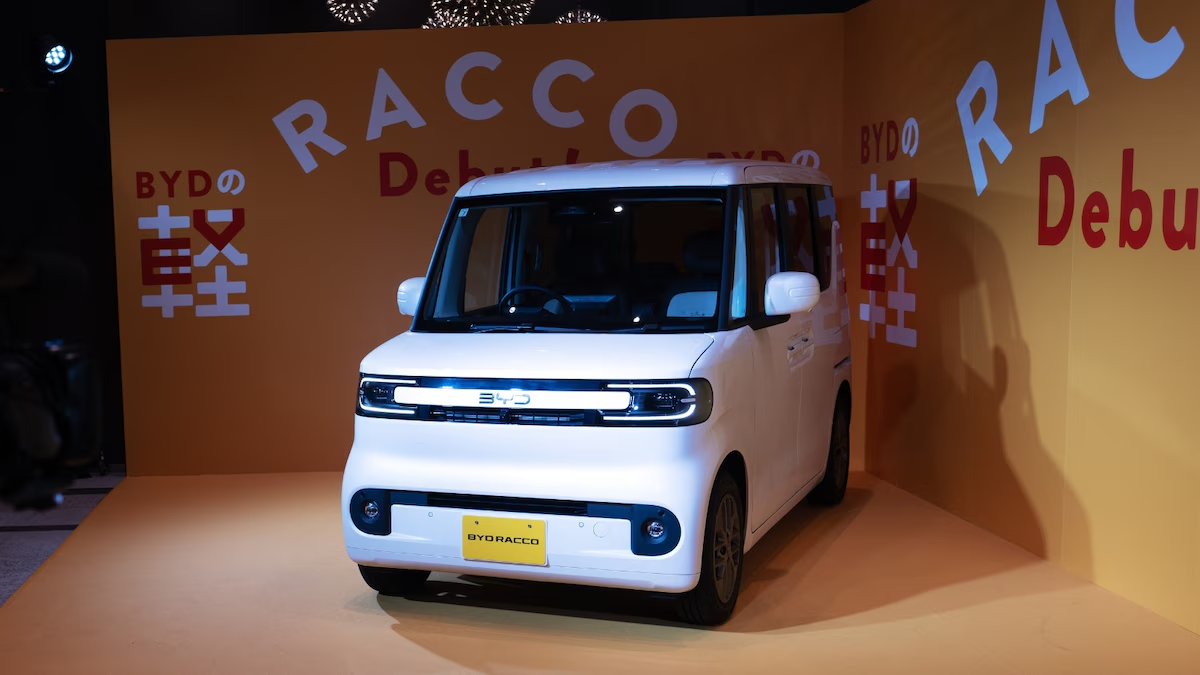
Including subsidies, the entry-level Racco will cost less than ¥2 million ($12,210) and offer a minimum range of 210 kilometres (130 miles), BYD Auto Japan Chief Executive Officer Atsuki Tofukuji said Tuesday. That puts it within striking range of Nissan Motor Co.’s Sakura — Japan’s best-selling EV.
Cheap and ultra-compact “kei,” or lightweight, cars account for nearly 40% of new vehicle sales in Japan. Most commonly offered as micro vans or trucks, they offer an affordability and versatility that’s tailored to the island nation’s narrow backstreets and rural byways. New gas-powered models sell for as little as ¥1.2 million.
Debuting a minicar puts BYD up against the country’s biggest automakers in their home market, which few foreign brands have successfully cracked. The introduction of a kei car shows BYD isn’t backing away from Japan, even after a lacklustre start since entering the country more than three years ago.
Toyota group companies Suzuki Motor Corp. and Daihatsu Motor Co., along with Honda Motor Co., collectively control about 80% of the minicar market, a key entry-level segment, according to Bloomberg Intelligence.
“Automakers are positioning minicars as a practical entry point, as shorter daily driving distances ease battery requirements and range concerns,” BI’s Tatsuo Yoshida and Marie-Christine Yoko Huss wrote last week in a report.
The pint-sized car have garnered a cult following among some enthusiasts in the US. They’ve even caught the fancy of US President Donald Trump, who last year lobbied for Asia’s “cute” pint-sized cars to be made and sold in the US, despite safety concerns about their suitability on American highways.
Electric cars have faced a cool reception from Japanese car buyers, so the Racco will face a challenge both as a foreign nameplate and as an all-electric vehicle.
Nissan’s Sakura, which claimed 22% of Japan’s overall EV sales in 2025, starts at about ¥2.44 million and has a maximum range of 180 kilometres when fully charged. Honda’s fully electric mini car — called the “N-One e:” — starts at around ¥2.7 million.
However, both are eligible for hefty subsidies that can dramatically lower the cost, depending on where it’s purchased. The subsidised price of a new Sakura when purchased in Tokyo, for example, can fall below ¥1 million.
BYD’s Racco has a base price of ¥2.15 million, with the premium model costing closer to ¥2.5 million. All variations will be eligible for ¥150,000 in EV subsidies, Tofukuji said.
Non-Japanese brands make up just a fraction of new car sales, despite the best efforts by major global brands such as Jeep-owner Stellantis NV and Hyundai Motor Co. European brands including BMW AG and Mercedes-Benz Group AG have had more success carving out a niche market for foreign luxury cars.
Still, BYD has steadily expanded its model lineup and built out a dealership network since it began passenger vehicle sales in Japan more than three years ago.
The automaker will have delivered 10,000 cars in Japan by the end of this month, BYD Japan President Liu Xueliang told reporters in Tokyo. The company has also established 77 sales locations across the country, including 56 official dealerships.
In January, the Chinese EV giant said it would add two hybrids to its Japanese lineup as it looks to boost sales. Those models — the Atto 2 and Seal 6 — would complete an eight-car lineup BYD had pledged to roll out in Japan.