

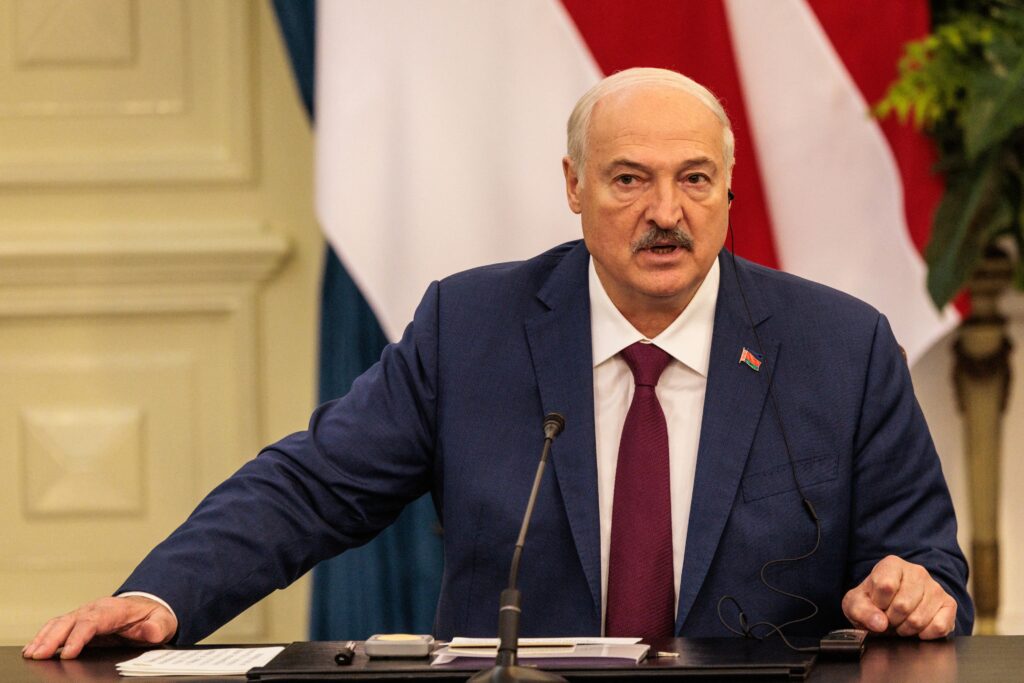
Belarusian President Alexander Lukashenko is under growing pressure from his warring neighbors, walking a tightrope between not angering his closest ally, Russian President Vladimir Putin, and not provoking Ukrainian President Volodymyr Zelensky who has threatened to strike Russian military and security assets in Belarus.
Lukashenko, a dictator who has ruled the small post-Soviet country with an iron fist since 1994, has been struggling to not let his country get dragged further into Russia’s war in Ukraine after allowing Putin to invade from Belarusian territory in 2022. But his balancing act has gotten increasingly difficult in recent days.
Last month, Lukashenko received an ultimatum from Zelensky to take offline four relay facilities in Belarus’s Brest and Gomel regions, near the Ukrainian border, which act as signal boosters for Russian drones and extend their operational range for strikes on Ukrainian cities.
By June 22, the stations had been turned off — first documented in complaints by pro-war Russian bloggers, then confirmed by Zelensky himself, though never publicly acknowledged by officials in Minsk.
A few days later, Lukashenko flew to Russia for a two-day closed meeting with Putin at his Valdai residence, where the Russian leader rarely receives foreign guests.
The meeting was unusually cloistered, without any media access or a statement afterward. Kremlin spokesman Dmitry Peskov later said it was “an informal interaction.”
Belarus depends heavily on Russia for economic and security assistance, but Lukashenko also engages in episodic attempts to court the West, seeking to limit the pain of sanctions and mindful of safeguarding his own political survival at home.
Ukraine and Belarus have navigated their relationship carefully since the start of Russia’s full-scale invasion, and have maintained diplomatic ties despite Russia’s use of Belarus as a staging ground.
In that context, Zelensky’s recent threats were unusually explicit and public. He set a seven-day deadline and said that if Lukashenko failed to meet it, Ukraine would take out the relay stations, a warning backed up by Kyiv’s growing success hitting targets inside of Russia.
Last week Lukashenko visited Beijing where Chinese leader Xi Jinping, appeared to lend support to the Belarusian’s tightrope act, saying that China that supports Belarus in safeguarding its national sovereignty, independence and territorial integrity.
Ukrainian officials have been warning since spring that Moscow is trying to pull Belarus further into its war effort as Russia’s own forces seem to be struggling on the battlefield.
As Russia and Belarus engaged in a joint nuclear exercise and tensions rose between Russia and NATO countries over drone incursions into European airspace, Zelensky said in May that he was prepared to take “preventive” measures to stop threats against northern Ukraine.
Analysts view the pressure on Belarus not as a prelude to activating Belarusian troops, which are a largely weak and unprepared force but as part of Putin’s search for ways to escalate and respond to Ukraine’s increasing successful effort to choke off occupied Crimea.
The Ukrainian peninsula, which Russia invaded and illegally annexed in 2014, has been used by Moscow as a crucial logistics hub for the war.
The rising pressure on Putin, including fuel shortages at home because of Ukrainian strikes on oil refineries, has led to speculation that the Russian leader may take some kind of drastic action.
“In a critical situation, I wouldn’t bet on the hackneyed ‘three trump cards’ — nuclear weapons, full mobilization, or invasion [of the Baltic states] — but rather, for instance, on precision strikes against targets in Europe linked to the Ukrainian defense industry,” said Vladimir Pastukhov, a Russian political scientist and honorary senior research fellow at University College London.
A European official, speaking on the condition of anonymity to discuss sensitive security matters, said Russia could make use of Belarus in two ways. One would be to attack Ukrainian logistics routes from Belarusian territory, which is closer to Ukraine’s European neighbors.
The second would be an escalation around Suwałki, a city in northeast Poland tucked between Russia’s Kaliningrad exclave and Belarus. The Suwałki gap is the only land corridor connecting the three Baltic states — Estonia, Latvia and Lithuania — to the rest of Europe.
“It’s quite difficult to win this war without disrupting supplies from the West to Ukraine,” the European official said. “From Belarus, they could attack logistics the same way they do in Donbas — create a complete kill zone within 40-50 kilometers of the border and hit it with cheap, mass-produced drones and artillery.”
In this round, Zelensky appears to have won. The relay stations have been shut down, and Lukashenko issued a sorry-not sorry apology for crude language he had used to describe the Ukrainian president.
“Perhaps I shouldn’t have said that, given that he is after all at war. Perhaps I shouldn’t have spoken so bluntly about it. But, on the other hand, he must understand that, as we often say: ‘You reap what you sow,’” Lukashenko said, adding that his earlier statements were a response to what he described as threats from Kyiv.
At the same time, he said Zelensky should be more careful and avoid “provoking” Belarus.
“No military action should be expected from Belarus, and especially from me,” Lukashenko said, calling Zelensky, a former actor and comedian, “young and inexperienced” and “not a military man.”
On Monday, Lukashenko insisted that his army will not take part in Russia’s invasion of Ukraine, in what seemed a bid to ease fears in Kyiv that Moscow is pushing Minsk to enter the war.
Addressing an audience of officers and military graduates, Lukashenko said: “I stress once again, dear comrades, that nobody is going to send you into this bloodbath. We don’t need war. It’s bad that war is going on in Ukraine. We are supporters of solving matters peacefully.”
China’s influence is significant. Despite Beijing’s publicly neutral stance on the war in Ukraine, it has provided a political and financial lifeline for Russia and wields influence over Moscow and Minsk.
For China, the stability of the Belarusian regime is of economic importance. While most Chinese goods reach Europe by sea, some 3 percent to 5 percent travel through Belarus, making it a key gateway for Beijing’s overland logistics.
“Beyond the regime’s political loyalty to Beijing, China has a vested interest in the uninterrupted transit of its goods through Belarus,” said Artem Shraybman, an expert on Belarusian politics and a Carnegie Russia-Eurasia fellow.
“But I would not overstate the capacity of China acting as a barrier or shield for Belarusian sovereignty in a crisis and this is an important caveat,” Shraybman added. “I currently see no pressing need for China to try to save Lukashenko from Putin.”
Belarus’s renewed engagement with Washington is another factor constraining Lukashenko from being drawn into Russia’s war.
As part of a deal Washington helped broker in March, after repeated visits by John Cole, the U.S. special envoy to Belarus, Lukashenko ordered the release of 250 political prisoners, handing an easy victory to President Donald Trump in exchange for the United States lifting sanctions on two Belarusian state banks, the country’s Finance Ministry, and the top Belarusian potash producers.
Trump has cultivated a much deeper relationship with Lukashenko than the Biden administration did, easing the international isolation he had faced.
“Lukashenko understands that if Belarus were to be fully drawn into the war, it would complicate dialogue with the West — and with the U.S. in particular — on issues such as the lifting of American sanctions,” Shraybman said. “This is another argument, though not the primary one, as there are plenty of internal ones at play, including concerns for his own life, his hold on power, and the state of the economy.”
The White House has also seen Lukashenko as a potentially useful intermediary with Putin should negotiations over ending the war pick up again.
Catherine Belton and Natalia Abbakumova contributed to this report.