


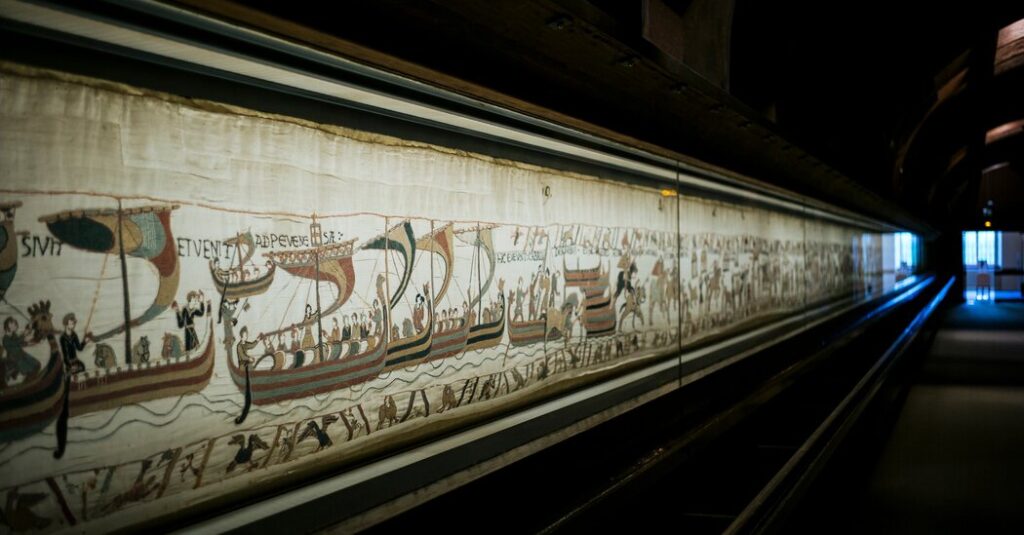
The Bayeux Tapestry arrived at the British Museum in London early Friday after a secretive nighttime operation involving multiple police forces — the first time the fragile embroidery has left France in several hundred years.
Regarded as one of the world’s great artworks, the artifact is over 220 feet long and depicts events surrounding William the Conqueror’s invasion of Britain in 1066.
French art experts have previously said the tapestry was too fragile to travel abroad. Yet on Thursday evening, a truck carrying it in a climate-controlled and vibration-dampening crate left Bayeux in northern France at 6:15 p.m. accompanied by French security services, according to the country’s culture ministry. Then the tapestry traveled by train under the English Channel.
Once it arrived in Britain, the British police accompanied the truck throughout its journey to the British Museum, where it arrived at 2:50 a.m., according to the ministry.
The tapestry is scheduled to go on display at the British Museum from Sept. 10 through July 11, 2027, in an exhibition that is already proving exceptionally popular.
After tickets went on sale this month, the British Museum announced that it had generated over 2.5 million pounds, about $3.3 million, in first-day sales. At one point, about 80,000 people were waiting in an online queue to buy tickets to see the tapestry in the country where many historians believe it was made.
Nicholas Cullinan, the director of the British Museum, said in a news release that moving the tapestry had been a “monumental effort,” and that watching it arrive in the museum’s loading bay was “a moment I will never forget.”
British museums and officials have repeatedly asked to borrow the tapestry since the 1950s, but French officials have rebuffed those requests. Then, in 2018, President Emmanuel Macron of France announced during an Anglo-French political summit that a loan would occur.
In the eight years since, the prospect of that loan has waxed and waned, with some French art experts setting up a petition insisting it must never happen because of the tapestry’s fragility and the potential for damage from vibrations during transport. The tapestry has 24,204 stains, 9,646 holes and 30 tears, according to a 2020 report.
On Friday, Macron published an opinion piece in The Times of London about the tapestry. “This loan from France means much more than simply moving an artwork,” he wrote. “It is a gesture of trust, a tangible expression of a longstanding friendship and a sign of our shared desire to see France and the United Kingdom build their future together.”
The British Museum said in its news release on Friday that the tapestry would “undergo condition checks before being carefully installed within a custom showcase case ahead of the exhibition opening.”