

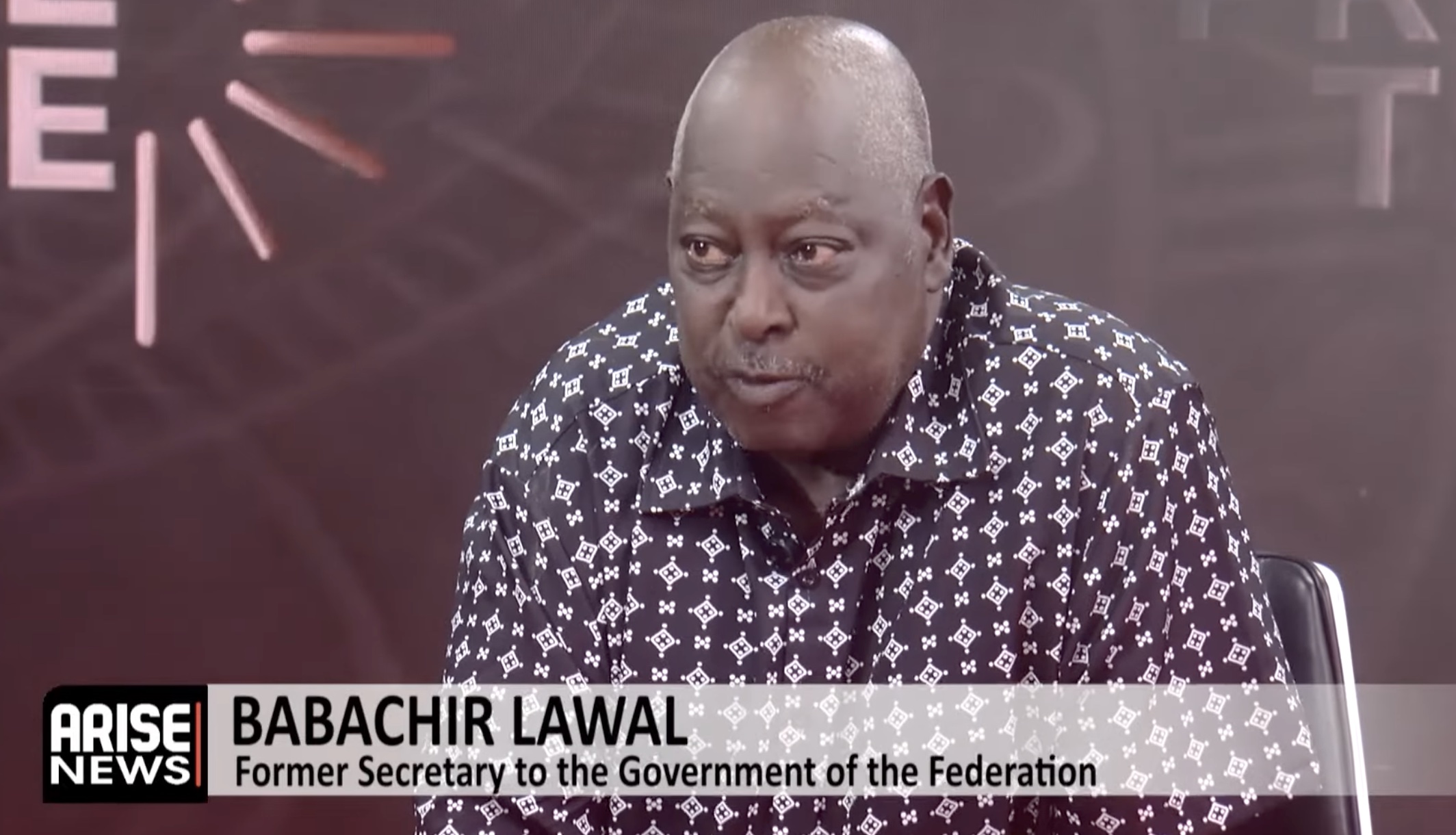
Former Secretary to the Government of the Federation, Babachir Lawal, has weighed in on the controversy surrounding the alleged existence of a fake federal agency, saying that if correspondence from such an agency is processed through the Office of the SGF, it amounts to a dereliction of duty.
Speaking in an interview with ARISE NEWS on Monday, he maintained that established verification procedures and due diligence within the SGF’s office should be sufficient to detect any agency that lacks legal recognition or official records.
“If an agency is received, processed, and forwarded without somebody asking in the SGF’s office exactly who these people are, it means there’s a dereliction of duty on the side of the SGF.
“The act setting up that agency will sometimes say the position has to be advertised, interviewed, and shortlisted names sent to the president for approval. Some, you just write and he just approves. So the SGF will go through the file, and in that process of due diligence, will be able to find out whether such an organization exists. If there is no record for it in the SGF’s office, he will raise a red flag on it,” he explained.
Lawal further stated that no legitimate federal agency can simply emerge without due process. He said new agencies are created through presidential approval, consideration by the Federal Executive Council, and, where necessary, legislation to provide a legal basis for their existence and funding.
“What we used to do is if there’s a new agency that either the president or a minister proposes to handle some specific assignments or duties, he will first of all raise a memo to the president, who will approve that such be created. And then a memo will be sent to the Federal Executive Council on that particular agency, and we’ll debate it.
“Now, sometimes it will require some legislation to give that agency a legal mandate to operate. Some will just be within the presidential approval, and then the agency is created. Because really, you cannot appropriate funds to an agency that has not been legislated for. There has to be a legal basis for its existence. But first of all, it is the executive that raises such an agency, makes the proposal, debates it, and the Attorney General of the Federation will normally put an opinion on it. Then, if the Federal Executive Council approves, it’s sent to the legislature for legal establishment,” he added.
Addressing a document showing the SGF’s office forwarding a request from the alleged Presidential Foreign Investment Promotion Council, Lawal said such correspondence should never have been processed if the agency lacked legal approval. He insisted that if an agency did not officially exist, the SGF’s office would have identified that before forwarding any request.
“It should not have arisen in the first place if it is not a legally approved agency. It should not exist. And the SGF would know that if it doesn’t exist on any basis, why is he forwarding a request? If it doesn’t exist, such will not happen in our time,” he insisted.
Arguing that while the President’s spokesperson may issue official statements on behalf of the administration, Lawal maintained that any correspondence from a federal agency passing through the Office of the SGF should first undergo due diligence to verify the agency’s legal status before it is forwarded.
“I’m sure the president would assume that such an entity has gone through all the checks and balances before it is established, and therefore, not every communication from that agency needs to be verified. But as far as it is coming through the office of the SGF, due diligence must be done first before it is forwarded.”
Lawal further claimed that the SGF had been sidelined in several government processes, describing the situation as an “institutional compromise” rather than a mere administrative failure. He questioned how an allegedly non-existent agency could have obtained a budget code and progressed through multiple layers of the budgeting process without being flagged by the relevant institutions.
“I don’t think so. I mean, it’s not thinking—this SGF has been sidelined in a lot of things from what we hear. He has been sidelined in a lot of things.
“It’s institutional compromise, because in this, I sense there’s quite a big racket going on somewhere along the line. If the agency was created by maybe one big man alone, and then he wants to go through the budget process, the budget office assigns the budget code according to the chart of accounts in GIFMIS. So, how did they manage to assign the budget code for this agency that does not exist? Who inserted it?
“Because first of all, the budget office issues a budget call circular to MDAs, and everybody starts to prepare his budget according to the budget line. They give you ceilings, and you prepare your budget and forward it to the budget office as an agency or ministry. Now, the Ministry of Budget and Planning would, in our time, call every MDA to come and defend its budget. Now, if you don’t exist, how did they recognize that you are a genuine entity? Who gave out the budget code and allowed their budget to pass?”, he questioned.
Emphasising the SGF’s oversight role, Lawal said the office bears primary responsibility for identifying and flagging any non-existent agency before it reaches the National Assembly.
“That’s what oversight is. The SGF should be able to know, because before it gets to the National Assembly, that budget goes through the SGF,” he said.
He added: “Unless there’s a dereliction of duty by the SGF’s office, the responsibility to flag that this is a fake agency would have come from them.”
Calling for a broader investigation, Lawal said the matter should be the subject of a judicial, rather than merely an administrative, inquiry.
‘I don’t think it should even be administrative alone; it should be a judicial inquiry,” he stated.
He questioned claims that an alleged ₦27.5 billion take-off grant was released to the agency before any budgetary allocation, asking who approved and disbursed the funds and through what official process.
“Nigerians are talking about how 1.3 billion Naira was inserted into the budget. The man himself first said the quarrel came about because he refused to part with 48% of the 27-point-something billion Naira take-off grant. That money has been spent before this budget office was looking for the budget. Who gave him the money? It was not appropriated for; it’s not in any budget, that 27.5 billion Naira for which he says somebody demanded 48%. Who gave him the money? How did the process of generating the request for the release come up? How did it go through?
“We are just talking about the tip of the iceberg here. Down there, before we got to here, 27.5 billion Naira had already been disbursed, according to him, as a take-off grant. How did that money get to him? It was not in the budget. So this is what should frighten us. If such money can go to a fictitious organization, we only now begin to see it when we are quarreling about how did it get into the budget. How did that money get to them?”, Lawal quizzed.
Rejecting the claim that the system ultimately worked, Lawal argued that the alleged fraud only came to light because of a dispute over the sharing of funds, not because existing safeguards detected it.
“I think we all know that thieves and armed robbers always fight and they expose themselves during sharing. His complaint was that the Presidency was after him because somebody demanded 48% of the take-off grant of 27.5 billion Naira. And so, somebody was not happy since he refused to part with that money. So you see, that’s how we got to know this to start with. That is the reason why we got to know this on his side of the coin. It’s about the sharing of the 27.5 billion Naira. That’s why the thing came up.
“So it didn’t work. It should have worked before that money left the government coffers into the account of the agency,” he maintained.
Speaking on calls for senior officials to step aside during the investigation, Lawal said such a move would reflect best practice, citing his own suspension while allegations against him were investigated.
“It depends on the will of the President. I can use myself as an example. When there was this brouhaha between me and the Senate, remember I was suspended for some time while an investigation was going on. So now, that is best practice.
On the role of the National Assembly, Lawal argued that the controversy also exposed weaknesses in legislative oversight. He claimed lawmakers failed to properly scrutinise budget proposals line by line, allowing questionable allocations to pass without sufficient examination.
“It’s already out of their hands. I believe now the thing is on the President’s desk.
“It is a legislative oversight. This government—this National Assembly—has no interest in scrutinizing the budget that comes before them. Most of the legislators just go in there to earn their salaries and collect allowances and go. They don’t scrutinize the budget line by line. We all know how this particular government works. There are some people that when they talk, nobody else has the authority to contravene,” he claimed.
Rejecting suggestions that the controversy was an isolated case, Lawal said allegations of appointments being bought had circulated for some time. However, he added that he was not aware of such practices during his tenure as SGF and said they were not part of his official responsibilities.
“It’s not a one-off thing. The issue of buying appointments is not new. People have been hearing it as rumors, as allegations, all over that. In this government, people buy appointments. We’ve heard it on the streets. And so this is not a new thing. I don’t know in our time. Nobody was buying appointments. No, it’s not to my knowledge. It’s not to my knowledge that people buy appointments. It probably could be, but I wouldn’t know that. It’s not part of our mandate to know such things,” Lawal said.
The former SGT argued that the controversy reflects broader weaknesses in the current administration, claiming that multiple power centres and weak institutional controls have undermined effective governance.
“This government doesn’t take governance seriously. When things like this happen, Nigerians are not surprised. We are only interested in this because we have an opportunity to poke attacks on the government, not because we don’t know that these things happen in this government. It’s so porous.
“There are so many power centers that, you know, nobody does a budget. Nobody implements a budget. Ministers go to the office and sit down and read newspapers. Overheads, maybe if they are lucky, it comes one per quarter, at least paid quarterly. Some governments don’t even get overheads. Everybody’s redundant. But there’s money being appropriated and money being spent, but nobody sees where the money is going to. So that is part of the loopholes,” he asserted.
He also questioned the handling of the alleged agency, suggesting attention should focus on how it was able to function and receive public funds despite questions over its legal status.
“Why are you interested in 27.5 billion Naira that had already been collected and spent? We are talking about an agency that we are claiming doesn’t exist. Maybe it exists, but it doesn’t have a legal framework for its existence. But it exists. And there are a lot of powerful people that make sure it exists in that form. Those are the people we need to expose. The Chief of Staff, in particular, is so powerful. The SGF is there, just reneging on his responsibilities. And nothing has happened now,” he lamented.
Favour Odima
Follow us on: