

LANTON, France — With his watering can and bucket, Jean-François Pauner meanders from one small fire to the next along a forest floor, dousing small flareups of wildfires that have swept through woodlands four times the size of Paris in southwestern France.
“This is the first fire I’m experiencing real-time, and I can tell you it’s vicious,” said Pauner, 64. “It’s underground, it comes out at any moment, and no matter how much we try to extinguish it, re-extinguish it, re-extinguish it, it keeps restarting.”
“It’s like a steamroller that’s constantly, constantly rolling,” said Pauner, wearing shorts, boots and sunglasses on a string around his neck on a road through cultivated pine trees, as the ground smoldered.
Pauner is among the untold numbers of volunteers who have mobilized to support firefighters battling the biggest wildfires in years in France.
“I’m protecting my forest, and my home,” he said, pouring his watering can into a smoking ditch as if watering a garden, then huffing in the heat.
Hundreds of thousands forced from their homes
The wildfires that tore through cultivated forests on an Atlantic coast also known for towering sand dunes and tourist resorts devastated about 162 square miles west of Bordeaux, driving nearly a quarter-million people out of their homes and vacation sites.
Europe is facing an extremely hot summer, fueling wildfires from the Atlantic coast to the eastern Mediterranean. The United Kingdom, Spain, Germany, Greece and Turkey battled blazes this week.
As cooler, more humid air moved into southwest France this week, authorities allowed two-thirds of the 224,000 evacuees to return home, including some more on Friday.
But the ground still simmers in many places.
“It’s stabilized, but not totally stopped,” French Interior Minister Laurent Nunez told RTL radio. “Hot spots remain.”
Volunteers like Pauner — what he calls “little eyes” on watch to report flare-ups to firefighters — do what they can with limited resources. Others have mobilized their trucks and giant jerrycans to supply water to fire crews.
Prolonged drought and climate change have created fire-prone conditions. Pauner said the region endured more than two months without significant rainfall, leaving vegetation exceptionally dry.
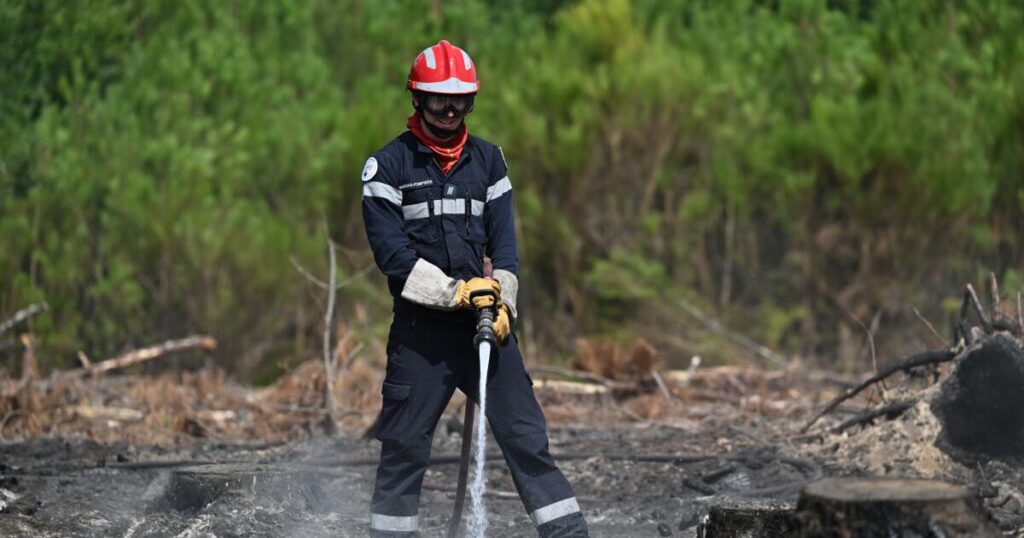
In the smoking forests, fire crews used rakes to dig down into the smoldering forest floor so buried embers can be doused with water, a long and painstaking job. Ukraine became the latest country to send help, dispatching 70 people and 10 vehicles in the coming days, Nunez said.
Investigators suspect that contractors clearing away vegetation inadvertently ignited the blaze last week. But other fires have been attributed to arsonists or criminal negligence.
Nunez said police have made 308 arrests in connection with blazes this summer — more than 120 of them involving minors — and that 33 people have either been convicted or are being held pending court rulings.
Elsewhere in Europe, fires are also burning
Blazes continued in other parts of Europe.
In England, where half the country is gripped by drought, firefighters battled a wildfire on an east coast heath in Suffolk, near a nuclear power station that fire services said wasn’t threatened. More than 100 firefighters were deployed.
“I wouldn’t say it is under control,” said Henry Griffin, a fire officer.
Many parts of Greece were listed at high or extreme risk of wildfires, with strong winds. Three Greek firefighters died fighting fires this week on the southern island of Crete. Gale-force winds were hampering aircraft from dumping water on the flames. Only one helicopter was able to scoop water from the sea to fight the blaze.
Carlson and Macpherson write for the Associated Press. Macpherson reported from Paris. AP writers Danica Kirka in London, Elena Becatoros in Athens, Greece, Jamey Keaten in Geneva and John Leicester contributed to this report.