

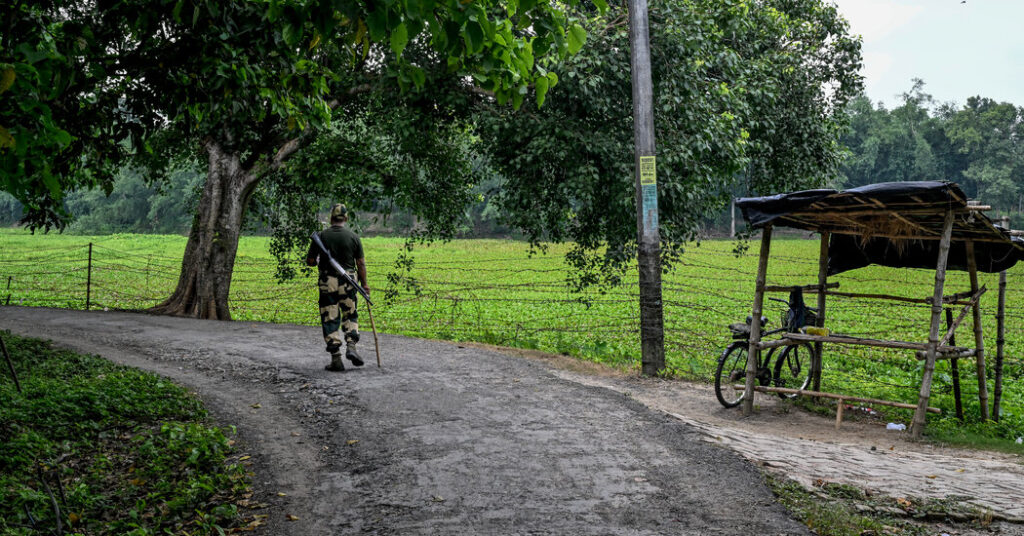
India and Bangladesh share one of the longest borders in the world, through which impoverished Bangladeshis often slip unnoticed in search of jobs and smugglers ferry goods as varied as cattle, gold and raisins.
But that sievelike, roughly 2,500-mile border has increasingly become a fault line between the traditionally friendly neighbors. India is rounding up those with Bangladeshi papers, or undocumented immigrants suspected of being from the country, and deporting them across the border, sometimes in the dead of night. Bangladesh, which says India is avoiding proper repatriation channels, has stepped up patrols to stop the influx and push people back across the border.
On a recent morning on the Bangladeshi side of the border, armed guards captured a man, three women and a child in the farming village of Durgapur. The group had apparently made their way from the Indian state of West Bengal on foot under cover of darkness, when fishermen spotted them around 4 a.m., village dwellers said.
For around 24 hours, the captives squatted in the so-called buffer zone between the two countries as Indian and Bangladeshi border guards met to determine their fate. Hundreds of people gathered to watch the action, including Motiar Rahman, 45, a village resident, who had rowed his boat across a narrow river to where the group was caught.
“Those people were standing at the bank of the river, which is inside Bangladesh,” Mr. Rahman said.
Bangladeshi guards accused their Indian counterparts of pushing the people — none of whom carried identifying documents — in their direction.
The individuals looked afraid, said Milon Patwary, a local journalist who witnessed the events and shared videos, explaining their predicament: “If they went in either direction, they could get shot.”
Eventually, the Bangladeshi border guards used their rifles, sticks and whistles to herd the group back toward the Indian side, he said.
Border Politics
Events like these have increased in frequency since Suvendu Adhikari, the new chief minister of West Bengal — where about half of the Bangladesh-India border lies — began fulfilling his election promise to find and eject undocumented immigrants.
Mr. Adhikari, a member of the Hindu nationalist Bharatiya Janata Party, has said that more than 10,000 people from Muslim-majority Bangladesh have been deported and more than 1,000 were in custody waiting to be sent back since he began the deportation drive in late May. Hundreds more have returned home voluntarily upon hearing of the crackdown, according to Indian security personnel.
But Bangladeshi officials have contested India’s claims. They say they have taken back only around 300 deportees through formal repatriation channels since January, and the Border Guard Bangladesh foiled attempts by Indian security forces to “push in” around 850 others in the past two months — a sharp increase since Mr. Adhikari came to power. Critics and opposition parties have accused Mr. Adhikari and other leaders of the B.J.P. — the political party of Prime Minister Narendra Modi of India — of using inflammatory rhetoric to whip up anti-Muslim sentiment to address what is partly a problem of economic opportunity.
In a June address to the West Bengal Legislative Assembly, Mr. Adhikari said, “The previous government treated Bangladeshis like our sons-in-law,” a reference to the pride of place the son-in-law has in Hindu culture. “They used to eat our rice, our medicine and wear our clothes.”
To get a fuller picture, we visited a few points on both sides of the border to talk to village residents, security forces and some Bangladeshi nationals being detained by Indian authorities. Border officials from both countries spoke to us on the condition of anonymity because they were not authorized to speak publicly.
The border between India and Bangladesh is a cartographic feat spanning marshes, hills, ponds topped with thatches of water hyacinth, and rivers that create and destroy sandbars at whim. The countries agreed in 1975 to leave 150 yards on each side of the border as a buffer zone, or what locals call “no man’s land,” where farmers could tend to their crops.
India has fenced all but a fifth of its side of border and built gates to let Indian farmers in and out. Where fencing is impossible, buoys and pillars mark the boundary. There are searchlights and security cameras. But all that, as well as 24-hour patrols on both sides, does not appear to have deterred migrants or smugglers.
The View From Bangladesh
In June, we headed to northern Bangladesh, following reports that earlier that month, Indian forces had pushed dozens of immigrants — including those with Bangladeshi documents, Indian identity cards or no papers on them — across the border, and Bangladeshi forces were refusing to take them in without a formal repatriation process.
Relations between the countries have been tense since 2024, when a student uprising in Bangladesh toppled the autocratic government of Sheikh Hasina, who fled to India. In the chaotic aftermath, Hindu minorities in Bangladesh were targeted, contributing to anti-Muslim sentiment in West Bengal that may have helped Mr. Adhikari win the election.
We talked to farmers like Mr. Rahman, who said he had witnessed numerous cases of people being pushed across the border in Durgapur, in Bangladesh’s Lalmonirhat border district. He took us to a point just over a mile from the border, where we could see a fence India had erected and CCTV cameras it had hoisted on a pole. Bangladeshi border guards on bicycles with rifles on their backs patrolled the area.
Officials from the Border Guard Bangladesh said they have encouraged residents to keep an eye out for intrusions.
Hamidul Islam, 50, who grows corn, rice and vegetables in Durgapur, said farmers tending to their crops worry about getting caught in crossfire during a border skirmish.
In another border village, a group of three children, two women and five men was pushed out of India last month and refused entry by Bangladesh. For three days, they remained stranded in the buffer zone, sitting outside through sun and rain not far from Bangladesh’s Panchagarh area, while officials discussed their fate.
The individuals were unable to prove their Bangladeshi or Indian identity, according to Belal Hossain, a member of Bangladesh Ansar, an auxiliary paramilitary force, who had spotted a couple of them heading toward Bangladesh. “The people said they were brought to the border with other people in three full buses,” Mr. Hossain said. Eventually, India’s Border Security Force took them back, he said.
The View From India
In India, we drove from Kolkata, the capital of West Bengal, to Hakimpur, one of the state’s biggest border checkpoints. Dozens of bicycles and motorbikes confiscated from smugglers were stacked against a wall by the checkpoint, waiting to be auctioned off.
Mr. Adhikari’s election slogan was “detect, delete, deport”: Detect undocumented migrants, delete them from voter rolls and deport them to Bangladesh. The approach follows decades of mostly unsuccessful efforts by successive Indian governments to police the porous border.
Enforcement is controversial and complicated. There are no reliable estimates of the number of Bangladeshis residing illegally in India, partly because it’s often hard to distinguish them from Indians. This is particularly difficult in West Bengal because many people there share a language and traditions with Bangladeshis.
Mr. Adhikari’s government has repurposed buildings near the border in West Bengal into temporary holding centers for deportees, but is expected to create permanent ones.
Pathasathi, a government guesthouse with powder-blue cement walls in Tentulia, about a half-hour’s drive from Hakimpur, has been turned into one such holding pen. Police officers monitored the facility, which was off limits to visitors. The 200-person-capacity guesthouse was nearly full, according to one officer. Some detainees sat by windows, waving as we walked by. Colorful garments hung from clotheslines. Outside the gate waited a garishly decorated private bus, onto which police officers were escorting a line of people to take them to an undisclosed location.
Alaknanda Bhowal, the superintendent of police in the district covering Tentulia, said that the deportation process was “ongoing” and several agencies were involved, including the district’s intelligence bureau.
At the nearby Charghat holding camp — a repurposed emergency center for flood victims with a maximum occupancy of 116 — there were 19 detainees, according to Sumanta Biswas, a police officer at the site. They were under constant police surveillance but the state government provided three simple meals a day — traditional breakfasts of sweet jaggery and flattened rice; lunches and dinners of rice, lentils and vegetables — and cots to sleep on. The camp had electricity and a toilet with running water, and provided basic health care.
Abdul Rahim Gazi, a 30-year-old bricklayer from Munshiganj village in Bangladesh, was among those being held in the camp. He said he had made his way to India around two years ago in search of better pay, which he secured, earning 400 rupees a day — 100 more than what he got in Bangladesh. Mr. Gazi said he had a Bangladeshi voter ID card.
“I am going back voluntarily,” he said, from behind the bars of a padlocked gate.