

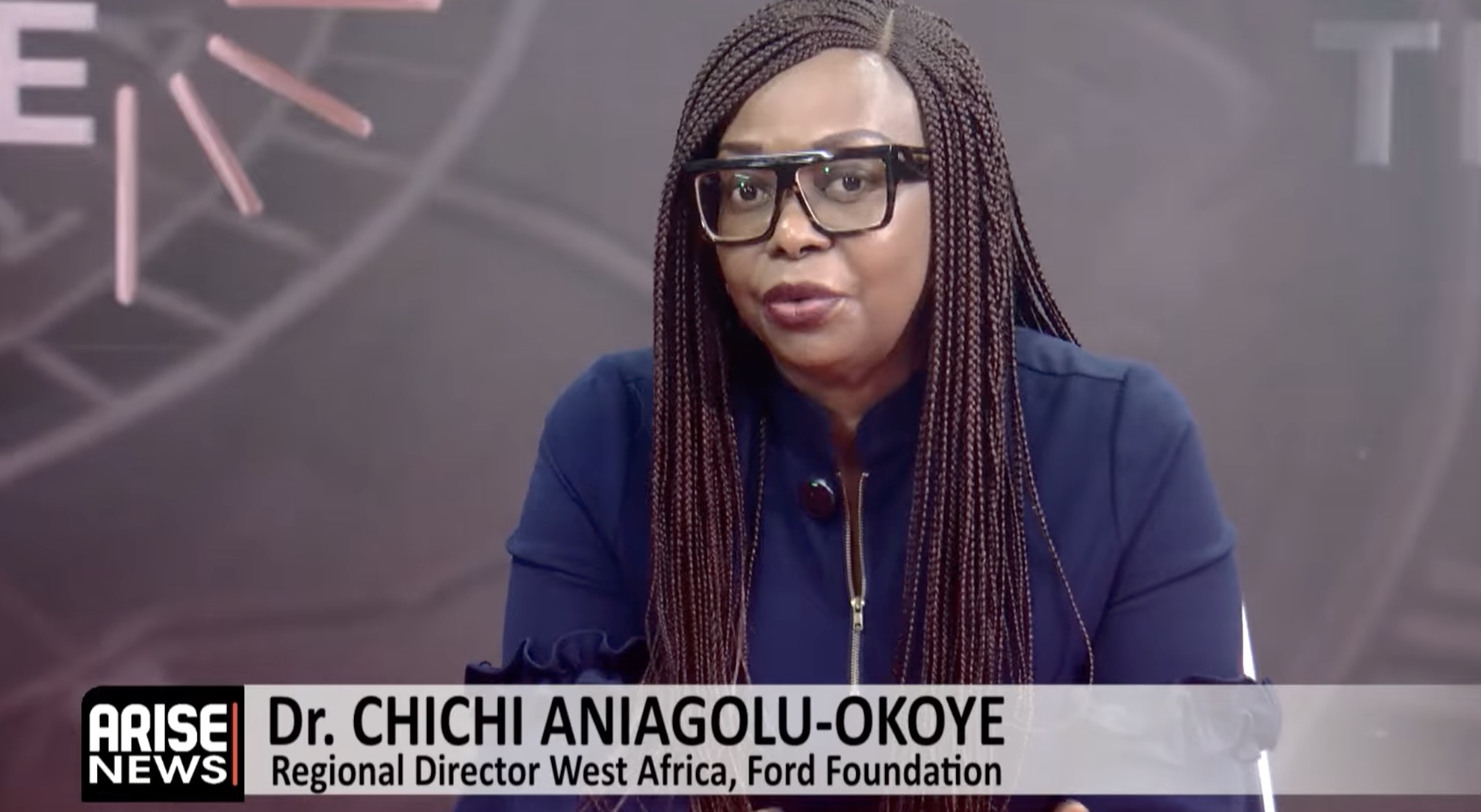
The Regional Director, West Africa, Ford Foundation, Dr Chichi Aniagolu-Okoye, has argued that what many Nigerians describe as tribalism has been weaponised by politicians to advance personal interests, shield corruption, and evade accountability.
Speaking in her personal capacity during an interview with ARISE NEWS on Friday, she maintained that ethnic sentiments are often exploited to secure loyalty rather than promote competent leadership or improve the welfare of citizens.
“This is not to say that I don’t recognize there is prejudice; there has always been prejudice against people. But what I’m talking about is the weaponization of tribalism for political gain, which is what we have done since independence.
“Politicians realized very quickly that this is something they can use to mobilize the people, even when it is not in the interest of the people,” she highlighted.
Expanding on her argument, Aniagolu-Okoye said politicians have long used ethnic identity as a scapegoat to conceal self-interest, arguing that truly tribal leaders would prioritise competence and development over personal loyalty. Instead, she said, many public officials appoint loyalists who serve their interests rather than the people.
“There’s no question that it has been the biggest scapegoat for politicians. If you look at it historically and in present times, 99% of the time, the politician has not served the people. Every state in Nigeria is ruled by somebody from that state. If they were really tribalists, we would be seeing healthy competition between the states. We would see state governments doing the best to make their states work. You would see a state governor going to the ends of the earth to find the best person.
“You will see someone who is incompetent, but that’s the person they want in the position. The reason they want that person is not because they are going to serve the community, but because they know that person will do their bidding. Even if that person comes from their ethnic group, ultimately, people end up being hoodwinked into those kinds of situations,” she explained.
She also blamed citizens’ complacency for enabling the trend, arguing that politicians have exploited ethnic sentiments since independence to mobilise support even when it runs contrary to the public interest.
According to her, the problem is not tribalism but “cronyism” and “sentimentalism,” warning that electing incompetent leaders on the basis of ethnic identity ultimately harms everyone, regardless of their background.
“There’s no question about that; we’re to blame. The reason it works is because we are complacent. It’s something that goes all the way back to the colonial period. People were made to organize more around tribe than around issues. Our politics from the very beginning has always been around tribe.
“It is cronyism, and it is sentimentalism. If you elect somebody who is incompetent into a position, regardless of what the ethnicity is, everyone is going to suffer because that incompetence is going to show. Many times we think that we are doing ourselves a favor by electing people who come from our own ethnic group. But if we look at it historically, none of our states have become El Dorado,” she said.
Arguing that many Nigerians have lost faith in meritocracy, Aniagolu-Okoye said politicians exploit ethnic divisions to distract from governance failures and evade accountability.
“First of all, if a politician got elected on the fact that he’s ‘one of our own’—even though objectively he was never one of their own—that sentiment puts him in place. When he is then accused, it’s a lot easier for him to turn around and say, ‘It’s not about me, it’s about the people.’ It’s a perfect strategy for the politician. He gets elected based on ethnic sentiments, and when he gets into trouble, he can mobilize.
“But what we have done in Nigeria is to use tribalism as a tool of manipulation and oppression of the people from our own ethnic groups. We use it when it’s convenient, whether it is an election or when somebody is being accused. But when it comes to actually providing services for the people, tribalism is totally forgotten,” she noted.
Challenging the media’s portrayal of governance failures, Aniagolu-Okoye urged journalists to stop framing every issue as tribalism, arguing that doing so masks cronyism and corruption. She added that ethnic identity should be used to drive development within communities, not deepen division.
“The media has been complacent in using tribalism to layer on so many other challenges that we face. It’s important that we start calling things what they are, because when you misdiagnose things, you end up not giving the right prognosis. We should look inwards and use tribalism as an internal mirror, not as an external mirror, to create the society that we want. Once every group is doing well, the nation will do well.”
Responding to concerns about marginalisation, Aniagolu-Okoye argued that Nigeria’s communities possess enough resources to drive their own development if they prioritise local capacity over political appointments.
“There is no part of this country that does not have the resources to develop. None. The argument I’m making is that if people focus more internally and not about appointments. If people stop worrying about what is being done to them and start looking at what we can do for ourselves—how do we ensure that we can maximize our resources, maximize our people, and create an enabling environment—that changes the game,” she said.
She added that changing the narrative from ethnic loyalty to competence would improve the quality of leadership and make it harder for politicians to exploit identity politics for personal gain.
“As soon as you see people beginning to see and think differently, it changes the equation. That’s what has happened in many countries that have started to develop. They have started seeing things not from a negative tribal lens, but from a positive lens of saying, ‘Who is going to be the best person for us?’
“Once that happens, the politicians can’t even throw up the worst of them. What is happening today is that it’s not the best of any ethnic group that is being thrown up; it’s the mediocre. It’s the ones who play these dirty games. People who have excellence don’t want to be associated with certain things.
“But once the narrative changes—once ethnic groups begin to say, ‘No, this guy does not represent us, he’s not going to do stuff for us’—that automatically starts changing the quality of the people that we throw up for elections and everything else”, she concluded.
Favour Odima
Follow us on: