

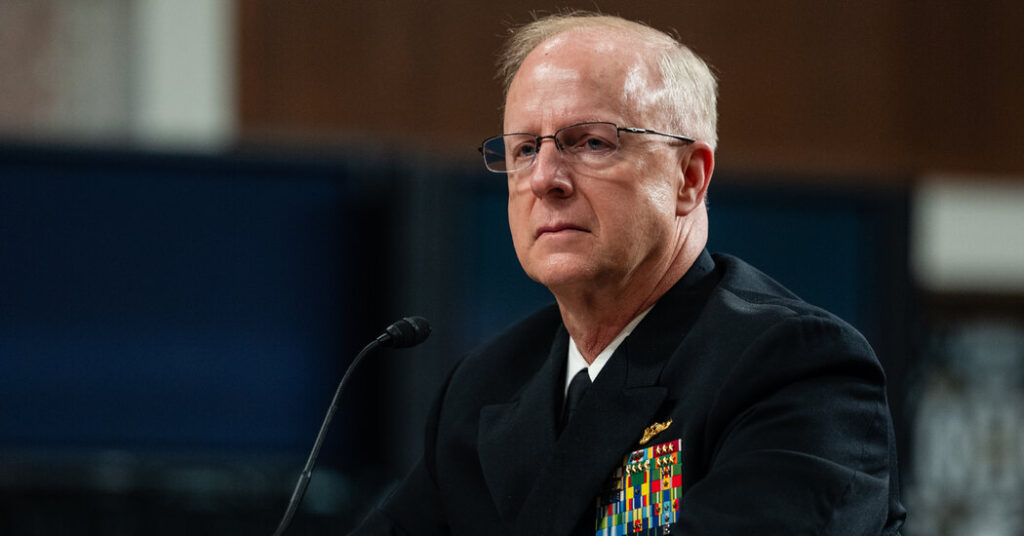
Adm. Daryl Caudle saw an opening to land the Navy’s top job last year, and he seized it.
Before Pete Hegseth had even been sworn in as defense secretary, Admiral Caudle, then the head of a major Navy training command, offered to help Mr. Hegseth prepare for his politically contentious Senate confirmation hearing, according to current and former defense officials.
The outreach was a breach of military ethics, the officials said. Senior military officers are supposed to avoid any hint of partisan bias or political activity.
Nothing came of the offer. But soon after Mr. Hegseth took office, he fired the first woman to lead the Navy: Admiral Caudle’s boss. Days later, a senior officer on Admiral Caudle’s staff contacted Mr. Hegseth’s team in another breach of protocol.
His pitch: Mr. Hegseth should choose Admiral Caudle to be the next chief of naval operations, the current and former officials said, speaking on the condition of anonymity to discuss sensitive personnel matters.
The officer described Admiral Caudle in terms that matched Mr. Hegseth’s view of the values that military officers should embody. There was “no one more in line” with Mr. Hegseth’s vision for remaking the military, he said, according to an official familiar with the exchange. The officer cast Admiral Caudle as a “warfighter” who was wanted to remove “woke barriers” that he claimed were weakening the force, the official said.
Even though Admiral Caudle was not on a list of candidates recommended by senior Navy officials, Mr. Hegseth chose him for the job.
But before the promotion could be finalized, the admiral needed to address another problem. There was an unresolved inspector general investigation into comments he had made to sailors about the Pentagon’s Sexual Assault Prevent and Response program, officials said. Some interpreted his remarks as blaming victims.
To help resolve the inquiry, Admiral Caudle hired Timothy Parlatore, a Navy Reservist and well-known lawyer who had represented Mr. Hegseth and President Trump. Mr. Parlatore had recently been tapped by Mr. Hegseth to serve as his “special adviser” in the Pentagon. Before Admiral Caudle was a client, Mr. Parlatore had recommended him to Mr. Hegseth as a strong candidate to lead the Navy, officials said.
The inspector general found the allegations of wrongdoing to be unsubstantiated, and Admiral Caudle took over as the 34th chief of naval operations last summer.
His path to that position is a case study in how the military promotion process at the Pentagon under Mr. Hegseth has deviated from tradition, leaving it susceptible in the view of critics to politicization and favoritism.
Since taking office nearly 18 months ago, Mr. Hegseth has fired or sidelined more than two dozen senior officers, including Admiral Lisa Franchetti, who held the top Navy job before Admiral Caudle. He has also removed from promotion lists about 40 senior officers who had been selected by boards made up of their peers.
Mr. Hegseth has insisted that his actions were necessary to root out those he has described as radical ideologues. “The left captured the military quickly, and we must reclaim it at a faster pace,” he wrote in his 2024 book, “The War on Warriors.” “We must wage a frontal assault, a swift counterattack, in broad daylight.”
Admiral Caudle’s promotion is a view into the flip side of Mr. Hegseth’s purge.
Before the defense secretary had even taken office, he had publicly singled out Admiral Franchetti as someone he believed had been promoted solely because of her gender. She knew that if Mr. Hegseth was confirmed, she would likely be fired.
In December 2024, Admiral Franchetti called together the Navy’s four-star admirals to discuss potential replacements, officials said.
She reminded them that their most important job in the coming weeks was to put the Navy’s integrity and its reputation as an apolitical institution ahead of their ambitions, according to people familiar with the meeting.
Admiral Caudle was in the room that day, and around the same time was also privately offering to help Mr. Hegseth prepare for his confirmation hearing, defense officials said.
Capt. Dave Hecht, a spokesman for Admiral Caudle, said in a statement to The New York Times that the admiral planned to limit his discussion with Mr. Hegseth to “factual, operational matters.”
He said that Admiral Caudle’s interactions with Mr. Hegseth always focused on military, not political, issues. “Adm. Caudle has consistently conducted himself in a professional, nonpartisan manner throughout his career,” Captain Hecht’s statement added.
A Pentagon directive counsels active-duty troops to avoid “partisan political activity.”
After Mr. Hegseth fired Admiral Franchetti, senior Navy officials, led by the service’s acting secretary, assembled a list of the three officers they believed were best qualified to fill her position. Admiral Caudle was not on it. Navy leaders thought he was better suited to lead the U.S. Strategic Command, which oversees the country’s nuclear arsenal, the officials said.
Mr. Hegseth reviewed the Navy’s list in a meeting with senior staff members.
“Where’s Caudle?” he asked, according to officials with knowledge of the meeting.
Mr. Hegseth’s chief of staff said he was not familiar with the admiral. Mr. Hegseth instructed him to discuss the matter with Mr. Parlatore, officials said.
Mr. Parlatore, who had left the Navy a decade earlier, had recently been commissioned by Mr. Hegseth as a Navy reservist and member of the Navy’s Judge Advocate General’s Corps.
As a civilian attorney, he had represented naval officers and sailors in a series of high-profile cases. His clients included Chief Petty Officer Edward Gallagher, a Navy SEAL who in 2019 was charged with killing a wounded prisoner in Iraq. Chief Gallagher was ultimately acquitted of nearly all the charges against him.
Mr. Parlatore also helped Mr. Hegseth negotiate a $50,000 settlement with a woman who had accused him of raping her in 2017. And he had represented Mr. Trump in matters related to the Jan. 6, 2021, riot at the Capitol and classified documents found at Mr. Trump’s Mar-a-Lago resort.
Mr. Parlatore had not met Admiral Caudle, but told Mr. Hegseth that he had heard good things about him, officials said. Other staff members recalled Admiral Caudle’s eager outreach during Mr. Hegseth’s confirmation process.
In late March, Mr. Hegseth selected Admiral Caudle to lead the Navy. In a statement, Sean Parnell, the chief Pentagon spokesman, said that Mr. Hegseth “interviewed many candidates for the position and ultimately found Admiral Caudle to be the right fit.”
“Every decision is based strictly on merit,” Mr. Parnell added.
Before Admiral Caudle’s nomination could be sent to the White House, the inspector general had to complete its investigation, which had languished for more than a year. Sailors recalled Admiral Caudle telling them in an informal conversation at an awards banquet that the Pentagon’s Sexual Assault Prevention and Response program needed to focus more on helping troops avoid risky behavior.
According to the sailors, Admiral Caudle offered examples: If he strode naked through the forest, coated in honey, he should not be surprised if he were attacked by a bear, officials said. If he wore gold chains and a fancy watch on a visit to Harlem, he risked getting robbed. At least one sailor believed Admiral Caudle was blaming assault victims for provoking their attacks.
The admiral declined to comment on his remarks.
In an interview with The New York Times, Mr. Parlatore described his work on behalf of Mr. Caudle as routine. He identified and suggested witnesses to the inspector general, and accompanied Admiral Caudle to his interview with investigators. “The same thing I have done for hundreds of others,” he said.
The inspector general’s job, like a prosecutor’s, is to collect evidence and offer findings. A decision to punish is made by the service member’s chain of command, which includes the Navy secretary and potentially Mr. Hegseth.
Admiral Caudle took command as the chief of naval operations last summer.
“I’m chomping at the bit to get after the work that lies ahead to ensure that our Navy remains and forever will be the most dominant, lethal and credible maritime fighting force the world has ever known,” he told a crowd of dignitaries that included several former chiefs of naval operations, including Admiral Franchetti.
He closed his speech with a pledge to lead the Navy with “integrity, honor and resolve.”
Since then, Mr. Parlatore’s dual role as a private lawyer and special adviser to Mr. Hegseth has sparked concern in Congress. In April, Representative Jason Crow, Democrat of Colorado, asked Mr. Hegseth if Mr. Parlatore represented officers being considered by Mr. Hegseth for promotions.
“I’m the one that makes decisions about choosing senior officers,” Mr. Hegseth said.
“Does he represent them, Mr. Secretary?” Mr. Crow pressed.
“He doesn’t represent anyone,” Mr. Hegseth replied. “He’s a legal adviser to me on reserve duty, and always has been.”
The next day, Mr. Parlatore sent Mr. Crow a letter.
“You asked whether I represent senior military officers under consideration for promotion,” Mr. Parlatore wrote. “I do not.”
He did not mention his earlier work for Admiral Caudle. At the time of the letter, Mr. Parlatore said, he was not representing clients being considered for promotions.
Mr. Parlatore said that there was nothing preventing him from working as a Navy reservist in Mr. Hegseth’s office and representing military clients. “The vast majority of military cases, if I wanted to do them, there would be no conflict of interest,” he said.
Mr. Parnell, the Pentagon spokesman, said that Mr. Parlatore was “in full compliance with all ethics laws and regulations.”
Still, to avoid any appearance of impropriety, Mr. Parlatore told The Times that in late 2024, he stopped taking new military clients and ceased charging earlier clients with active cases.
The sole exception, he said, was Admiral Caudle.