

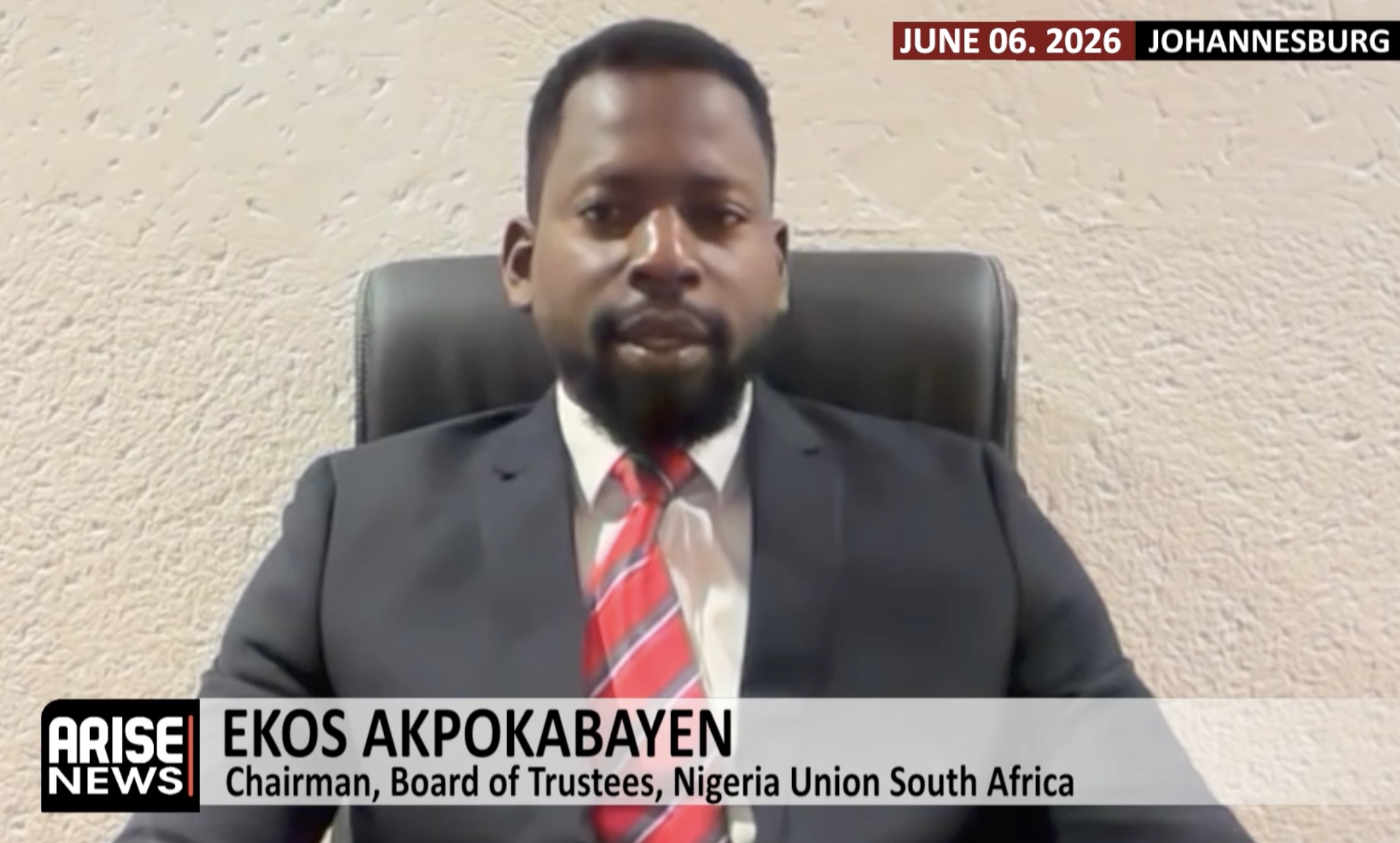
The Chairman, Board of Trustees, Nigerian Union, South Africa, Ekos Akpokabayen, has said that although tensions have eased following the June 30 anti-migrant protest deadline in South Africa, the security situation remains fragile as xenophobic attacks continue to spread to new areas, prompting more Nigerians to register for voluntary departure from the country.
“Yes, it was very tense leading up to the June 30th protest. It was very tense, but things have calmed down a little bit. Although some of the leaders of the march have insisted that they want to carry out these marches every Thursday. We’re not sure how true that is, but currently on the ground, there is still some tension. It’s not as bad as it was before June 30th, but it’s still early days.
“We still have a lot of Nigerians who are opting to leave, who were not part of the list of over 1,000 Nigerians that declared they wanted to leave South Africa. More Nigerians are coming up to put down their names that they are interested to leave, because we’re seeing pockets of xenophobic waves and attacks in areas where there were no incidents before,” he revealed.
Akpokabayen said Nigerians are often perceived as targets because they integrate easily into South African society, live across different communities and are known for their strong work ethic. He noted that while Nigerians see themselves as law-abiding visitors, some South Africans misinterpret their visibility and confidence as an attempt to dominate or take over, a perception he said is inaccurate.
“From our point of view, our culture—Nigerians are one of the nationalities that find it very easy to integrate.
“As Nigerians, we are very proud of being Nigerians, and because of our work ethic and our culture, we always stand out. In South Africa, this is not very welcome. Most times it’s being construed as trying to take over, trying to dominate, and trying to be someone who is not like a visitor, but owning the land.
“We don’t understand why this is, because Nigerians don’t want to take the land. We understand we are visitors, and we play by the rules. But you know, some South Africans feel that Nigerians are too comfortable and too loud in the way we conduct ourselves, but that’s not necessarily the case,” he insisted.
Speaking on the indiscriminate targeting of migrants, Akpokabayen said both documented and undocumented foreigners are being affected because protesters have no legal authority or means to determine anyone’s immigration status.
“We’ve seen a lot of documented immigrants being targeted because remember, the protesters do not have the equipment or the authority to know who is illegal or not. Every time we’ve seen them displaying and trying to force issues to say someone is illegal, they don’t have the authority. The government has consistently mentioned that,” he said.
He added that Nigerians continue to face intimidation, death threats and xenophobic attacks, including the burning of a Nigerian-owned car shop, warning that without decisive government intervention, the violence could spread further across different provinces.
“When you see South African citizens going into people’s houses or shops and intimidating them, the government has insisted in public—just even today they released a memo saying nobody should do that. But when Nigerian citizens or foreigners see these kinds of things, they have no choice but to be scared.
“We saw recently where threats were given that if some of the foreigners do not leave those areas, their properties will be burned. We received reports two days ago where a Nigerian car shop was burned. It was definitely a xenophobic attack.
“We’ve seen major incidents that we are reporting. There’s intimidation, there are threat messages, and death threats to Nigerians especially, and foreign migrants, to leave certain areas. This is pocketed across different provinces. We know that if there’s no hands-on intervention, it will continue to spread,” he warned.
Speaking on the welfare of displaced Nigerians, Akpokabayen said the growing number of people seeking refuge at the Nigerian High Commission has created a humanitarian crisis, with many stranded due to delayed flights and a lack of accommodation.
“It’s been very challenging because what we’ve seen over time is that the number of Nigerians coming into the High Commission to seek refuge has grown. They call us as leaders of the union. Especially the president has been up and down being called. A lot of citizens were stranded in front of the Nigerian High Commission because they didn’t have anywhere to stay or anywhere to go, and because the flights were delayed. This has caused a huge humanitarian crisis.”
He said the union has mobilised healthcare workers and food supplies to support affected Nigerians, while calling for stronger cooperation with government officials to ensure those wishing to return home voluntarily receive the assistance they need.
“We as the union had to organize and mobilize healthcare through the doctors’ forum, and then we had to mobilize food for them. We’ve been on hand making sure that we attend to the needs of Nigerians there,” he said.
“We want to use this opportunity to appeal, because at some point, it seemed as if the union was in clash with the officials in government, trying to create an uprising. But we’re trying to meet the needs of Nigerians. For example, the union president was harassed not to come to the High Commission, and certain Nigerian citizens were turned back going into the mission. So we are appealing. We don’t know where this information is coming from.
All we want to do is to help Nigerians. It’s a selfless sacrifice. We want to help Nigerians to go back home, especially those who voluntarily want to go back home. We need cooperation between the union and the government. It’s as simple as that,” he concluded.
Favour Odima
Follow us on: