

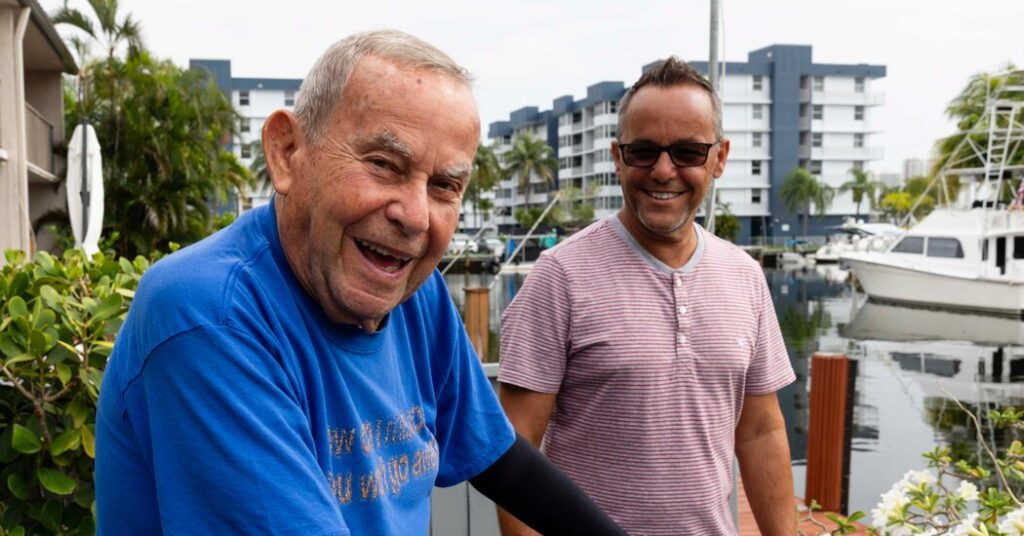
Dennys Gonzalez was skeptical when doctors told him his father could participate in a clinical trial exploring whether medical cannabis could treat agitation in people with advanced dementia.
But Mr. Gonzalez, who helps care for his 87-year-old father, Emilio, said not only were his fears unfounded, but the treatment — a combination of two common components of medical cannabis: THC and CBD — greatly eased his father’s distress and frustration.
Before the trial, Mr. Gonzalez said, “my dad would actually get aggressive if you would try to help him with something.”
But “while he was on this treatment, all that changed,” he said.
The preliminary results of the trial involving 120 patients with advanced dementia near the end of their lives, presented Tuesday at the Alzheimer’s Association International Conference in London, found that most of the patients receiving the THC/CBD treatment experienced similar benefits. After 12 weeks, agitation eased for nearly 90 percent of those participants, while less than a quarter of those who received a placebo exhibited less agitation.
Medical experts said the results suggest that a carefully formulated and administered cannabinoid treatment might help address agitation, a common and unsettling symptom of dementia. The study has not yet been peer reviewed or published.
“I was thrilled to see that because there’s a lot of suffering that’s happening,” said Elizabeth Edgerly, a licensed clinical psychologist and the Alzheimer’s Association’s vice president of care and support. She said while the findings require confirmation from larger trials, the results “look really promising that it could be something that could help people with advanced dementia.”
Agitation affects nearly half of people with advanced dementia who are nearing the end of their lives, experts say. It is often difficult to manage and upsetting for patients, family members and caregivers, and can include vocal outbursts, hostility, moaning, groaning, repetitive movements or phrases, throwing things, and hitting, scratching or pushing other people.
Currently, many such patients are treated with antipsychotics, anti-anxiety drugs or opioids, medications that often do not help and can cause risky side effects. Dr. Edgerly said some of those medications can induce confusion and sedation, and they can cause people to die sooner. “Anything that represents something that’s both effective and safer is a huge improvement over what the standard of care has been,” she said.
Some previous studies have suggested that cannabinoids might help agitation, but others have not, said Dr. Kevin Hill, the director of addiction psychiatry at Beth Israel Deaconess Medical Center in Boston. He was not involved in the new study and he noted that it used a formulation of the treatment that was developed for the clinical trial and hasn’t been submitted for Food and Drug Administration approval.
Dr. Hill was a co-author of one of several analyses that found little evidence that cannabinoids were effective for many of the other conditions for which they were being tried and that they carried risks of side effects, including cannabis use disorder.
Nonetheless, Dr. Hill said, he has prescribed dronabinol, an F.D.A.-approved THC cannabinoid, to patients with dementia and found it “very helpful in some of those cases.” He said the new study, which was primarily funded by the National Institute on Aging, part of the National Institutes of Health, seemed carefully conducted and had produced “a very robust finding.”
The main thing, he and others said, is that such medications should be prescribed and overseen by experienced health care providers.
“It’s exciting that this presents another option to treat agitation, but it doesn’t mean that people should be giving their parents medical marijuana because cannabinoids have their own risks,” Dr. Hill said. “Treatment of agitation should be overseen by a medical professional.”
Mr. Gonzalez, a real estate agent in Miami, said he had wondered if the treatment might have unwanted side effects. “When they tell you they’re going to put your dad on something that is based on marijuana, does that mean that my dad is going to be high all the time and he’s going to fall?” he said.
The researchers reassured him that would not happen because the compound included too low a dose of THC to produce a high. Mr. Gonzalez said that almost immediately after his father began receiving the treatment, “his behavior improved, his level of tolerance dealing with other people improved and he would allow you to help him better in tasks like putting on his shoes.”
The F.D.A. recently gave approval for Auvelity, a drug previously designated for major depression, to be used for agitation in Alzheimer’s, a decision the Alzheimer’s Association welcomed because it was the first non-antipsychotic medication approved for that purpose. Dr. Edgerly said the cannabinoid study involved a different patient population: Participants had various types of dementia, not just Alzheimer’s, and were either in hospice or medically eligible for hospice care. Experts praised the study for demonstrating that it was possible to conduct a randomized trial with such a frail population.
Hospice designations are typically for patients expected to die within six months, but Dr. Edgerly said the definition can be more elastic for dementia patients, given the unpredictability of their life expectancy.
The study’s lead researcher, Dr. Jacobo Mintzer, a professor in the department of health sciences at the Medical University of South Carolina, said it was named the LIBBY trial after a woman who suffered from agitation that did not respond well to drugs like Valium or morphine. He said he realized that with “this most common human experience, we need to have ways for people to die with calmness, dignity and grace.”
Researchers took steps to be sensitive to patients’ circumstances while maintaining scientific rigor, he said. Instead of requiring clinic visits, the participants, whose average age was 81, were treated wherever they lived: at home, where three-quarters of them resided, or in nursing homes or other institutions.
The participants, who were often in hospice for conditions other than dementia, could keep taking their other medications. The treatment was formulated as a digestible oil, so patients did not have to chew it. For those unable to swallow, drops were placed on the tongue or in patients’ feeding tubes, Dr. Mintzer said.
The study — a Phase 2 trial, which is smaller than the Phase 3 trials considered to provide the most convincing evidence — was conducted at 10 locations around the country. Just over half the 120 participants were women; 54 were Hispanic and 18 were Black.
Researchers commissioned a Canadian pharmaceutical cannabinoid company to develop the oil, which contained 2 milligrams of THC and 100 milligrams of CBD per milliliter. Half the participants received a placebo oil. The others received 1 milliliter twice daily for a week, then double that dose for 11 weeks. THC is a psychoactive; CBD is nonintoxicating.
“The difference between us and Joe that sells marijuana across the street is that we actually have a purified, biologically active compound, and we did a scientifically valid experiment with this compound at a certain dose at a certain frequency and for a specific indication,” Dr. Mintzer said.
After two weeks, those receiving the treatment scored significantly lower on a standard agitation scale than those receiving the placebo. Independent clinicians found that 84 percent of those receiving the treatment showed improvement, compared with 31 percent of the placebo group.
After 12 weeks, the difference in scores was even greater, and clinicians found improvement for 87 percent of the treatment group, compared with 24 percent of the placebo group.
There were no serious safety problems linked to the treatment, Dr. Mintzer said. He reported that 23 percent of the treatment group and 12 percent of the placebo group experienced “serious adverse events,” but said those events “were consistent with those expected in this patient population and included infections, worsening dementia symptoms and death.” Eight people in the treatment group and three in the placebo group passed away during the study, he said.
Ryan Vandrey, a professor in the psychiatry and behavioral sciences department at Johns Hopkins University School of Medicine, said the results support those of a smaller and shorter trial he and colleagues published recently, in which Alzheimer’s patients with agitation were given either a placebo or dronabinol, the THC treatment. He called the new study “a significant advancement” that should prompt more research geared to getting a cannabinoid therapy approved for agitation.
Dr. Vandrey said THC tends to have a calming effect at the low doses used in his trial and the new study. He said CBD has a different pharmacological mechanism and that adding it, as the new trial did, “may be particularly valuable” by enhancing anxiety-reducing effects and possibly reducing some unwanted side effects.
He said medical cannabis is “never a first-line therapy” and should be tried “when the existing treatments are either ineffective or cause unacceptable side effects.” Patients shouldn’t obtain it unprescribed or from unregulated sources because it might contain harmful contaminants, he said.
Mr. Gonzalez said that since the clinical trial ended, his father, who also has Parkinson’s, “is somewhat back to his old behavior,” sometimes yelling in frustration and not sleeping as well as he did with the cannabinoid treatment. Mr. Gonzalez fears his father might fall when sleeplessness causes him to wander the house at night.
“It’s a shame they don’t still have that available,” Mr. Gonzalez said. “It actually worked.”