

“Shine, Perishing Republic,” wrote the poet Robinson Jeffers in 1925 about a corrupt Roaring Twenties America that he feared was “heavily thickening to empire.” We survived that degradation, just as we will the present. But Jeffers’s twin sentiments should guide us as we celebrate our 250th birthday: We glow as a nation. But we decay.
If we’re honest on this July Fourth, we must admit that the sturdy American men and women who made the revolution are a distant historical memory. Today, we resemble the imperial Britain of 1776 more than the scruffy patriots who rebelled against it. We’re a nation with an appalling gap between rich and poor, rather than the republic of farmers and merchants that our Founders envisioned.
At 250, America is a nation in late middle age showing unmistakable signs of decline. Our political system is broken, and our politicians seem unable to solve big social or economic problems. Our education system is broken, and our children’s test scores are in continuing decline. Our social cohesion has unraveled so much we often feel like two nations rather than one.
“Corruption never has been compulsory,” Jeffers implored. Yet somehow, we’ve twice elected a president who exuberantly uses power for his own political and financial gain. His republic shines, to be sure, but with gold ornaments strewn across the mantel. His heroes are Gilded Age plutocrats and their mercantilist tariff policies, rather than the rebels who took arms against taxes and tariffs. He posts images of himself as a king even as we mark the rejection of the “abuses and usurpations” of King George III.
And yet, as Jeffers wrote, America retains “a mortal splendor.” Beyond the Washington tar pit, Americans remain willing to take risks and fail, and know how to fall and get up again. We’re a muscular nation that weirdly seems to grow tougher as it ages. We still invent the best technology, make the best movies, record the best music. We may elect dreadful leaders, but we survive them.
Traveling abroad usually makes me appreciate America more. For the decades I’ve reported from overseas, it was obvious that America, for all its stupid mistakes, remained the anchor of global security and stability. We enforced the rules that helped the world prosper, and even if our allies were often free riders, we created a tide that lifted nearly all boats.
America still dazzles the world, but there has been a change. I spent the past week in Thailand, a country that was once tightly within America’s gravitational field but now is buffeted by the dueling superpowers, a retreating United States and a rising China. Chinese tourists crowd Bangkok’s airport; a wall of billboards advertising Chinese electric vehicles lines the highways.
As a guest at a conference hosted by the consulting firm Kearney, I heard foreign analysts talk repeatedly about how America has become an unreliable and sometimes abusive partner. The old U.S.-led order is over, agreed speakers from Britain, India and Malaysia. What is emerging is fragmentation, in the Middle East, in the ASEAN countries of Southeast Asia, and in Europe.
The only speaker who truly celebrated President Donald Trump was Chinese. “Trump is a disruptor for everyone, but great news for China,” he said. Trump and President Xi Jinping are “converging” toward China.
America may be retreating, but the rest of the world fills the space. Even as Trump imposes tariffs, other nations are rushing to join new free-trade alliances. Trade is growing faster than the global economy, one speaker noted. Globalization isn’t dead; it’s instead rewiring and adapting. Trump pulled the plug, but the power remains on. The U.S.-led future is uncertain, so companies plan for multiple futures.
Thais tell me they don’t want to live under Chinese hegemony — like people across Asia, they fear rising Chinese power. But they don’t trust America anymore, either. We’re too erratic and self-interested. We demand respect from other nations, but we don’t earn it. The most popular country in Southeast Asia these days is Japan — the brutal imperialist of 80 years ago. Today the Japanese are seen as reliable and patient. They’re predictable, in a world that isn’t.
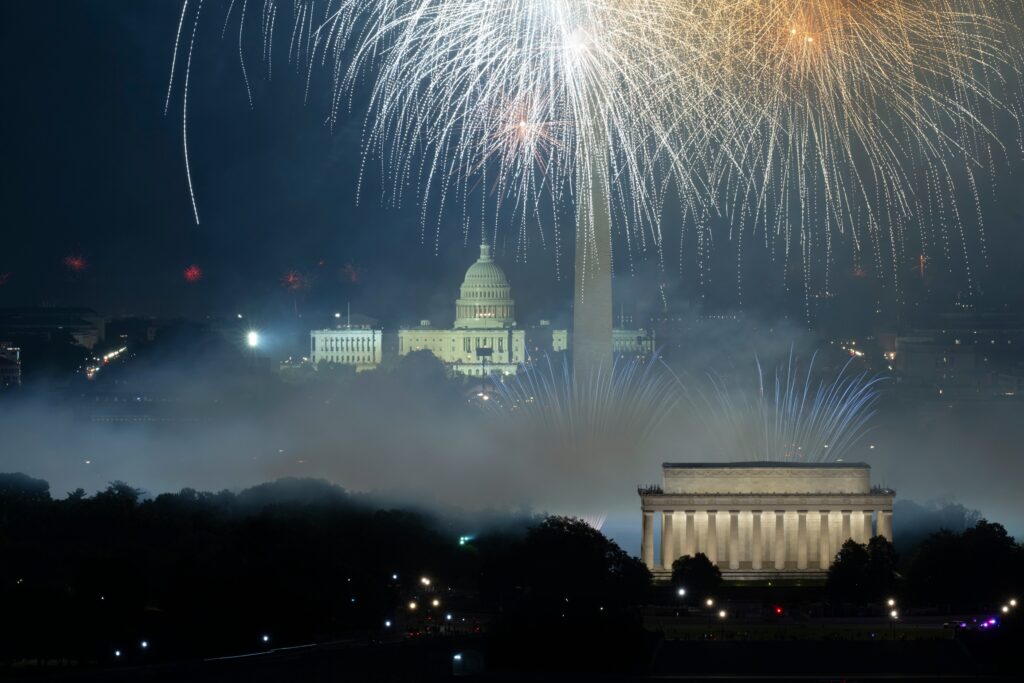
The fireworks will still explode on July Fourth (though I could do without a long, pyrotechnic presidential speech beforehand). I’ll celebrate this holiday for the first time without my father, who died five days short of 105 last year. Every year he would announce that he was going to give a “patriotic address” and then boom out our street number and Zip code. The American story still brings tears to my eyes, but I’m a sentimentalist: “Daddy, do you cry during every movie?” one of my children once asked.
As Americans, we rise, we fall, we rise again. Jeffers wanted to make sure that on this journey, we kept our eyes on something lofty. “But for my children,” he wrote, “I would have them keep their distance from the thickening center … when the cities lie at the monster’s feet there are left the mountains.”
Our nation has an uncanny ability to keep climbing, even in the worst of times. Our “declaration of independence” 250 years ago was an aspiration. We still struggle to redeem the promise that “all men are created equal” and that there’s a universal right to “life, liberty and the pursuit of happiness.” We’ve had good leaders and terrible ones, but each year, whatever the adversity, we remember what this story is about. And we think how lucky we are, still, to be part of the American story.