

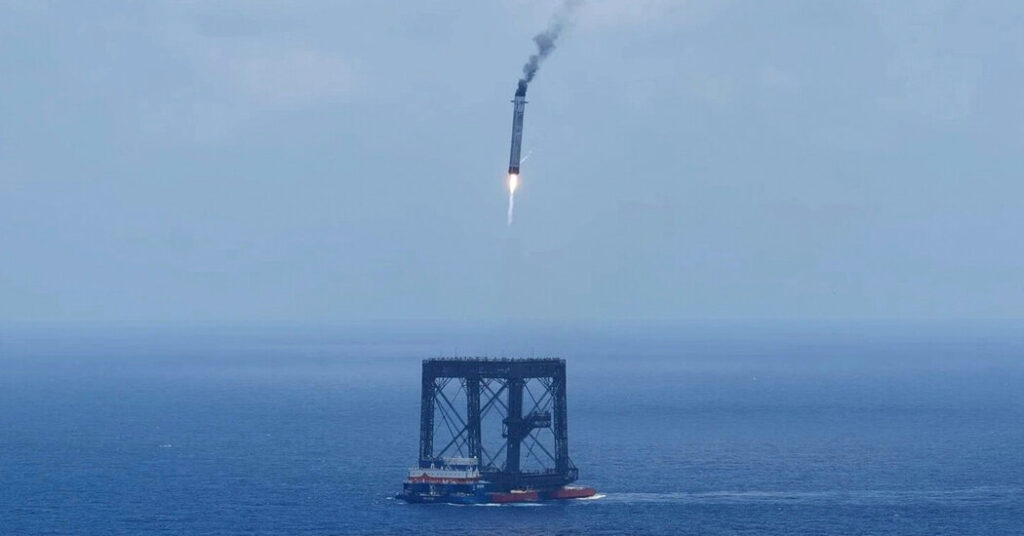
On Friday, the bottom part of a rocket that had been launched just minutes earlier descended toward what looked like a stubby drilling derrick floating in the South China Sea. As the rocket stage, known as a booster, slowed almost to a stop and precisely maneuvered into the center of the structure, a grid of wires gently closed around it.
It was a remarkable success for a Chinese government-owned space company. On the inaugural flight of its new Long March 10B rocket, it nailed a critical step toward China’s goal of developing reusable rockets.
The wire-catching technique was also novel. By snagging the booster as it hovered above the platform, engineers eliminated the need to equip the booster with landing legs.
The milestone offered further evidence that China’s space industry, while still trailing that of the United States, may be closing the gap. Reusing rockets instead of discarding them after one launch enables a quicker pace of operation — more like jetliners — and reduces costs for the launching of satellites and other payloads.
But Todd Harrison, a senior fellow at the American Enterprise Institute, a think tank in Washington, was not overly impressed, noting that Elon Musk’s rocket company, SpaceX, first landed a booster more than 10 years ago with its Falcon 9 rocket. The Long March 10B is roughly comparable in size and capability to the Falcon 9.
“It means they are making progress,” Mr. Harrison said of the Chinese, “but not necessarily catching up to where U.S. capabilities are today.”
SpaceX has since successfully landed Falcon 9 boosters more than 600 times.
Phil Smith, an analyst at BryceTech, an aerospace consulting firm in Virginia, said that the booster landing was not a game-changer but that it showed that Chinese rocket engineers are talented. In the past, “the sense was that the quality wasn’t as good,” he said. “That is long gone now.”
The landing of the Long March 10B booster does not directly play into China’s efforts to send its astronauts to the moon by 2030, because that capability is not needed for a moon mission. But the ability to reuse boosters could accelerate China’s launch industry, following the example of SpaceX.
A decade ago, SpaceX had already shown that it could launch satellites on a Falcon 9 for $62 million, a price tag cheaper than what competitors around the world charged. But it was not launching all that often.
That started to change on Dec. 21, 2015, when the booster of a Falcon 9 rocket helped lift a satellite to space and then set down a few minutes later, softly and intact, on a concrete landing pad at Cape Canaveral.
The economics of the space business did not change overnight — SpaceX launched eight Falcon 9s in 2016 — but over time, quick refurbishment of the boosters allowed SpaceX to launch more quickly at a lower cost since it was no longer throwing away most of the rocket on every launch.
Last year, the company carried out 165 Falcon 9 launches.
“So might China be entering a phase a few years from now where they start to see exponential growth?” Mr. Harrison said. “I think that’s entirely plausible.”
SpaceX, however, has not rested on its laurels with the Falcon 9, which reuses the booster but still throws away the rocket’s upper stage. The much larger Starship rocket that SpaceX is developing aims to upend the rocket industry a second time — a fully reusable rocket that can carry far larger payloads at much lower costs — and China has nothing that would compare to Starship for five to 10 years, Mr. Harrison said.
China has a commercial space industry now as well. In 2014, it made a key regulatory change that opened parts of its space industry to private investment. “China is using, in a sense, a hybrid growth playbook,” combining SpaceX-like innovation with its traditional expertise in mass production, said Jonathan Roll, a researcher at Arizona State University who led a 2025 report about the Chinese space companies. “They’re using ours to innovate, and they’re using their own to scale. “
With private investment, as well as an influx of money from city and provincial governments, a slew of space start-ups have popped up in China. “This investment uptick is clear,” Mr. Roll said when the report, commissioned by the Commercial Space Federation, a trade group, was unveiled in September.
Mr. Harrison remains optimistic that the United States, with the entrepreneurial risk-taking of companies like SpaceX and Jeff Bezos’ space company, Blue Origin, will continue to outpace what the Chinese government and Chinese companies will be able to accomplish.
“They don’t have the same kind of market dynamics,” Mr. Harrison said. “They don’t have the same access to capital in the private sector. There are major impediments to China getting market share.”
In the moon race, however, delays with NASA’s Artemis return-to-the-moon program mean that the next footsteps on the moon could be those of Chinese astronauts.
“I think they’re going to get a human on the moon before we can get back,” Mr. Harrison said.
Because the Communist Party in China rules the country unchallenged, it can set space priorities and plan those efforts over years and decades. In the United States, an election and a new president often change the marching orders for NASA, especially for human spaceflight, meaning programs start and stop, resulting in lost time and wasted money.
Many American politicians describe the competition between the United States and China as a 21st-century space race, similar to the Cold War race to the moon between the United States and the Soviet Union, which culminated in the landing of the Apollo 11 astronauts in 1969.
The stakes are higher now, they say, because it is no longer just a race for national prestige and bragging rights, but also to hold a military high ground and take advantage of potential economic gains like valuable minerals that can be mined from the moon and asteroids.
“Space is no longer reserved simply for peaceful exploration,” Senator Ted Cruz of Texas, the chairman of the Senate Committee on Commerce, Science and Technology, said during a hearing in September. “It is today a strategic frontier with direct consequences for national security, economic growth and technological leadership.”
At the turn of the millennium, China’s space program was in its infancy, but it laid out ambitious plans for the future and has methodically hit those goals. The first Chinese astronaut was launched to orbit in 2003. China launched a prototype space station in 2011, and now has a permanent station in orbit. It put a robotic lander and a small rover on the moon in 2013 and followed that up with three more successful robotic missions to the lunar surface. It put a lander and a rover on Mars in 2021.
“I think the two countries are certainly peers,” Mr. Smith said, in comparing the space capabilities of the United States and China.