
40 Years On: From THISWEEK To THISDAY, ARISE News And Lekeelekee, A Legacy That Transforms Nigerian Journalism

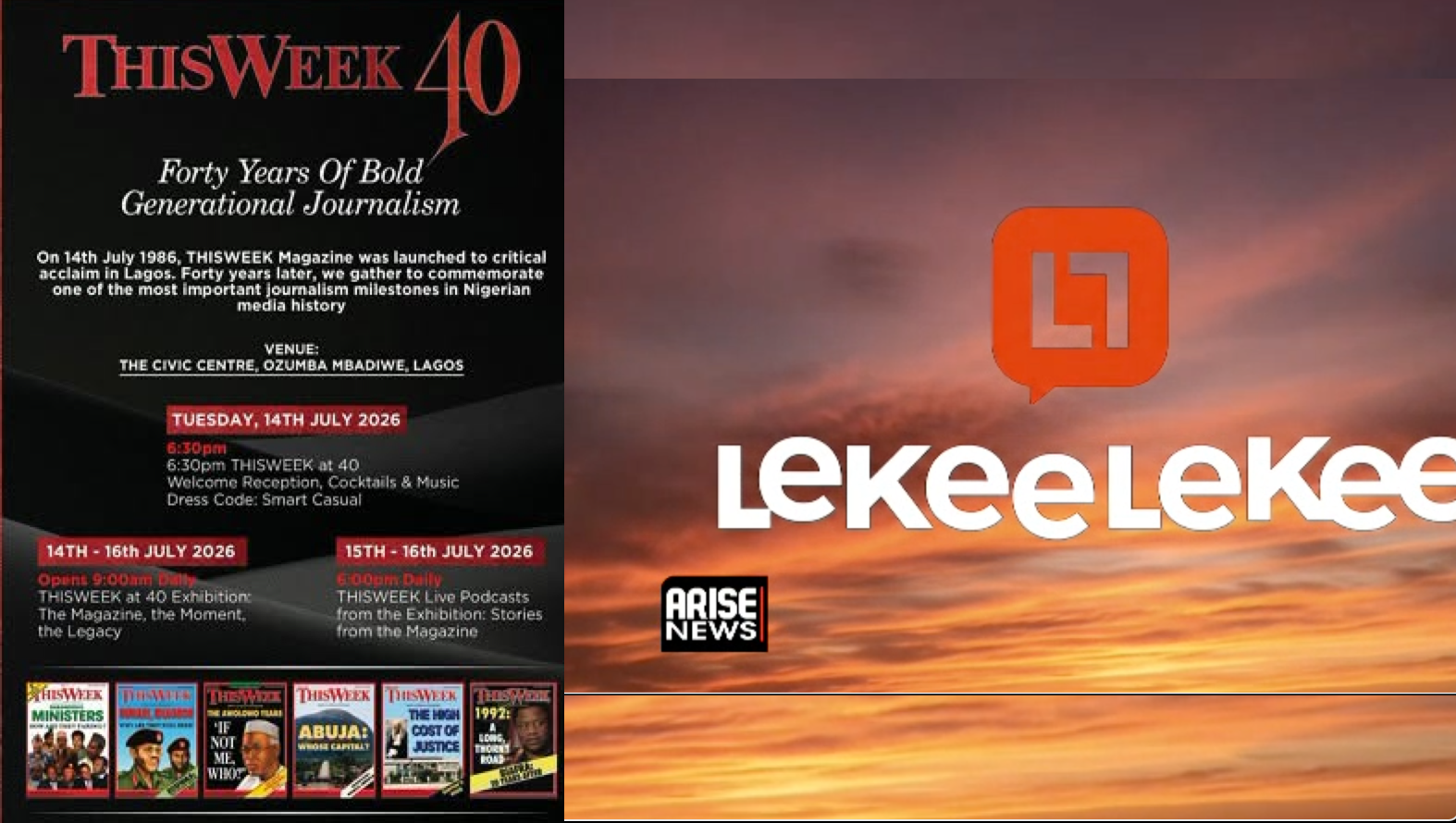
Forty years after THISWEEK first appeared on Nigerian newsstands, its founding editor, Sonala Olumhense, has offered a moving reflection on a publication that not only transformed journalism but also inspired institutions that continue to shape the country’s media landscape today.
For Olumhense, THISWEEK was never merely a magazine. It was an idea, a movement and a declaration that excellence in Nigerian journalism was possible. The publication’s enduring legacy, he suggested, can be traced through the emergence of THISDAY, ARISE News Channel and, more recently, the Lekeelekee social media platform, all founded by Nduka Obaigbena, whose faith in young journalists and uncompromising pursuit of excellence first found expression in THISWEEK.
Recalling those formative years, Olumhense said every challenge within the newsroom was met with four words that became both a rallying cry and a philosophy: “We Can Do It.”
Long before Barack Obama’s “Yes We Can” became a global political slogan, Obaigbena was instilling the same spirit in a newsroom filled with ambitious young reporters determined to redefine Nigerian journalism.
“But 22 years before that, in Lagos, Nigeria, another young man was saying something similar. He was trying to bring to life Nigeria’s most powerful newsmagazine. His name was Nduka Obaigbena, and he was building a new movement in four words. “We Can Do It.”
“Four words that shaped optimism in the mettle of concrete and determination in the fettle of stubbornness. It did not matter what the rock was or how wide the ocean. “We Can Do It,” he would say. We could solve it.
“That was THISWEEK. And no matter how long the night was, we often, by breakfast, held the triumph in our hands,” Olumhense wrote.
These four words, ‘We Can Do It’ Olumhense recalled, embodied optimism, courage and relentless determination. Whatever the obstacle, whether editorial, logistical or financial, the response was always the same. They would find a way.
That conviction had been embedded in the publication from its conception.
In the inaugural publisher’s message in 1986, Obaigbena described THISWEEK as “a tonic” conceived at a time of severe economic hardship but driven by the belief that Nigeria deserved a news magazine capable of uplifting the national mood while articulating the Nigerian perspective on world affairs.
The ambition was to build “a pocket of excellence in journalism” with lucid writing, compelling photography, lively presentation and complete editorial independence.
Business leaders and professionals who backed the venture were persuaded not by promises of influence but by the conviction that a younger generation deserved the opportunity to redefine Nigerian journalism. They invested with the understanding that ownership would never interfere with editorial judgment.
Building the editorial team became the next challenge. Obaigbena turned to some of the country’s brightest journalists, convincing Olumhense to leave The Guardian as pioneer editor while attracting respected names including Pini Jason, Lawson Omokhodion, Tunji Lardner, Lanre Idowu, Greg Obong-Oshotse and Taiwo Obe.
Together they embarked on a journey to create a publication that would challenge conventions while pursuing excellence without compromise.
The atmosphere inside the Ogunlana Drive newsroom soon became legendary.
Olumhense remembered how the magazine attracted curious attention from neighbours who struggled to believe the stylishly dressed young men and women streaming into the building worked for a news organisation.
One young passerby eventually stopped his car, crossed the road and approached a group of staff members.
“I don’t know what you people are doing in this place,” he told them, “but whatever it is, I want to be a part of it.”
That encounter, Olumhense said, perfectly captured the magnetic spirit that surrounded THISWEEK.
Former Managing Editor Pini Jason would later recall in 2006 the same unique atmosphere in a tribute marking 20 years after the assassination of Dele Giwa.
He remembered that weekends often revolved around football at the University of Lagos sports ground and staff outings to the beach, creating an environment unlike any newsroom in Nigeria.
Many outsiders mistook THISWEEK for an advertising agency or even a laundry service because of its youthful energy and vibrant culture.
But on Sunday, October 19, 1986, that atmosphere was shattered.
Jason recounted arriving at the office to find Lauretta Onwufuju anxiously working the telephone before quietly breaking the devastating news that Dele Giwa had been killed by a parcel bomb, a moment that forever altered Nigerian journalism.
For Olumhense, however, one of the defining demonstrations of the THISWEEK spirit came on the night Chief Obafemi Awolowo died.
Immediately the news broke around 10 p.m., reporters instinctively returned to the newsroom. Before midnight, a reporting team was already heading to Ikenne in an unregistered brand new vehicle. By dawn, ThisWeek had gathered the richest collection of material on the late statesman while competitors were only beginning to arrive hours later.
It was yet another affirmation that impossible assignments simply demanded harder work.
Forty years later, Olumhense argues that while Obaigbena has gone on to build influential media institutions, ThisWeek remains unique because it represented the purest expression of grassroots journalism.
He lamented the disappearance of numerous state-owned newspapers and influential regional publications that once held local governments and communities accountable.
According to him, the decline of grassroots journalism has left vast areas of governance unreported despite trillions of naira flowing annually to states and local governments.
Without strong local reporting, he warned, democracy increasingly operates in darkness, with political elites speaking mainly to one another instead of to the people.
“Forty years later, Nduka has had other children, so to speak. Because he could. But none of them is from the loins of THISWEEK. We ought to address this. Because Nigeria, without THISWEEK, is poorer, not richer. Because, in these 40 years, we have lost something of what got us here: irrepressibility of professional spirit. And I affirm that it resides deeply in grassroots journalism, the very breastmilk that nurtured Nduka at the Nigerian Observer.
“Grassroots journalism is what grants journalism credibility rather than compromise. Without it, you simply have the political elite talking to the political elite. Here is a sample of what we have lost since ThisWeek: Daily government newspapers in states that had them, and dozens of local and regional private papers, including Bazazzaga, Zaria; Nigerian Compass, Sagamu; Jakadiya in the North; Sunray, Port Harcourt; The Monitor, Ibadan; Albishir, Borno; Post Express, Lagos; Alfijir, North; Zaruma Newspaper, Sokoto; Third Eye, Ibadan; Himma, Katsina; The Comet, Lagos; and The Sentinel, The Democrat, The Analyst, The Reporter, and Today Magazine (all in Kaduna).
“This has led to a curious situation where Nigerian democracy is increasingly conducted in the dark. Consider, for example, that in 2025, our 774 local governments collectively received federal revenue allocations of N5.35 trillion, and in the first half of 2026, approximately N3.05 trillion. Similarly, in 2025, the 36 states and the FCT collectively received N8.17 trillion, and in the first half of 2026, N4.07 trillion. That is N20.64 trillion (nearly $15 billion) in 18 months, that is largely unreported. The THISWEEK Can-Do spirit in local and regional reporting is Nigeria’s missing intervention. On this 40th anniversary, I invite us to talk about this. We Can Do It. Indeed, we must,” he assured.
As THISWEEK marks its 40th anniversary, Olumhense believes its greatest lesson is not nostalgia but renewal.
The publication’s greatest contribution, he said, was proving that young journalists, armed with integrity, courage and an unwavering belief in excellence, could build institutions that outlived generations.
That same spirit, he pointed out, remains Nigeria’s missing intervention.
THISWEEK also produced journalism stars like Lanre Idowu, the second Editor, Lawson Omokhodion the Business Editor who later became Managing Director of a bank , Tunji Lardner,jnr, the poet Uzor Maxim Uzuatu, Norbert Esenwah, David Deji Borha, Azuka Jebose ETC
Follow us on: