

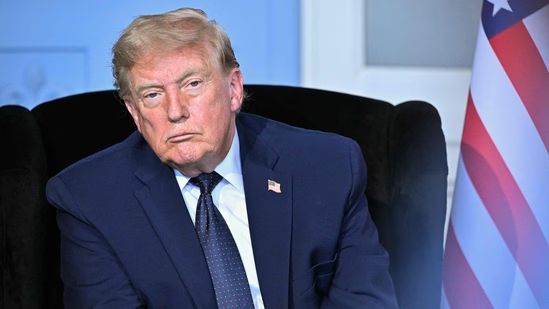
The United States and Iran have now reached a breakthrough framework agreement to end their nearly four-month-long war, marking a major step toward peace. Both sides have also confirmed that an in-person signing ceremony is scheduled for Friday, June 19, 2026, in Switzerland.
This agreement is being seen as the most serious progress so far after months of conflict and failed attempts at a full deal. The main idea of the framework is to officially stop the war and move toward a structured peace settlement between the two countries.
$300 billion fund plan
One of the biggest and most talked-about parts of this deal is a possible “$300 billion reconstruction fund” that is said to help rebuild Iran after the war. This fund idea is still not confirmed officially by either the United States or Iran, and the exact details are unclear, including whether it will actually be created or how it will work.
The Iranian news agency (Mehr News Agency) says that the United States and its allies would be responsible for paying into what Iran calls a “reconstruction fund” to repair war damage. Iran has long demanded that the US and Israel pay compensation for war damage, calling it a war “reconstruction” or “compensation” fund after major destruction inside the country.
Also read: Trump celebrates 80th birthday with historic UFC event at White House: Key highlights here
Frozen money release
Reuters reports that instead of a confirmed $300 billion fund, the deal may involve a broader economic development plan for Iran, with final details expected during a 60-day negotiation period after the agreement is signed. The report also notes that this plan does not clearly confirm any fixed $300 billion amount, and the full structure of funding is still under discussion.
Another key part of the draft deal includes the possible release of about $24 billion in frozen Iranian assets, with $12 billion possibly unlocked even before negotiations fully begin. The draft also says that half of these frozen funds must be made available to Iran before formal talks begin, showing early financial easing steps in the agreement.
Oil route and trade
US President Donald Trump announced that the deal is complete and said that commercial shipping will resume freely through the Strait of Hormuz, which handles about 20% of global oil flow. Iranian Foreign Minister Abbas Araghchi said that in diplomacy, no deal is perfectly one-sided, and both sides must feel some level of satisfaction for an agreement to work, as reported by CNBC. He also added that expecting a “50-50 split” is unrealistic, and successful negotiations always require compromise from both sides.
Overall, the $300 billion fund remains the most debated part of the agreement, but it is still uncertain, unconfirmed, and likely to be shaped further during upcoming negotiations.