

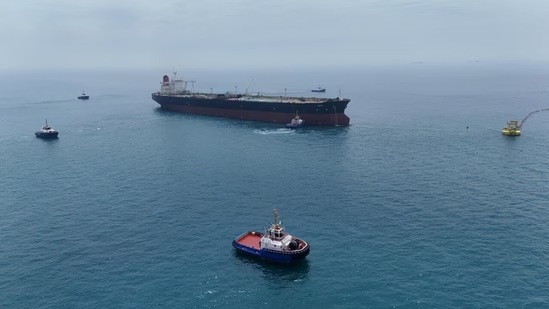
Two weeks after the Iran war began, top oil-industry executives warned Trump officials that oil prices could climb much higher unless the vital Strait of Hormuz waterway reopened soon.
The scale of the disruption could hardly be exaggerated: ocean-faring vessels usually carry some 20% of the world’s daily diet of crude and oil products through the narrow artery between Iran and Oman.
And yet, oil has languished below $100 a barrel for over three weeks. A U.S. barrel fetched $84.88 Friday, driven lower again by reports that the U.S. and Iran were closer than ever to a peace deal.
As far as financial markets are concerned, an oil crisis hasn’t materialized so far. That has given President Trump more time to negotiate a peace accord with Iran. Oil executives and commodities traders still say the worst is yet to come even if hostilities cease: Global oil stockpiles are declining rapidly, getting ever closer to a critical low point that could force prices higher.
Here’s why oil prices haven’t soared to record levels—yet.
The China pullback
Official data show that China imported 7.8 million barrels a day in May. That’s a huge drop from around 11 million barrels a day in recent years, and the lowest level in nearly eight years. Even during the Covid pandemic, when China’s economy was largely shut down, crude oil imports didn’t fall below 8 million barrels a day.
The missing 3 million barrels—roughly equivalent to the combined daily oil consumption of Italy and France—have taken away a chunk of global demand, keeping oil prices in check.
However, analysts and traders differ on just how long China’s import cuts can last—and what would happen if the world’s largest oil importer starts buying more again. The next week or two are crucial, traders have said.
The Trump factor
Traders have learned in the past months that betting against Trump is a dangerous endeavor. Many have been scared to hold oil positions over the weekend or make any long-term bets.
Throughout the conflict, Trump posted on social media frequently and liberally. Through these verbal interventions, which were sometimes contradicted by Iranian officials, Trump has repeatedly taken the steam out of oil prices.
A trickle of tankers
Despite what some shippers and maritime analysts called a “double blockade” enforced by both the U.S. and Iran, crude oil flows from the Persian Gulf monarchies are recovering steadily after collapsing at the beginning of the war.
About 100 million barrels of non-Iranian oil—or roughly 2.5 million barrels a day—have reached global markets through the Strait of Hormuz since the beginning of May, according to commodities- and shipping-data provider Kpler. That’s still a fraction of the 15 million barrels a day transiting before the war, but it’s a big improvement from just roughly 1 million barrels a day of non-Iranian oil flowing in April, according to Kpler.
These barrels were increasingly ferried out by ships that sailed “dark.” Vessels turned off lights and traveled without Automatic Identification Systems on, making them harder to spot electronically and less prone to Iranian attacks. Some ships stayed in touch with U.S. military officials during these transits, the Journal previously reported.
The world’s energy resilience
The Hormuz crisis struck at an opportune moment, when the world had energy reserves. Countries also launched policies to help consumers through higher prices. And there was an offsetting effect from an artificial-intelligence boom that is powering trade and business investment in the U.S. and beyond.
It also highlights an underappreciated shift in the workings of the global economy. Over the years, countries have become steadily more energy efficient, squeezing more economic activity out of each drop of oil or cubic meter of natural gas burned. The energy needed to generate a dollar of gross domestic product, adjusted for inflation, since 2000 has fallen by about a third in the U.S. and Europe and by about 40% in China, according to World Bank data.
New oil routes
Saudi Arabia’s East-West Pipeline and a smaller Emirati pipeline are helping Gulf producers bypass the Strait of Hormuz. Together they are transporting almost 9 million barrels of oil a day.
Iran is also trying to move oil by rail to China. Rail infrastructure linking Tehran to the Chinese cities of Yiwu and Xi’an already exists.
The big caveat
For member countries of the Organization for Economic Co-operation and Development, inventories of liquid fuels are expected to sink below 2.3 billion barrels by December, the lowest since 2003, when the Energy Department started tracking the data. In Cushing, Okla., one of the nation’s most vital commercial oil stockpiles appears to be on the verge of falling to a critical low.
If the dwindling global buffer against oil-supply shocks shrinks enough, prices could skyrocket, oil executives said. “Most people with a model would say [physical oil prices] will shoot up once you get to that really low inventory level, up to $150, $160” a barrel, Neil Chapman, an Exxon Mobil senior vice president, said at a conference late last month.
Write to Rebecca Feng at [email protected], Collin Eaton at [email protected] and Josh Ulick at [email protected]