
US, Iranian delegations head to Switzerland to begin talks on Lebanon, Tehran's nuclear programme

Senior US and Iranian officials are heading to Switzerland for the first round of talks to implement the peace agreement signed earlier this week, with negotiators expected to focus on Tehran’s nuclear programme and a ceasefire in Lebanon.
The Swiss resort of Bürgenstock will see US Vice President JD Vance, Iranian Parliament Speaker Mohammad Bagher Ghalibaf discuss key issues along with officials from mediating countries Pakistan and Qatar.
“We’re going to hopefully make progress on the nuclear issue, make progress on the Lebanon ceasefire issue — those are the two big things that I think we’re going to be focused on,” Vance told reporters before departure.
The talks mark the first in-person talks after US President Trump and his Iranian counterpart, Masoud Pezeshkian, signed the deal.
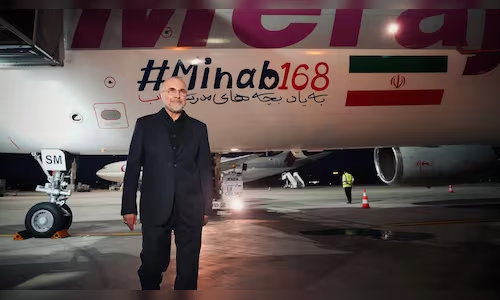
Iran has signalled to press the US over the killing of roughly 180 children, including at least 168 girls, in Iran’s Minab on February 28. An elementary school was targeted among many other sites when Israel and the US had carried out a coordinated attack, triggering the war in West Asia.
Ghalibaf posted a message ahead of his departure in which he paid tribute to those who died in the attack.
“I consider the innocent children of Minab and all the martyrs of dear Iran to be watching over my every action and behavior at every moment,” Ghalibaf wrote on X. On the aircraft on which he was to fly for the talks, were written “#Minab168”.
The negotiation is also likely to smooth over fresh tensions over the Strait of Hormuz.
Iran’s Khatam al-Anbiya Central Headquarters said on Saturday that the strategic waterway would be closed to vessel traffic, accusing the US and Israel of violating the ceasefire agreement. The command described the move as the “first step” in response to what it called breaches of commitments and warned that additional measures could follow.
However, US Central Command (CENTCOM) rejected Iran’s assertion that it controls the strait and said American forces were monitoring the situation to ensure the continued flow of maritime traffic through one of the world’s most important energy chokepoints.