

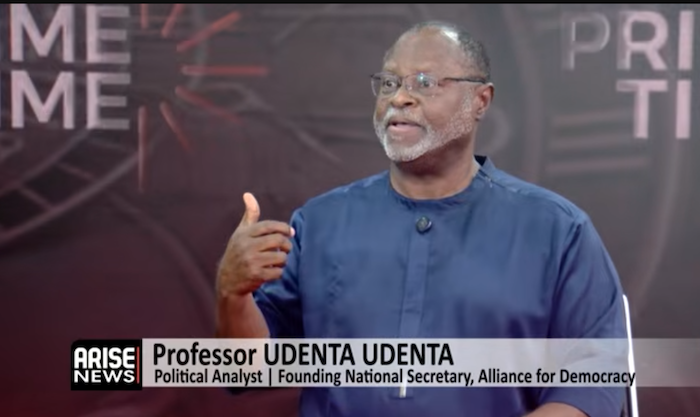
The founding National Secretary, Alliance for Democracy, and a political analyst, Professor Udenta Udenta, has said Nigeria’s democracy has fallen far short of the ideals that inspired the June 12 struggle, arguing that democratic institutions have become weaker despite more than two decades of civilian rule.
Speaking in an interview with ARISE NEWS on Friday, the political analyst also said that the Independent National Electoral Commission, (INEC), under Mahmood Yakubu lacks the credibility to conduct a free and fair election in 2027.
“30-something years after June 12th, the country has undergone democratic institutions weaker than they were before. The election as a part of their intro having been delivered as if what was delivered June 12th was the freest and fairest in history of the country. Now under this Mahmood Yakubu, who I say repeatedly has been procuring and curated to serve the purposes of the moment, of the ruling party, of the president, in all his re-margins.
“Leaders of thought across Nigeria have said resign from that position. He cannot conduct a credible election, in no way,” he insisted.
On whether the gains of the June 12 election have been sustained, Udenta said Nigeria has moved away from the ideology of politics, party discipline and electoral system that helped make the election a success.
“The area in which the gains of that June 12th arrived, we talked about an electoral system, or the method of delivering the election, talked about that the party formation, party discipline, and party coherence.
“So now you have a multi-party system, then there was a two-party system, different from a multi-party democracy where you have the bigger parties and smaller parties representing identity-driven perspectives and instincts. So rather than now building again on the gains of these two parties to say, we have to ideologically form parties,” he said.
Commenting on President Bola Tinubu’s June 12 Democracy Day address, Professor Udenta said the speech was rhetorically strong but disconnected from the lived realities of Nigerians, insisting that governance performance—not political messaging—will define public judgment ahead of the 2027 elections.
“The point is that it’s good to have grand vision and grand pontificating in a speech of that moment of June 12. But the reality is far more prosaic. It’s not aesthetic or poetic, what Nigerians are going through. It’s incredible, and it’s every sense of suffering. It’s amazing that our resilient spirit, our sense of survival, is what is still holding this country together. You need to face realities squarely and not escape from it. He’s going to run for re-election. He will not run on his speech; he will run on his—on his, not mandate. They’re not going to stand on his mandate. He will run on his record.
“So, a speech like this is good. A feel-good moment for him and his team. But for the country, they are bemused because there is a disconnect,” he stressed.
Highlighting the biggest threats to the credibility of the 2027 general elections, Professor Udenta warned that state capture, weakened institutions, and compromised independence of key democratic bodies such as the legislature, INEC, and the judiciary could undermine the integrity of the electoral process.
“There is a state capture going on. The National Assembly, it is a National Assembly, is there in name but not as an entity.So, we don’t have a National Assembly. It’s already captured.
“Then you have INEC. As I said, they’re moving to try and procure and produce, to have guidelines in an electoral timetable that make it almost impossible for parties already overburdened by lawfare—PDP, SDP, ADC, and so on—to even come out of the fire alive, fire in block.
“You find the judicial system is only there. When you talk about state capture, the diminishing of the space, political parties that are around are actually experiencing this today. They are almost like crippled. And then you have an electoral empire that is less than independent, and a security apparatus that we even suspect what their role will be. This election danger signals, political risks. I believe out of these disastrous scenarios, you can have a failure of successful elections,” he warned.
On his message to Nigerians questioning whether democracy is still delivering on its promises, Professor Udenta urged resilience and collective political action, insisting that the country can still recover from its current challenges if citizens and political actors unite around a reform-driven agenda ahead of 2027.
“The central message is: resilient spirit, stoutness of heart, grim determination, iron will. That this moment, too, will pass,” he assured.
He added that real political change would depend on unity among citizens and opposition groups to redirect Nigeria’s democratic path.
“And if the people are united, if, for example, we have a party of the future like NDC, created by the leader who was there with you, and building to meet the criteria of one person, robust, charismatic energy, institutional building format, to come together and deliver this in 2027. A new beginning out of the piercing darkness we find all around us. The scaffold that is interlocking the nation to this miasma of failure and disaster. A new Nigeria is beginning, a democracy that is restored, richer in scope and deeper in content, to deliver for the prosperity of Nigerian people.”
Favour Odima
Follow us on: