

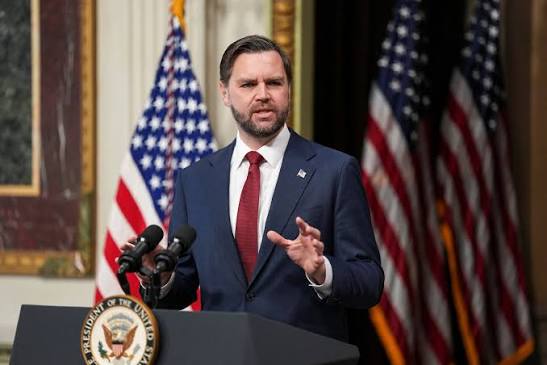
(U.S. Vice President JD Vance. Photo Credit; Reuter)
US Vice President JD Vance has revealed that President Donald Trump may release details of a preliminary peace agreement between the United States and Iran before Friday, as fresh details continue to emerge about a deal expected to formally end months of conflict in the Middle East.
The disclosure follows Trump’s announcement at the G7 summit in France that the agreement had already been signed electronically by key officials from both countries, with the President telling French President Emmanuel Macron that the deal was fully signed.
Vance described the memorandum of understanding between Washington and Tehran as a fairly general document, spanning roughly a page and a half, noting that several technical details would still need to be resolved in future negotiations.
He explained that the agreement establishes a framework under which Iran would receive certain benefits in exchange for meeting key obligations, including commitments tied to regional stability and nuclear restrictions.
Speaking in a television interview, Vance said one of the core elements of the agreement involves the International Atomic Energy Agency and the United States assisting Iran in dismantling its highly enriched uranium stockpile, while also confirming that international nuclear inspectors would be permitted to return to Iran under the deal.
The agreement is also expected to result in the reopening of the Strait of Hormuz on Friday, restoring one of the world’s most important oil transit routes following months of disruption linked to the conflict.
Reports indicate the ceasefire framework will remain in place for a further 60 days while negotiations continue toward a permanent settlement.
Pakistan’s Prime Minister, Shehbaz Sharif, whose country reportedly played a mediating role in the talks, had earlier announced that the agreement provides for the immediate and permanent halt of military operations on all fronts.
Despite the diplomatic breakthrough, tensions persist in parts of the region. Israeli Prime Minister Benjamin Netanyahu said Israeli forces would continue operating in security zones across Lebanon, Syria, and Gaza for as long as necessary, while reiterating that Iran would never be permitted to acquire nuclear weapons.
Iranian officials, for their part, described the agreement as a significant political victory, even as they expressed continued distrust toward the United States.
The development has already triggered notable reactions in global markets, with oil prices falling sharply amid expectations that the reopening of the Strait of Hormuz will help stabilise energy supplies and ease pressure on international trade routes.