

In 1751, Captain Henry Ellis of an English slave-trading ship lowered a bucket with a built-in thermometer while sailing 25°N in the north Atlantic Ocean. In those times, water temperatures at different sites and depths were captured by seafarers sailing across the globe.
The captain was startled by the findings. The deep water in the ocean was icy cold. “The cold increased regularly, in proportion to the depths, till it descended to 3,900 feet: from whence the mercury in the thermometer came up at 53 degrees (Fahrenheit); and tho’ I afterwards sunk it to the depth of 5,346 feet, that is a mile and 66 feet, it came up no lower,” he wrote in a letter.
This account, according to Stefan Rahmstorf of the Potsdam Institute for Climate Impact Research, was the first recorded temperature measurement of the deep ocean. The captain’s finding went on to become the basis on which scientists now understand workings of waters on Earth – deep waters are cold, and warmer waters are closer to the surface.
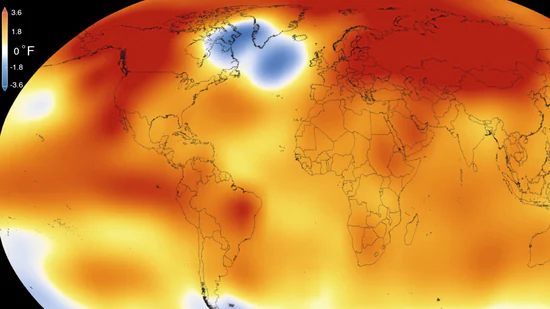
But just south of Greenland, in the northern Atlantic Ocean, is a large patch of water that has been cooling even as the rest of the ocean warms. On modern temperature maps, it shows up as a blue spot in brushes of red and orange that cover most of the world.
Known as the ‘cold blob’ or the ‘North Atlantic warming hole’, the patch that belies the global warming trend is located roughly 25°W–45°W, 50°N–60°N in the subpolar North Atlantic and has been cooling at a rate of 0.15 degrees Celsius per century from 1900 to 2014.
Nasa’s GISTEMP data confirms a long-term cooling trend from 1880 to 2025 in this region – and the reasons for it, research published last month, indicates it has much to do with an Atlantic Ocean current.
Also read: The climate promise that won’t survive geopolitics
What scientists make of the cold blob
The cold blob was not discovered so much as gradually recognised.
The variance was present in temperature records captured by seafarers and datasets going back to the 19th century — visible, in retrospect, in the same Nasa GISTEMP data now used to map it. But, for decades, the anomaly was believed to be an anomaly, perhaps just ‘noise’ in the data. While the world saw temperatures increase by an average of 1°C over the past century, the patch had quietly cooled about 0.9°C.
The first modern study that took a systematic, long-period view was by Mihai Dima and Gerrit Lohmann in 2010. It analysed patterns of sea surface temperatures since 1870 and found that the blob may be linked to the Atlantic Meridional Overturning Circulation, or AMOC.
AMOC, a belt of water that influences weather across continents, had been weakening since the 1930s, the researchers flagged.
Also read: What India must do as climate crisis worsens
The Earth’s ocean conveyor belt
AMOC is a system of ocean currents in the Atlantic Ocean that brings warm water to the north and cold water to the south.
One of its circulation patterns is the movement of warm surface water through the Gulf Stream to the north, where water cools and forms sea ice. As ice is formed, salt is left behind, making the water denser. That dense, cold, salty water then sinks and is carried southward through the deep ocean. Eventually, it is pulled back up toward the surface in a process called ‘upwelling’, where it warms and the cycle restarts.
The entire circulation loop takes an estimated 1,000 years and involves moving water at a volume of roughly 18–20 sverdrups — the unit oceanographers use for ocean current flow, where one sverdrup equals one million cubic metres of water per second. To put it in context, this is equivalent to approximately 90–100 times the flow of the Amazon river at its mouth.
AMOC is critical for regulating the European climate — milder winters experienced in the UK and northwestern Europe compared to the polar regions happen partly because the AMOC brings heat up from southern latitudes.
In the south, after sinking, the cold deep waters flow along the sea floor towards the Antarctic. From there, they circulate into the Indian and Pacific Oceans, where ocean mixing and westerly winds in the Southern Ocean gradually pull them back to the surface — completing the loop.
Beyond heat, the water belt transports nutrients that support marine ecosystems and plays a role in the carbon cycle, transporting carbon-rich surface waters to the deep ocean. If this sinking process slows down, the ocean cannot transfer carbon dioxide from the atmosphere to the deep ocean as quickly, leaving larger amounts of greenhouse gases in the atmosphere and accelerating climate change.
Cold blob as a symptom of a weakening AMOC
Starting 2012, multiple studies linked the cold blob to a weakening AMOC. The cooler patch of water, researchers say, sits precisely where the AMOC delivers its northward-flowing heat. A slowing conveyor belt means less heat, and consequently, a cooler region.
But a section of scientists have over the years pointed to other possible reasons for the cooling effect, among them the loss of surface heat due to atmospheric influences and the impact of aerosol pollution.
Much of this has now been countered.
Last year, researchers at the University of California, Riverside (UCR), analysed 20 years of AMOC observations and a century of oceanic temperature and salinity data and tested with 94 different climate models. They came to the same conclusion.
“If you look at the observations and compare them with all the simulations, only the weakened-AMOC scenario reproduces the cooling in this one region. It’s a very robust correlation,” co-author Kai-Yuan Li had said in a statement. The study, titled ‘Weakened Atlantic Meridional Overturning Circulation causes the historical North Atlantic Warming Hole’, was published in Communications Earth & Environment journal in May 2025.
The latest study by Rahmstorf and colleagues was published in Geophysical Research Letters in 2026. By analysing temperature data, this study concluded that the cold blob was likely due to reduction in transport of heat in the waters because surface heat loss had declined over the years.
“To explain a cooling trend in the cold blob region by surface heat loss while the AMOC is steady, this heat loss would need to increase to outcompete the AMOC’s heat supply. The opposite is seen in the ERA5 data (a global weather dataset): surface heat loss has in fact decreased (since 1993 significantly, since 1955 slightly) over the cold blob. The latter is to be expected when the AMOC supplies less heat to the region and thus less is released to the atmosphere,” the study read.
If AMOC collapses
The consequences of sustained AMOC weakening or a collapse is stuff of science fiction, literally. It was the premise of the 2004 movie The Day After Tomorrow, which was inspired by the book The Coming Global Superstorm.
Stefan Rahmstorf, the scientist cited above who has extensively researched on the subject, even wrote of a scene from the movie that shows the protagonist-researcher addressing a climate conference in Delhi.
“On the other hand, given the rules and constraints of the genre, it is remarkable to what extent the film-makers have tried to include some realistic background. Early in the film a UN climate conference in Delhi is shown where Jack Hall gives a talk about the possible risk of a shut-down of the North Atlantic Current. I gave a very similar talk at such a UN conference in Buenos Aires in 1998 – I even showed the same diagram.
In the film talk, Hall states that a (AMOC) shutdown might occur in a hundred years, or a thousand, or not at all. Many real climatologists have said the same thing. In this way, what climatologists think is presented in a realistic way in the film, and it is very clear that the rapid drama that later unfolds is counter to what any climatologist expected – it’s where the fiction starts,” Rahmstorf wrote in a review
Much of this fiction is supported by science.
A 2023 study by Peter Ditlevsen and colleagues at the University of Copenhagen’s Niels Bohr Institute, published in Nature Communications, used statistical modelling and over a century of ocean temperature data to estimate that under current greenhouse gas emissions, AMOC was likely to collapse in this century.
The Potsdam Institute for Climate Impact Research (PIK), in an August 2025 study, found that under high-emission scenarios, AMOC could shut down after the year 2100, cutting the ocean’s northward heat supply and causing “summer drying and severe winter extremes in northwestern Europe” alongside “shifts in tropical rainfall belts”.
In another research, scientists estimated that annual temperatures in Germany’s Bremen could drop by up to 10°C under an AMOC collapse, the US could see reduced rainfall and monsoon systems in South Asia, including India, could be disrupted.
A warmer southern hemisphere would alter the Pacific Ocean’s temperatures, indirectly making episodes of El Nino – known to suppress the Indian monsoon – stronger. Because over half of India’s cultivated land relies on monsoon rainfall for irrigation, millions of farmers’ livelihoods and the country’s food security would take a hit from any disturbance in the season.
A weakened AMOC could also lead to accelerated melting of Antarctica’s ice sheets and a reduction in the ocean’s ability to absorb atmospheric carbon, shooting more greenhouse gases into an already warming world.