

Environment

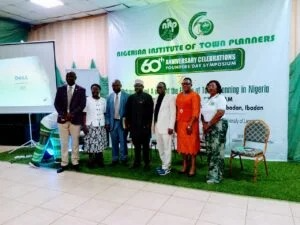
DR Chime Ogbonna, the National President, Nigerian Institute of Town Planners (NITP), has urged governments at all levels to strengthen collaboration with town planners to address Nigeria’s urban development challenges.
Ogbonna, speaking at the institute’s 60th Anniversary and Founders’ Day Symposium in Ibadan on Friday, said that town planning and governance were inseparable.
He noted that effective government could not exist without the work of planners, and planners could not succeed without government support.
The institute’s national president, who said the event was organised to reflect on past achievements and failures in town planning practice, lamented the difficult enforcement of town planning laws.
Ogbonna, a Fellow of the Nigerian Institute of Town Planners (FNITP), said that enforcing the laws has become increasingly difficult across federal, state, and local government levels in recent times.
“We need to look into our relationship with the government because government and town planning are more or less the same.
“There cannot be any government without the activities of town planners. There can also be no successful town planning activity without government support.
“However, in recent times, it has not been easy for us to get the law promulgated in the area of town planning fully implemented.
“We are using the 60th anniversary symposium to actually look back and then check where we have gotten it right and where we have not gotten it right.
“At the end, we will be able to know those areas where we think we have not done very well, and begin to make amends so as not to repeat the same mistakes,” he said.
The Guest Speaker, Prof. Leke Oduwale of the Department of Urban and Regional Planning, University of Lagos, called for an innovative master plan to tackle Nigeria’s urban and environmental challenges.
Speaking on the theme, “In Retrospect and a View of the Future of Town Planning in Nigeria”, Oduwale said the process remained difficult for policymakers and government agencies to implement.
According to him, the final product of planning is usually a bulky booklet, which politicians with four-year tenures find hard to appreciate or read.
“This is because it is not something that people can see immediately as part of an administration’s achievements within a four-year term,” he said.
To address the challenge, the professor proposed legislation that would make it compulsory for governments to prepare master plans for towns within each senatorial district.
According to him, if every governor prepares three master plans yearly for the three senatorial districts in a state, it will translate to nine master plans in three years.
He also suggested that planning projects could be given to consultants with land rewards to save government funds.
“If the governor uses three years to work, that is nine master plans.
“If we are having master plans for nine towns in three years, we must have covered all towns within a few years. With that, we go into villages,” he said.
Also, Prof. Grace Olukoyi said that the Land Use Act had to be revisited to meet the realities of Nigeria’s socio-cultural fabric.
Olukoyi, of the Urban Planning and Environmental Management, Lead City University, Ibadan, said this in her keynote speech.
“Most of the time, governments would have acquired land, and even individual developers, and when they are not developed, you will see a lot of issues of trespassing, a lot of land grabbing, and so many other social issues coming up.
“So, there is a need to revisit that Act and see what we can do to make sure that, as we plan for access to land to be improved, we also take care of all the socio-economic reactions that can come as a result of this.
“Land grabbing is a social issue, and one of the things we can do to address it is to ensure that access to land is more inclusive.
“Most of the time, we have reforms and policies that are imported and do not reflect the realities,” she said.
Earlier, the Chairman, 60th Anniversary Committee, Dr Moses Ogunleye, said they chose Ibadan for the symposium to honour the nine foundation members who established the body sixty years ago in Ibadan.
He said the symposium called for more implementable development plans, noting that plans on infrastructure must be implemented as development progresses so that cities can cope with the new developments. (NAN)
F.O
Tags: Gaps Town Planners