

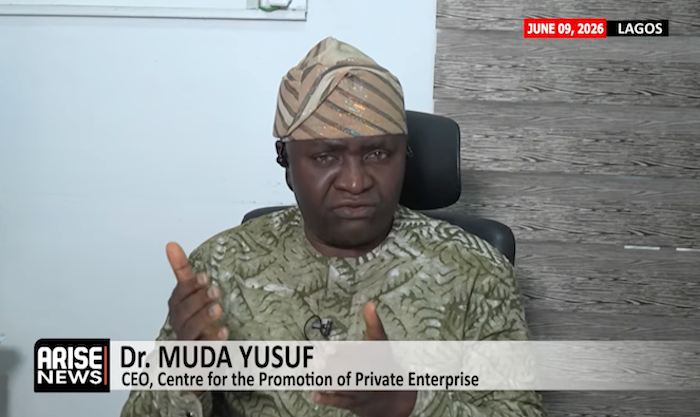
The Chief Executive Officer of the Centre for the Promotion of Private Enterprise (CPPE), Dr Muda Yusuf, has criticised the Senate’s passage of a bill seeking to replace the current N10 per litre excise duty on sugar-sweetened beverages with a percentage-based levy tied to retail prices, arguing that the proposal is primarily aimed at raising revenue rather than addressing public health concerns.
Speaking in an interview on ARISE NEWS on Tuesday, Yusuf said the justification for the proposed tax was weak and not supported by available data on sugar consumption in Nigeria.
“My view here is that this is about funding. It’s about raising funds, much more than even the public health objectives,” he said.
Yusuf argued that Nigeria’s sugar consumption remains among the lowest globally and questioned claims that sugar-sweetened beverages are a major driver of health challenges such as diabetes and obesity.
“Out of 176 countries, Nigeria’s ranking in terms of per capita sugar consumption is 166, according to the Food and Agricultural Organization. It’s a UN body. And the per capita consumption as of 2023, which is the latest data we have, was about 7.1 kg per annum, per capita,” he said.
He added: “Even in South Africa, South Africa is doing 25 kg. Egypt is doing about 33 kg per capita. And when you look at countries in Europe, it’s between 30 to over 50 kg per capita in terms of sugar consumption.”
According to Yusuf, dietary habits rather than soft drinks should be the focus of efforts to address health concerns linked to sugar consumption.
“When we look at the critical factors driving even diabetes and all of that, studies have shown that it is more because of the heavy carbohydrate consumption that we eat in this part of the world,” he said.
“For many households, we consume carbohydrates in the morning, in the afternoon, in the evening, for breakfast, for lunch and for dinner. We take a lot of fufu, pounded yam, bread, rice. This is a recurring menu on our diet.”
Yusuf maintained that the proposed legislation would give government broad powers to increase taxes on a wide range of non-alcoholic beverages under the guise of public health.
“By the time you allow this legislation to pass, what will happen is that the government will now introduce percentages, rather than the 10 Naira per litre. It will now go into percentage. And the percentage can be anything,” he said.
“This is about revenue generation.”
The CPPE chief also linked the proposal to broader concerns about tax policy, saying it appeared to contradict the objectives of the Federal Government’s tax reforms.
“This is even a negation of what the president even told us. Because when we had the tax reform, the president was very clear that this is not about raising new taxes. This is about efficiency in tax administration. This is about ensuring better compliance,” he said.
Yusuf said the public health case for the levy remained unconvincing.
“My point is that the public health argument is not that compelling, given the data that has been illustrated,” he said.
The Senate-approved bill seeks to replace the existing flat-rate excise duty on sugar-sweetened beverages with a retail price-based levy, a move supporters say could help reduce consumption and generate funding for public health programmes. However, critics, including the CPPE, argue that the measure could increase costs for manufacturers and consumers while doing little to address the root causes of health challenges linked to diet and lifestyle.
Faridah Abdulkadiri
Follow us on: