

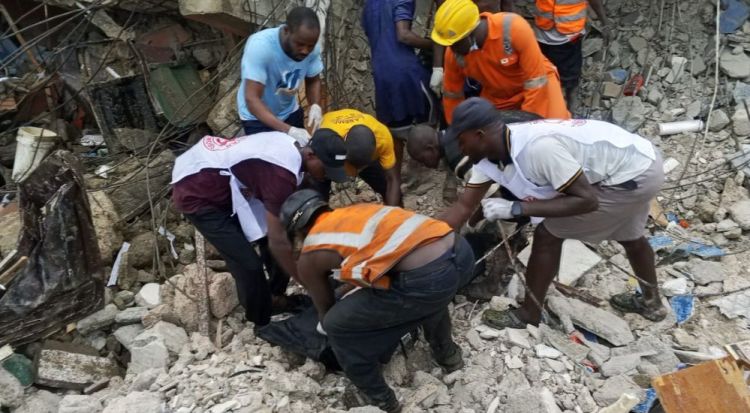

The dust had barely settled over Alakija in Lagos before the inevitable question returned to the national consciousness: where is next?
For residents of Nigeria’s commercial capital, the collapse of yet another multi-storey building has become more than a tragic headline. It has become a recurring nightmare. Families mourn loved ones, emergency workers dig through heaps of concrete in desperate searches for survivors, government officials promise investigations, experts identify familiar failings, and life gradually returns to normal until another structure gives way. Blueprint reports
The latest tragedy, which occurred in the Alakija area along the Lagos-Badagry Expressway, claimed at least nine lives while 27 others sustained varying degrees of injuries after a three-storey building housing residential apartments and commercial shops suddenly collapsed. Rescue teams from the Lagos State Emergency Management Agency (LASEMA), National Emergency Management Agency (NEMA), Lagos State Fire and Rescue Service, the police, military and volunteers worked tirelessly for hours to pull survivors from the rubble. Governor Babajide Sanwo-Olu subsequently ordered integrity tests on adjoining buildings and a full investigation into the cause of the disaster.
Yet, beyond the condolences and official visits lies a disturbing reality. The Alakija collapse is only the latest entry in a long catalogue of avoidable structural failures that have continued to expose serious weaknesses in Nigeria’s construction industry and regulatory framework.
A city haunted by structural failures
Lagos has witnessed some of the country’s most devastating building collapses over the past two decades.
Many Nigerians still remember the tragic collapse of the Synagogue Church of All Nations guesthouse in Ikotun in 2014, where 115 people lost their lives, including dozens of South Africans. Investigations later attributed the disaster to structural deficiencies despite initial conflicting narratives.
Two years later, another five-storey building under construction collapsed in Lekki, killing more than 30 workers after developers allegedly exceeded approved specifications.
In 2019, tragedy struck again at Ita Faaji on Lagos Island when a building housing a primary school collapsed during school hours, killing children and adults alike.
Then came perhaps the most shocking of all: the collapse of the 21-storey luxury building under construction on Gerrard Road, Ikoyi, in November 2021. The disaster claimed 42 lives, including that of the developer himself, and raised fresh questions about regulatory oversight after reports indicated that the building exceeded the number of floors originally approved.
Each incident triggered outrage. Each prompted promises of reform. Yet, each has been followed by another collapse.
Warning signs too often ignored
Perhaps the most heartbreaking aspect of the latest Alakija tragedy is that survivors insist the collapse did not occur without warning.
Several occupants disclosed that visible cracks had appeared on the building days before the incident. They claimed the landlord was informed, but no urgent remedial action was taken.
One shop owner recounted narrowly escaping death after leaving the building shortly before it caved in, while another said his apprentice was trapped and killed beneath the debris.
These accounts reinforce a pattern repeatedly observed in previous building collapse cases: warning signs are often ignored until disaster strikes.
Across Lagos, distressed buildings displaying cracks, sagging beams, weakened foundations and compromised structural elements remain occupied daily by tenants and business owners, many of whom either underestimate the danger or lack alternative accommodation.
Why do buildings keep collapsing?
Construction professionals have consistently pointed to several recurring factors responsible for Nigeria’s building collapse epidemic.
Among them are poor structural designs, the use of substandard building materials, engagement of unqualified artisans instead of certified professionals, disregard for approved building plans, weak supervision during construction and outright corruption.
In many cases, developers alter approved designs midway through construction by adding extra floors without reinforcing foundations or supporting columns.
Equally troubling is the proliferation of quacks within the construction sector. Individuals without engineering qualifications frequently undertake complex structural projects, exposing occupants to enormous risks.
Experts have repeatedly warned that many developers prioritise profit over safety, cutting costs through inferior materials while bypassing professional supervision.
Regulatory failure or enforcement deficit?
Successive Lagos State administrations have introduced measures aimed at reducing building collapses.
The Lagos State Building Control Agency (LASBCA) routinely seals distressed buildings, issues contravention notices and demolishes unsafe structures.
Following the Alakija incident, the agency again appealed to residents to promptly report distressed buildings so that preventive action could be taken before lives are endangered.
However, critics argue that regulation in Nigeria remains largely reactive rather than preventive.
Buildings are often identified as unsafe only after obvious structural failures have developed.
Even when notices are issued, some developers allegedly ignore them or continue construction with little consequence.
The result is a regulatory system that struggles to enforce compliance consistently.
Accountability remains elusive
One issue continues to dominate public discussions after every building collapse: accountability.
Despite repeated disasters, very few developers, contractors or public officials have been successfully prosecuted.
Real Estate Developers Association of Nigeria (REDAN), Lagos Chapter, recently called for criminal prosecution of individuals whose negligence contributes to structural failures, insisting that demolition alone cannot solve the problem.
Similarly, safety advocates argue that unless those responsible face severe legal consequences, future developers may continue gambling with human lives.
The absence of visible punishment has created a perception that negligence carries little consequence.
Urbanisation outpacing safety
Lagos remains one of Africa’s fastest-growing cities.
Thousands migrate into the metropolis every week in search of economic opportunities, placing enormous pressure on housing and commercial infrastructure.
As demand for accommodation rises, developers race to construct residential and commercial buildings, sometimes sacrificing quality for speed.
Older buildings, many erected decades ago, also continue to deteriorate due to poor maintenance, illegal modifications and prolonged exposure to environmental stress.
Urban planners warn that unless comprehensive structural integrity assessments become routine, the city could continue witnessing preventable disasters.
Beyond emergency response
Emergency responders deserve enormous commendation for their dedication whenever tragedy occurs.
During the Alakija collapse, personnel from LASEMA, NEMA, the Lagos State Fire and Rescue Service, the military, police and volunteers demonstrated remarkable courage in rescuing trapped victims despite difficult conditions.
However, emergency response alone cannot become the nation’s strategy.
Every successful rescue operation represents a tragedy that should never have occurred in the first place.
Building safety begins long before rescue equipment arrives. It begins with professional design, strict regulatory compliance, quality construction, continuous inspection and responsible maintenance.
Prevention must become national policy
Building collapse is no longer merely a Lagos problem.
Similar tragedies have occurred in Plateau, Anambra, Kano, Rivers, Delta and several other states, suggesting a nationwide challenge requiring coordinated action.
Professional bodies, including engineers, architects, builders and town planners, have repeatedly advocated stricter certification processes, continuous monitoring of construction sites, digital approval systems and severe sanctions against defaulters.
Public awareness also remains critical.
Residents must resist occupying visibly distressed buildings simply because accommodation is scarce or affordable. Likewise, landlords must understand that delaying repairs could ultimately cost lives.
Where’s next?
That question should unsettle every policymaker.
If the underlying causes remain unchanged, another collapse is not a possibility but a probability.
The next building could be a residential apartment, a shopping complex, a school, an office block or even a place of worship.
The victims could be workers reporting for duty, children attending classes, traders trying to earn a living or families asleep in their homes.
The Alakija collapse should therefore serve as more than another tragic statistic. It should become a turning point.
Nigeria possesses competent engineers, builders, architects and regulatory institutions capable of preventing most structural failures. What has often been lacking is consistent enforcement, political will and accountability.
Until distressed buildings are identified and secured before they fail, until developers who violate regulations are prosecuted without compromise, and until safety is placed above profit, the haunting question will continue to echo after every tragedy.
Where’s next?
Sadly, unless decisive action replaces routine condolences, the answer may only be a matter of time.