

Foreign
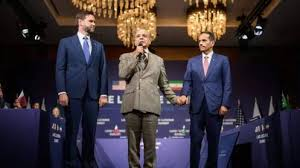
The U.S. and Iran on Monday concluded their first round of peace talks in Buergenstock, Switzerland, agreeing through Pakistani and Qatari mediation on a roadmap to end their war.
The News Agency of Nigeria (NAN) reports that mediators said the parties made “encouraging progress”, but tension persisted over Lebanon and the Strait of Hormuz.
The two sides agreed to reach a lasting deal within 60 days at the Qatari-owned Swiss mountain resort, where talks concluded early on Monday.
Pakistan and Qatar said they also agreed a mechanism to halt fighting in Lebanon and opened a communications line for safe shipping through the strait.
The meeting followed an interim deal signed last week, in spite of Tehran reclosing the waterway on Saturday and President Donald Trump threatening to resume attacks on Iran.
Pakistani Prime Minister, Shehbaz Sharif, announced on X that the first round of talks had “concluded successfully” in “a positive and constructive atmosphere”.
He said progress included a roadmap toward a final deal within 60 days, a high-level oversight committee and the commencement of further technical talks.
U.S. Vice President, JD Vance, who led Washington’s delegation, said Trump had asked them “to turn over a new leaf” with the people of Iran.
He said progress had also been made toward ending hostilities in Lebanon, adding, “These things are always a little bit messy.”
The main Iranian team, including senior diplomat Mohammad Qalibaf, left for Tehran, ISNA reported, though technical talks would continue through the week.
Iranian Foreign Minister, Abbas Araqchi, said Tehran had secured waivers for oil and petrochemical exports, the release of some frozen assets and a reconstruction plan.
Oil prices fell further after the joint statement, easing fears of a supply shortage, with global benchmark Brent crude trading below 80 dollars per barrel.
The negotiations began under a memorandum of understanding reached last week to extend a fragile April ceasefire by at least another 60 days.
Before talks opened, Fox News quoted Trump as warning Iranian officials that they “won’t have a country” if they again tried to close the strait.
Iran’s semi-official Tasnim agency said the delegation refused to return to the room after Trump’s threats, but exchanged messages through the mediators.
It said nuclear talks required delivery of other parts of the deal, including frozen-asset releases and U.S. waivers authorising Iranian oil exports.
The interim agreement requires reopening the Strait of Hormuz and ending all hostilities, including in Lebanon, where violence continued after Friday’s ceasefire declaration.
Violence between Hezbollah and Israel has eased since late Saturday, with security sources citing the longest lull since Hezbollah opened fire on March 2.
Reflecting reduced tensions, the Israeli military lifted safety restrictions in eight communities near the Lebanese border from 6 a.m. (0300 GMT) on Monday.
Lebanese President, Joseph Aoun, discussed sustaining the ceasefire in a call with Vance, Qatar’s prime minister and White House envoy Jared Kushner.
Israeli President, Isaac Herzog, said Israel did not oppose a diplomatic end to the war, but funds from any deal must not aid Iran’s military.
(Reuters/NAN)
W.U
June 22, 2026
Tags: Abbas Araqchi Isaac Herzog JD Vance Joseph Aoun Mohammad Qalibaf President Donald Trump