

Business
- An International Monetary Fund (IMF) mission, led by Christian Saborowski, visited Sierra Leone from April 20 to May 1.
A staff-level agreement was reached on the third review of Sierra Leone’s economic program supported by the Extended Credit Facility arrangement (ECF), approved on October 31, 2024, and the authorities’ request for an arrangement under the Resilience and Sustainability Facility (RSF) to enhance resilience to climate change.
The IMF’s Executive Board is expected to consider both in the coming weeks.
AT the conclusion of the mission, Saborowski issued the following statement: “Sierra Leone’s policy adjustment has continued to yield tangible results. The domestic primary balance reached a surplus of 1.3 percent of GDP in 2025, supported by stronger tax revenues and expenditure restraint.
Together with a tighter monetary stance, the ambitious fiscal adjustment over the last few years has helped stabilize the exchange rate, reduce inflation, contain borrowing costs, and restore private access to credit.
“Looking ahead, policy implementation is becoming challenging. Revenue performance early this year was weaker than expected, while spending pressures have risen. While the authorities have some fiscal space to accommodate pressures arising from the Middle East war, steadfast fiscal consolidation—while protecting priority social spending—remains critical to keeping debt on a sustainable path.
“In the absence of a strong social safety net to provide targeted relief, the authorities introduced fuel price subsidies in April to avoid disruptive price movements. They are committed to treating the subsidy as strictly temporary while adhering to the agreed cost ceiling and reflecting it transparently in the fuel price formula. Meanwhile, efforts should continue to secure donor support to bolster social safety nets.
“The monetary policy stance is appropriate but may need to be tightened if inflationary pressures from the global energy price shock persist. Inflation is expected to rise to about 11.6 percent by end‑2026, before returning to single digits by end‑2027. Progress in reserve accumulation needs to continue while the government’s FX spending needs to be further curtailed.
“The banking system remains profitable and broadly resilient, but vulnerabilities persist—notably through exposure to sovereign risk. Continued efforts to strengthen financial sector oversight will help safeguard stability and support credit to the private sector.
“Growth accelerated in 2025 but is projected to fall to 4.0 percent in 2026 amid spillovers from the Middle East war. It is expected to rise toward its potential of about 4.5 percent over the medium term as shocks subside and reforms continue. However, downside risks are significant, including a more protracted Middle East war, potential reform fatigue, election-related uncertainties, and climate shocks.
“Against this backdrop, policy priorities should focus on: (i) continuing the fiscal consolidation while temporarily accommodating pressures from the war in the Middle East; (ii) further mobilizing revenues by bolstering tax and customs administration and enforcement; (iii) strengthening PFM and debt management to help contain fiscal and debt related risks; (iv) reforming the monetary policy framework, rebuilding reserves, and enhancing safeguards; (v) and implementing the recommendations of the Governance and Corruption Diagnostic.
“The proposed RSF arrangement would enhance long-term macroeconomic stability and resilience to climate change. Reform measures would target three priority reform areas: climate-sensitive public investment management, climate resilience; and financial stability. They are expected to catalyze financing for climate and sustainable development and will be supported by capacity development activities from the IMF and Sierra Leone’s other partners.
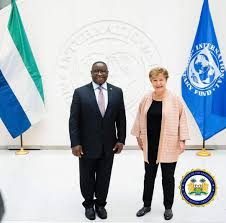
“The mission is grateful to the authorities for the open and productive discussions on the third ECF review and on reform measures to support the RSF. The team met with President Bio, Finance Minister Bangura, Governor Stevens, and other senior government officials. It also met stakeholders from civil society, the private sector and development partners.”
A.I
June 11, 2026
Tags: Christian Saborowski IMF