
Habeas Corpus: Did White House seriously consider to suspend it? All we know amid Insurrection Act debate

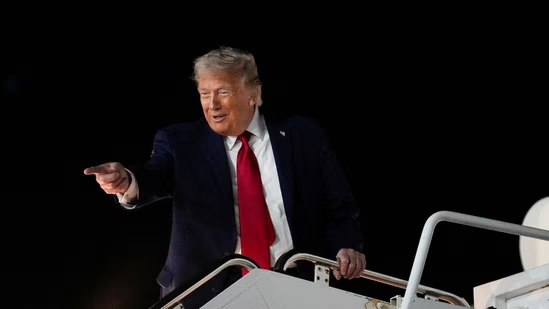
Officials at the White House seriously contemplated the suspension of habeas corpus rights for undocumented immigrants during the initial months of Donald Trump’s second term in office, according to a report by The New York Times on Monday.
Stephen Miller, the White House deputy chief of staff, was among the most vocal proponents advocating for this drastic measure as part of a strategy to increase deportations, as stated in the report.
However, Will Scharf, a conservative attorney and White House staff secretary, drafted a confidential memo addressed to chief of staff Susie Wiles, cautioning that the suspension of habeas corpus would be imprudent and could lead to negative repercussions, according to the Times.
Following the president’s apparent retreat from this proposal, the administration is said to have begun considering another extreme action, which involved invoking the Insurrection Act.
Scharf added another confidential memo, indicating that the action would likely face legal challenges “potentially obviating any advantage to be gained in terms of the flexibility that it would provide to the president,” per the Times.
Also Read: Josh Hokit’s ‘disgusting’ remark on Michelle Obama creates huge uproar: ‘This is embarrassing and gross’
What is Habeas Corpus?
Experts assert that the principle prohibiting unlawful imprisonment predates the Magna Carta and has served as a fundamental element of the legal framework in the UK, US, and various democratic nations for centuries.
In Latin, habeas corpus translates to “you should have the body,” suggesting that an individual must be presented before a court for a judge to determine the legality of their detention.
Referred to as the “Great Writ of Liberty,” habeas corpus empowers prisoners to contest their imprisonment in a judicial setting.
Habeas corpus is indeed a right recognized in US Constitution
Article One of the US Constitution specifies that “the privilege of the writ of habeas corpus shall not be suspended, unless when in cases of rebellion or invasion the public safety may require it.”
Although this is the sole reference to habeas corpus in the Constitution, it has evolved into a significant aspect of US law and has been the subject of numerous legal battles, including those in the US Supreme Court.
JD Vance reportedly advocated for invocation of Insurrection Act
During a meeting with Wiles and other prominent White House officials after the assassination of Alex Pretti, Vice President JD Vance allegedly advocated for its implementation to calm the disturbances in Minnesota and convey a warning to those resisting the actions of U.S. Immigration and Customs Enforcement. However, others, including Scharf, expressed reservations, and the meeting ultimately concluded without reaching a decision, according to the Times.
This information is sourced from the reporting conducted by Times journalists Maggie Haberman and Jonathan Swan for their upcoming book, “Regime Change: Inside the Imperial Presidency of Donald Trump.”
Has habeas corpus ever been suspended in the past?
Abraham Lincoln was the first president of the United States to suspend habeas corpus in 1861, during the period of the American Civil War.
This action resulted in a confrontation with Supreme Court Chief Justice Roger Taney, who asserted that it was Congress, rather than the executive branch, that held the authority to suspend the writ.
Lincoln proceeded to suspend habeas corpus in certain instances, as noted by the National Constitution Center, and in 1863, Congress sanctioned its suspension for the duration of the war when “the public safety may require it.”