
George Defends Tinubu’s Economic Reforms, Says Nigeria On ‘Long-Term Recovery Path’ Despite Hardship

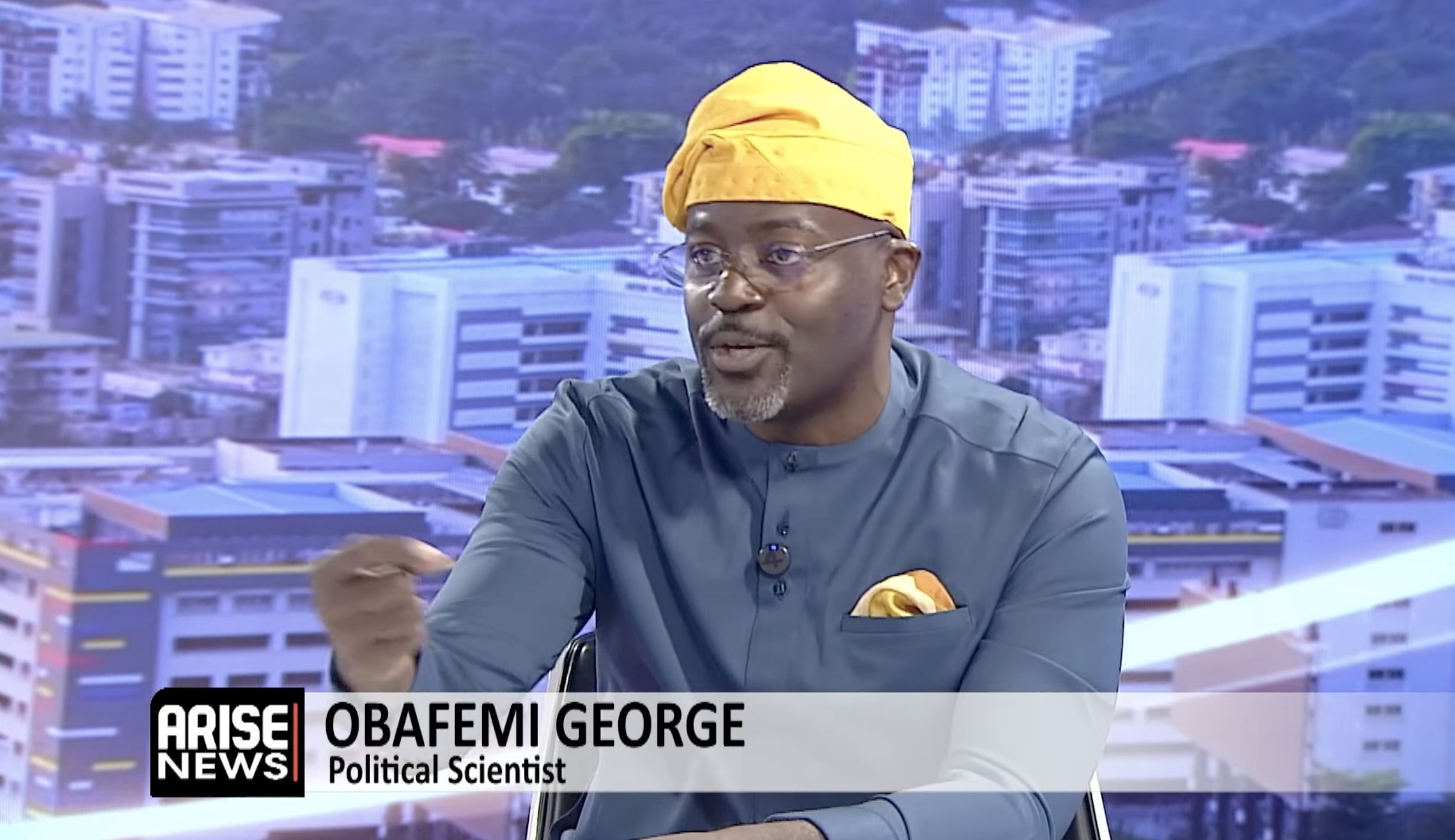
Political scientist, Obafemi George, has defended the economic policies of President Bola Ahmed Tinubu, arguing that the administration is laying what he described as “solid foundations” for long-term national recovery, even as Nigerians continue to face rising inflation, high cost of living, and persistent insecurity.
Speaking during an interview on ARISE News on Friday, George said ongoing reforms such as the removal of fuel subsidy and broader fiscal adjustments were necessary but painful decisions that should be assessed through a long-term and comparative global lens, rather than short-term economic hardship.
He warned that expectations of rapid transformation were unrealistic, stressing that national development typically unfolds over decades rather than a few years.
“You know, when you employ someone, you give the basic KPIs. And likewise when you put your president into office, that’s not just KPIs. It’s economy, infrastructure, education, health sector, even security or insecurity, whatever we tend to call it. And if you look at each of those, in my opinion, I could confidently say that the president did the bosses. And we can begin to interrogate his performance not just by data or with data, but even comparative analysis.”
On the pace of national development, he added:
“Countries all over the world. You know, when I hear such things, I ask people that they should give me one example of a country in our modern era that have transitioned from being a poor country to a prosperous country in 36 months. Just one.”
George cited international development experiences to support his argument that structural transformation takes time.
“When we talk about China. I mean, China lifted a million people out of poverty, but they didn’t do it in 36 months. It took them 40 odd long years. And what they did is exactly what we are doing. When China started that job in 1979, their GDP was just barely $179 billion.”
“They began to invest in infrastructure, which is what this government is doing.”
“Kagame has spent over 20 years to take Rwanda to where they are today.”
“Dubai that we all go to today. They started that job in 1974. It wasn’t until 2014 that Dubai actually arrived on the global scene as a tourist powerhouse.”
Addressing public anger over economic hardship, George acknowledged the pain but maintained that fuel subsidy removal was inevitable and financially necessary.
“What the president has done, he has laid solid foundation. And I tell people, there’s a magazine on the street that says, you pay now or you pay later. You pay now or you pay later. Whichever way you’re going to pay.”
“One of the things that we are going through that is causing our current pain is because some sacrifices that were meant to have been done years ago weren’t done.”
“If you remember… in 2013, it was clear to me that any government that succeeds will face economic headwinds because of subsidy.”
“By 2014… Nigeria was broke, that we should stop paying subsidy. If we had removed subsidy 10, 12 years ago, we would be where we are today.”
He further argued that subsidy payments were being financed through borrowing.
“Number one, we were not making money to pay subsidy. Because we want to let Nigerians know the truth. We were borrowing money to pay subsidy. We were also borrowing money to pay the interest on subsidy.”
“When subsidy was removed, it wasn’t that we were not suddenly saving money. We just simply stopped borrowing.”
On federal allocations to states, George said improved revenue collection had changed fiscal realities.
“The extra money which the state and the local government are now getting is simply because revenue has increased.”
“2022 NRS was generated about 3 trillion. When ZAC got there last year, it generated about 23 trillion. That is the extra money.”
On inflation and macroeconomic stability, he said:
“Once your macroeconomic policies are aligned, at the macro level, it’s an automatic process. There’s no way it will not get to the street.”
“International best global rating agencies have alluded to the fact that we’re on the right track.”
“S&P Global… just rated our economy from B- to B+. Stable. It’s stable. And that is what investors are seeing.”
On insecurity, George rejected claims of worsening conditions, arguing instead that Nigeria is facing a broader transnational security challenge.
“We can’t keep on dispersing openness. When, within a month, a nation has achieved 11 successes compared to one failure.”
“This current administration has confronted insecurity that is higher than the previous administration, has spent more, and has also recorded more successes in combating insecurity than the previous administration.”
He linked insecurity in Nigeria to instability across the Sahel region:
“By 2022, all of them began to break that military pact… And the moment French military forces vacated that entire Sahel region, what happened? The terrorists moved in.”
“So what we are now dealing with is no longer Boko Haram in Borno. What we are dealing with now is an international issue.”
He also pointed to recent rescue operations as evidence of progress:
“On the 2nd of May, some children were rescued in Goza Local Government. On the 8th of May, children were rescued in the same Goza Local Government. On the 23rd of May, 32 Nigerians who were kidnapped were rescued in Katsina.”
Responding to criticism that ordinary Nigerians have yet to feel improvement, George insisted that macroeconomic gains were already emerging.
“We have made that big. And the data out there shows that we have.”
“In less than 24 months… by 2026, we will have a single-digit inflation. And that’s how these things begin to cascade down to the common man on the street.”
He also pointed to investor sentiment:
“The MD of Shell plc came to Nigeria early this year. And he said that Nigeria has become the most attractive investment destination for Shell Global… Now they’re coming back to invest $20 billion in our economy.”
George maintained that historical judgment would ultimately rest with citizens as reforms play out over time.
“Nigerians will determine to what extent they have enjoyed or benefited from this administration.”
Boluwatife Enome
Follow us on: