
FG, EU, International IDEA move to tackle rising abuse in schools, strengthen justice for survivors

Africa
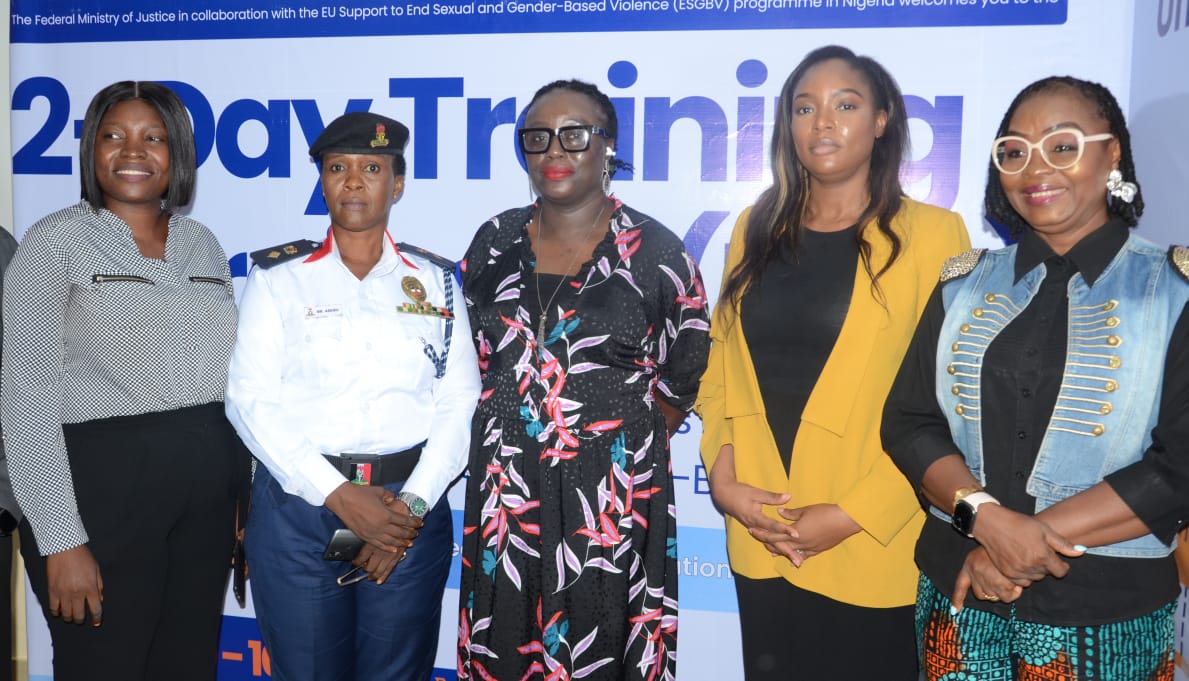
L-R; Executive Director, Protect the Child Foundation, Mrs.Elizabeth Ebulejonu; NSCDC Aremu Modupe; Head SGBV Ministry of Justice, Mrs. Yewande Gbola;
Gender-Based Violence Policy and Strategy Development Specialist for the ESGBV Programme, International IDEA, Ms. Melissa Omene; Assistant Director Ministry of Education, Mrs Apakasa Augustina; during the the First TOT Workshop for the Prosecution of Perpetrators of School-Related Gender-Based Violence (SRGBV) in Abuja.
As stakeholders seek to end violence in learning environments, improve prosecution of offenders
The Federal Government, the European Union (EU), and the International Institute for Democracy and Electoral Assistance (International IDEA) have intensified efforts to combat the growing incidence of school-related gender-based violence in Nigeria, amid concerns that schools, traditionally regarded as safe spaces for learning and development, are increasingly becoming sites of abuse, exploitation, and violence against children.
Stakeholders drawn from the justice, education, security, and child protection sectors have vowed to strengthen the prosecution of perpetrators and improve institutional responses to cases involving children, particularly within school environments.
This commitment was reinforced at the First Training of Trainers Workshop on the Standard Operating Procedure (SOP) for the Legal Pathway for the Prosecution of Perpetrators of School-Related Gender-Based Violence (SRGBV), held Tuesday in Abuja.
The workshop was organised under the EU Support to End Sexual and Gender-Based Violence (ESGBV) Programme, implemented by International IDEA in partnership with the Federal Ministry of Justice.
The event brought together representatives of the Federal Ministries of Justice, Education and Women Affairs, the Nigeria Police Force, the National Agency for the Prohibition of Trafficking in Persons (NAPTIP), the Nigeria Security and Civil Defence Corps (NSCDC), civil society organisations, and other stakeholders involved in child protection and access to justice.
Speaking on behalf of International IDEA, the Gender-Based Violence Policy and Strategy Development Specialist for the ESGBV Programme, Ms. Melissa Omene, described school-related gender-based violence as one of the most pressing challenges confronting Nigeria’s education sector.
According to her, children continue to face sexual harassment, abuse, exploitation, bullying, corporal punishment, technology-facilitated violence, and other harmful practices within school environments.
“SRGBV remains a deeply concerning reality within Nigeria’s education system, affecting children at both basic and secondary levels,” she said.
“Recent studies reveal that 18 per cent of sexual violence incidents occur in schools, while 25 per cent of children report experiencing corporal punishment by teachers. Beyond statistics, these are lived experiences that undermine safety, dignity, learning outcomes, and long-term wellbeing.”
Omene noted that survivors often endure lasting emotional, psychological, and educational consequences, with girls and other vulnerable groups disproportionately affected.
“Girls and other vulnerable groups bear a disproportionate burden, making our collective response both a professional obligation and a moral imperative,” she added.
She explained that although the Federal Ministries of Justice and Education developed Standard Operating Procedures in 2024 to guide reporting, referral, case management, and prosecution of school-related gender-based violence cases, inadequate awareness and inconsistent implementation had limited the framework’s effectiveness.
According to her, the training was designed to bridge those gaps by equipping participants with the knowledge and practical skills required to strengthen accountability and improve responses to cases involving children.
“Strengthening the legal pathway for prosecution is also about reinforcing accountability. It sends a clear message that acts of violence, especially those affecting children in school settings, will not be tolerated, and that institutions are prepared to respond with professionalism and due process,” she stated.
Omene further disclosed that the EU-funded ESGBV Programme, a four-year initiative running from 2025 to 2029, seeks to strengthen the implementation of legal and policy frameworks, improve survivors’ access to quality services, and promote positive social norms aimed at reducing gender-based violence at the federal level, in the Federal Capital Territory (FCT), and in the focal states of Benue, Kaduna, and Oyo.
She also revealed that suitable facilities within hospitals in the FCT had already been identified and were undergoing assessment for conversion into Sexual Assault Referral Centres (SARCs) to provide comprehensive support services for survivors.
In her welcome address, Head of the Sexual and Gender-Based Violence Response Unit at the Federal Ministry of Justice, Mrs. Yewande Gbola-Awopetu, stressed that every child deserved to learn in an environment free from violence, fear, and intimidation.
She described the SOP as a practical instrument for enhancing accountability and ensuring a coordinated, professional response to perpetrators.
“Today, we gather not merely as professionals representing different institutions, but as partners united by a common purpose: the protection of children and the preservation of safe learning environments across Nigeria,” she said.
“Every child enters a classroom with dreams, aspirations, and the expectation of safety. When violence enters those spaces, it does more than disrupt education; it diminishes confidence, weakens trust in institutions, and threatens the very foundation upon which young people build their futures.
“Behind every case file is a human story. Behind every report is a child seeking protection, dignity, and justice.”
Gbola-Awopetu urged participants drawn from the justice, education, and security sectors to become change agents within their institutions.
“No child should have to choose between education and safety, and no survivor should be denied justice because systems are weak or responses are fragmented,” she said.
Representing the Federal Ministry of Education, Assistant Director, Mrs. Apakasa Augustina, disclosed that the SOP had already been distributed to all 115 Federal Unity Colleges across the country, while principals had been sensitised on its implementation.
She emphasised the critical role teachers and school administrators play in identifying, preventing, and responding to abuse.
“There is no effective way to end gender-based violence without training school personnel because schools are among the primary places where such cases occur and are reported,” she said.
“I am pleased to inform you that the Federal Ministry of Education has already distributed this document to all 115 Unity Schools across the country. As the teachers participating in this training return to their schools, they will be equipped to support implementation and awareness of the SOP.”
Also speaking, Executive Director of Protect the Child Foundation, Mrs. Elizabeth Ebulejonu Achimugu, observed that many abuse cases fail to progress beyond the reporting stage because first responders often lack adequate knowledge of legal procedures and referral pathways.
She explained that participants were expected to cascade the knowledge acquired during the training to colleagues within their various institutions, while future phases of the programme would focus on teachers, caregivers, and other school personnel.
Stakeholders at the workshop expressed optimism that stronger collaboration among government agencies, schools, civil society organisations, and law enforcement institutions would help close existing justice gaps, improve prosecution outcomes, and create safer learning environments for children across the country.
The participants agreed that safeguarding children requires not only stronger laws and policies but also effective implementation, coordinated action, and a justice system capable of holding perpetrators accountable while ensuring survivors receive the protection and support they deserve.
F.O
Tags: Abuse in schools International IDEA