

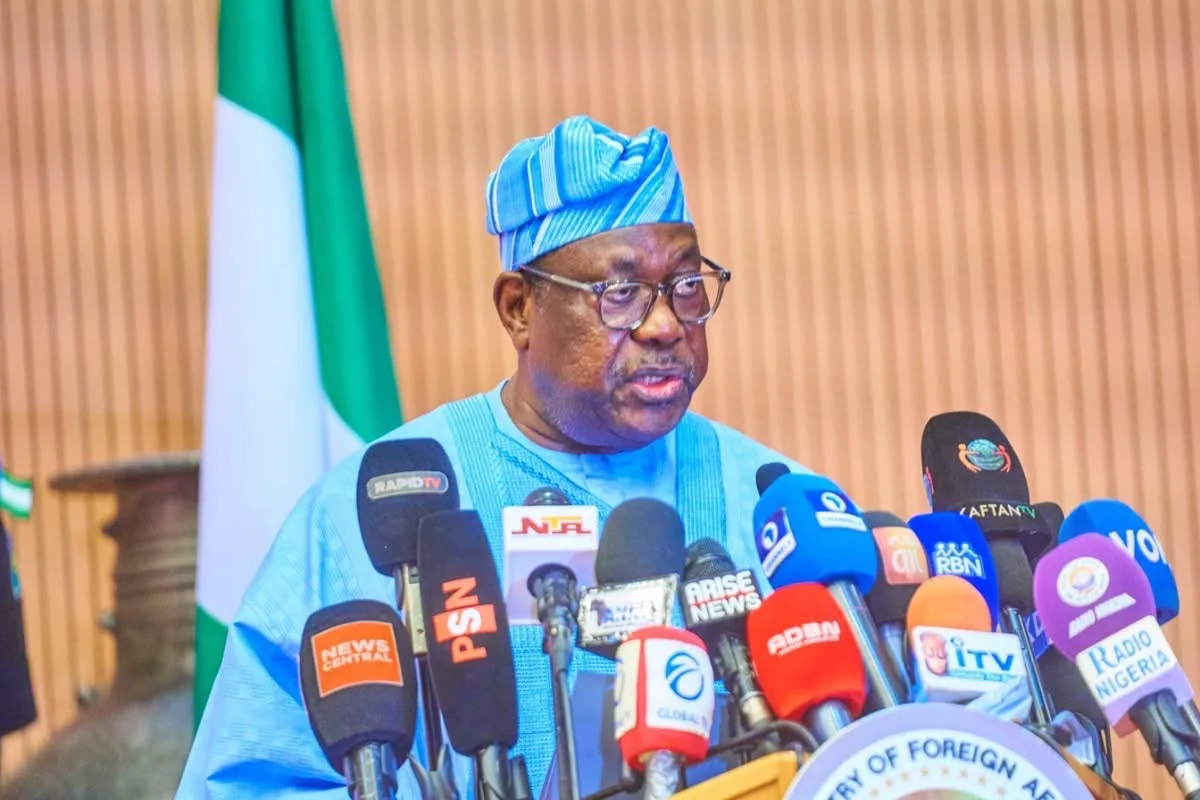
The Federal Government has defended the economic and social reforms introduced by President Bola Tinubu’s administration, insisting that Nigeria is on the path to recovery despite persistent economic hardship and security challenges across parts of the country.
The position was made known by the Secretary to the Government of the Federation (SGF), George Akume, who said key economic indicators showed that the country’s fortunes were improving under the administration’s Renewed Hope Agenda.
Speaking at a national press conference in Abuja on Tuesday, as part of activities marking the 2026 Democracy Day celebration, Akume reaffirmed the government’s commitment to fulfilling its promises to Nigerians and expressed confidence that the administration’s reforms were yielding positive results.
According to him, Nigeria’s economy recorded steady growth, with real Gross Domestic Product (GDP) expanding by 4.07 per cent in the fourth quarter of 2025 and 3.89 per cent in the first quarter of 2026.
While acknowledging that inflation and insecurity continue to affect citizens, the SGF maintained that the government’s reforms were beginning to produce tangible results.
“Government will never claim that every challenge has been solved,” he said. “Inflation has been painful, though it is on a downward trend. Insecurity still threatens lives and livelihoods, but evidence shows that the country is moving in the right direction.”
Akume described the Democracy Day briefing as part of the administration’s commitment to accountability, saying June 12 symbolises both the sacrifices that birthed democratic rule and the responsibility of elected leaders to improve citizens’ welfare.
He congratulated Nigerians for sustaining 27 uninterrupted years of democratic governance, describing the feat as one of the longest democratic experiences on the African continent.
Highlighting some of the administration’s achievements, the SGF said over three million vulnerable households had benefited from the Renewed Hope Conditional Cash Transfer Programme, while nearly one million Nigerians had accessed support under various government credit schemes.
He disclosed that the Nigerian Consumer Credit Corporation (CreditCorp) had disbursed N37 billion in consumer loans, with more than half of the beneficiaries obtaining formal credit for the first time.
On education, Akume said the Nigerian Education Loan Fund (NELFUND) had supported more than 1.058 million students since the implementation of the Student Loan Act, with over N184 billion released for tuition and upkeep allowances.
He added that the administration had expanded access to healthcare through the National Health Insurance Authority framework and increased funding for primary healthcare facilities across the country.
The SGF also touted the government’s anti-corruption drive, noting that proceeds recovered by anti-graft agencies had strengthened public interventions, including the transfer of more than N50 billion in recovered assets to support NELFUND.
According to him, Nigeria’s removal from the Financial Action Task Force (FATF) grey list in October 2025 reflected the impact of reforms in anti-money laundering and counter-terrorism financing.
On security, Akume said the Federal Government was investing heavily in military capabilities and regional cooperation to combat terrorism, banditry and other criminal activities.
He, however, urged citizens to complement government efforts by remaining vigilant and reporting suspicious movements to security agencies.
“We can say clearly that institutional responses are being sharpened, coordination is improving, and reforms are continuing because peace and civic order are foundations of democratic progress,” he stated.