

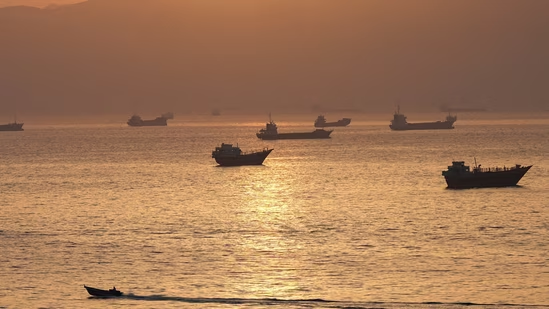
The Strait of Hormuz could open in the coming days following the US-Iran peace deal, which is scheduled to be signed in Switzerland on June 19. While the agreement has eased immediate concerns over a prolonged disruption to one of the world’s most critical shipping routes, maritime experts reportedly caution that a full return to normal operations is likely to take considerably longer.
Industry officials and maritime security specialists believe commercial traffic through one of the world’s most important energy corridors could remain restricted for several weeks. Their concern is centred on the possible presence of naval mines in and around the waterway, a threat that could continue to affect shipping even after hostilities have subsided, news agency Reuters reported.
Also read | Ease on Rupee, oil prices: What US-Iran peace deal means for India
According to assessments by Western maritime security sources, clearing the strait and establishing safe navigation routes could take between 40 and 50 days. During this period, minesweepers and underwater drones may reportedly be deployed to inspect and secure the area before shipping companies, insurers and energy firms regain confidence in the route.
Why mines remain a major concern
The Strait of Hormuz handled around 20 per cent of the world’s daily oil and liquefied natural gas supply before the conflict. Even a small number of mines can pose a significant threat to large commercial vessels carrying valuable cargo, news agency Reuters reported.
Also read | When will Strait of Hormuz reopen? US-Iran peace deal raises hopes but shipping recovery may take time
Iran had repeatedly threatened to use naval mines during the conflict as part of its efforts to assert control over the waterway. While Tehran has not confirmed whether mines were actually deployed, the United States has maintained that the threat is real and has said it targeted Iranian vessels involved in mine-laying operations.
On June 2, US Secretary of State Marco Rubio told a Senate Foreign Relations Committee hearing that Iran had “mined large segments of Hormuz — international waters”, though he did not provide further details.
Germany’s navy later said information shared by the US and British navies indicated mines had been detected at four locations around the strait, though Berlin noted that it had not independently verified those reports.
Shipping companies want guarantees before returning
For the shipping industry, uncertainty itself is a problem. Tankers carrying crude oil are often worth hundreds of millions of dollars when cargo and vessel values are combined, making operators reluctant to take risks.
Also read | Crude oil prices drop 4.7% after US-Iran agreement to end war and reopen Hormuz: Here’s what experts say
“We still consider it very risky for ships to commence transits at this point,” Jakob Larsen, chief safety & security officer at shipping association BIMCO told Reuters.
“The threat of mines in the area remains a concern immediately as well as further down the line and mine-free routes need to be established.”
Industry executives warn that even a single mine could have devastating consequences.
“One sea mine is enough to have fatalities,” Rene Kofod-Olsen, CEO of V.Group, one of the world’s largest ship and crew management firms told Reuters.
“That’s obviously a massive issue for global shipping,” he said.
Traffic remains far below normal levels
Although some ships have been allowed to move through the strait during the recent negotiations, maritime traffic remains a fraction of pre-war levels.
Shipping data indicates that only around 12 to 15 vessels have been passing through the corridor each day in recent weeks. Before the conflict, daily traffic ranged between 120 and 140 ships.
US President Donald Trump said last week that the United States had been taking millions of barrels of oil out through the route, while some countries reportedly reached arrangements with Tehran to allow vessels safe passage during the conflict.
Still, maritime experts say broader commercial confidence will not return until security concerns are addressed and navigation routes are certified as safe.
International effort likely before full normalcy returns
The prospect of a mine-clearing operation has already prompted several countries to prepare. Britain, France and Germany have deployed warships and minesweepers to the region in anticipation of potential clearance efforts.
Corey Ranslem, chief executive of maritime security firm Dryad Global, said Iran was still believed to possess a significant stockpile of naval mines despite military strikes targeting parts of its capabilities.
“If there is a mine field detected, it could potentially take weeks or months to remove the threat,” he said.
The head of the United Nations’ shipping agency also cautioned that reopening the waterway will be a gradual process.
Arsenio Dominguez on Monday welcomed the agreement to reopen the Strait of Hormuz as “an important step toward restoring safety in this vital maritime corridor for seafarers and ships”.
“However, its implementation will require time to ensure that all necessary safety and security guarantees are in place,” he said.
For now, the peace deal may have reduced the immediate risk of conflict, but restoring one of the world’s most critical maritime trade routes to full operation remains a complex task that could take several more weeks.
(With inputs from Reuters)