

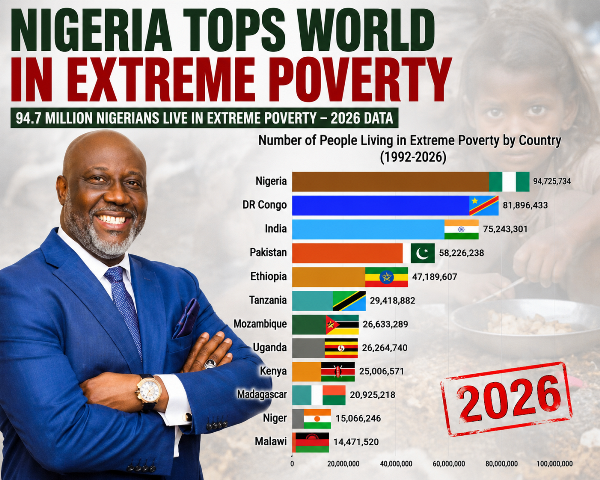
Former Kogi West Senator, Dino Melaye, has come under intense criticism from Nigerians on social media after sharing an infographic claiming that Nigeria now has the highest number of people living in extreme poverty in the world.
Melaye, in a post on his verified X (formerly Twitter) account, shared a graphic titled “Number of People Living in Extreme Poverty by Country (1992–2026),” which placed Nigeria at the top of the global ranking with 94.7 million people living in extreme poverty. The chart ranked the Democratic Republic of Congo and India behind Nigeria.
The post, which appeared to draw attention to the country’s worsening economic conditions, instead triggered a wave of reactions from Nigerians, many of whom accused the former lawmaker of attempting to score political points while failing to acknowledge his own role as a former public office holder.
Several users argued that Melaye, who spent years in the National Assembly representing Kogi West Senatorial District, had little to show in terms of legislative contributions aimed at addressing poverty and improving the welfare of ordinary Nigerians.
One X user, identified as @Emiloju60, criticised the former senator, writing: “And this is all you could achieve as a senator. Shame on you.”
Another user, @Onosetare, questioned Melaye’s record in the Senate, asking what specific bills or policies he sponsored that directly targeted poverty reduction during his tenure.
READ ALSO: Court summons Dino Melaye over alleged Multi-Billion tax evasion in Abuja
The criticism quickly expanded beyond his legislative performance, with many users accusing the former senator of hypocrisy, citing his lavish lifestyle and frequent display of luxury cars and expensive possessions while millions of Nigerians continued to struggle with rising living costs.
An X user, @sirdicking, suggested that Melaye should auction some of his luxury vehicles and donate the proceeds to struggling Nigerians instead of merely posting poverty statistics online.
Another commenter, @Bigdbanj, bluntly stated: “You are part of the cause. You should be ashamed of yourself.”
Beyond the criticism of Melaye’s political career, some social media users also questioned the authenticity of the data contained in the infographic.
One X user challenged the source of the figures, arguing that no official 2026 global extreme poverty statistics had yet been released by the World Bank, and alleged that the former senator relied on unverified data to advance a political narrative.
Others defended the current administration, maintaining that although poverty remains one of Nigeria’s most pressing socio-economic challenges, attributing the country’s situation solely to the present government ignores the roles played by successive administrations and former political office holders.
An X user, @TKyautah, argued that many politicians from Melaye’s era contributed significantly to the economic difficulties Nigerians face today, while another user, @timelyanalyst, dismissed the post as part of early political messaging ahead of future elections.