
'Desperate Trump used all kinds of leverage': Iran Supreme Leader Mojtaba Khamenei on US-Iran deal

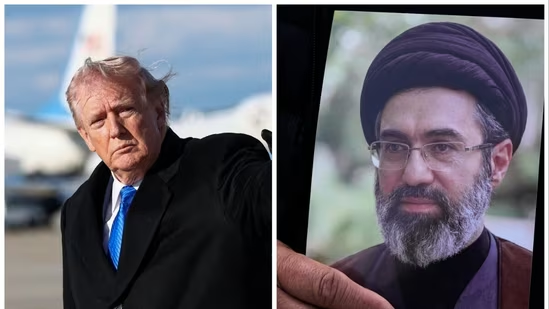
Iran’s Supreme Leader Ayatollah Mojtaba Khamenei on Thursday welcomed the agreement reached between Iran and the United States to end the conflict in West Asia, however, he acknowledged that he had reservations about the deal.
The agreement, signed by US President Donald Trump and Iranian President Masoud Pezeshkian, has set in motion a 60-day period during which both countries are expected to discuss broader issues, including Iran’s nuclear programme.
In a written statement, Mojtaba Khamenei said he had authorised the agreement despite having a “different view” on the matter.
Also read | ‘Cannot kill your way out’: JD Vance rebukes Israeli critics of US-Iran deal
Addressing the Iranian people, Khamenei said the deal was approved after senior Iranian officials, led by President Masoud Pezeshkian in his capacity as head of the Supreme National Security Council, assured him that the country’s rights and interests would be protected.
“As you have been informed, a memorandum of understanding was signed between the presidents of Iran and America,” Khamenei said, adding that Iranian officials had made “extensive efforts” to reach the agreement.
The supreme leader also attacked Washington, claiming that “it was the American president who, out of desperation, used all kinds of leverage to bring this about.”
Explaining his decision, Khamenei said: “I, as a matter of principle, held a different view; however, out of the commitment that the esteemed president—as the head of the Supreme National Security Council—gave to me on his own behalf and on behalf of the other members regarding the safeguarding of the rights of the Iranian nation and the Resistance Front, and his explicit acceptance of that responsibility, I granted my permission.”
Also read | US-Iran peace deal: A war Trump chose & lost
He added that Iranian officials had assured him they would not accept any additional demands from the United States.
“He (Iranian President) also explicitly stated that if the American side seeks to make excessive demands, they will not submit to them,” Khamenei said.
“However, it is self-evident that the in-person negotiations that will take place in the future will not mean acceptance of the enemy’s position,” he added.
Iran’s Supreme Leader also said that it is “self-evident that in-person negotiations that will take place in the future will not mean acceptance of the enemy’s position”.
Uncertainty over Switzerland meeting
Although the agreement has been signed, uncertainty remains over the next phase of diplomacy.
Earlier announcements had suggested that representatives from both countries would meet in Switzerland on Friday for a signing ceremony and discussions. However, neither side has firmly confirmed the plans.
JD Vance to travel to Switzerland
US Vice President JD Vance said he expected to travel to Switzerland for “technical negotiations” with Iran “this weekend”, rather than on Friday, while noting that plans could still change.
Meanwhile, Iran’s Tasnim news agency reported that “nothing has been confirmed” regarding a trip by the Iranian delegation.
Also read | Peace deal a way to avoid conflict for US, strengthens Iran’s hand in West Asia
The two countries have not maintained diplomatic relations since Iran’s 1979 Islamic Revolution, making any direct negotiations particularly significant.
Strait of Hormuz
One of the most immediate effects of the agreement has been the easing of tensions around the Strait of Hormuz, one of the world’s most important energy shipping routes.
The US military announced that American forces had lifted the naval blockade of Iranian ports, allowing ships to resume movement to and from Iran. However, it also stated that US warships would continue to remain in the wider region.
Maritime tracking data showed signs of activity returning. Three Saudi oil tankers exited the Gulf through the strait on Thursday, while the LNG vessel Mraikh became the first French liquefied natural gas carrier to pass through since the conflict began.
Iranian state television reported that ships seeking passage through the Strait of Hormuz must now apply through a newly established government body responsible for overseeing traffic in the waterway.
According to the Supreme National Security Council statement cited by state media, “no fees whatsoever will be collected from applicants for a period of sixty days”.
Economic relief and reconstruction
The agreement includes significant economic provisions for Iran.
Under its terms, Washington will remove oil sanctions that have weighed heavily on the Iranian economy.
The document also states that once a final understanding is reached regarding Iran’s nuclear programme, the United States will facilitate the release of a $300 billion reconstruction fund backed by regional countries.
(With AFP inputs)